
Blackmarketclash 10" LP (USA) | DISCOGS

UK chart


Release

Adverts

Posters

Reviews


The release of BLACK MARKET CLASH

Video | Facebook

This date in 1980 saw the release of BLACK MARKET CLASH, a mini-album released in the States, (October 22nd, 1980).

Bringing together a compilation of hard-to-find B-sides and remixes, this 10-inch record served as a electrifying supplement to their prior American albums. For stateside fans hungry for more from tthe band, Black Market Clash provided a satisfying dose of The Clash's uncompromising energy and searing social commentary.

By 1980, The Clash had firmly cemented themselves as one of punk's most vital groups through their first two albums - 1977's The Clash and 1978's Give 'Em Enough Rope.


Clash was released only in the US and Canada in between London Calling and Sandinista!

Punk Rock | Facebook

https://www.facebook.com/

Punk Rock - Trick: Clash was released only in the US and Canada in between London Calling and Sandinista!. It compiled recordings which were then unavailable in the US except as imports. The disc was one in the series of "Nu-Disk" 10-inch records from Epic. Other artists in the series included Gary Glitter, New Musik and Cheap Trick. At the time of release, this was the only record that featured the cover of the "Time Is Tight" instrumental by Booker T & the MGs. "Capital Radio" was extremely rare in the UK. Rather than re-issue the original the group recorded a new version for The Cost of Living as "Capital Radio Two." "Cheat" is from their UK debut album but had been left off the US version.

"Bankrobber" had been a UK A-side. "Robber Dub" was originally intended for the b-side of an unreleased "Bankrobber" 12" dance club single. The two tracks appear here in a combined edit that is unique to Black Market Clash. "Justice Tonight/Kick It Over", the dub version of "Armagideon Time", is the last track. This was previously available as the B-side to the 12-inch "London Calling" club single. The full length version of "Justice Tonight/Kick It Over" is 8:54 and the 7:00 edited version is also unique to Black Market Clash. Black Market Clash was reissued in the 1980s on 12-inch vinyl and cassette, with the same track listing as the 10-inch. It was re-released on compact disc in 1991, but discontinued when Super Black Market Clash replaced it. It was available again for a short period of time in 2006 in a few countries. It was reissued on 10-inch vinyl again in 2011. Terry Chimes - drums on "Capital Radio" and "Cheat"


The Clash Official | ***Super Black Market Clash*** is a 1993 compilation album released

The Clash | Facebook

Super Black Market Clash is a 1993 compilation album released by the English punk rock band The Clash. It contains B-sides and rare tracks not available on the group's regular studio albums. The album is an expanded repackaging of the 1980 release Black Market Clash, a 10-inch EP containing nine songs. The man in the foreground of the front cover art on both releases is Don Letts, who worked with The Clash on several projects and later was a founding member of Big Audio Dynamite.


Supert Blackmarketclash


NOTTING HILL CARNIVAL RIOTS
1976 Carnival Police Clash

Link or archived PDF

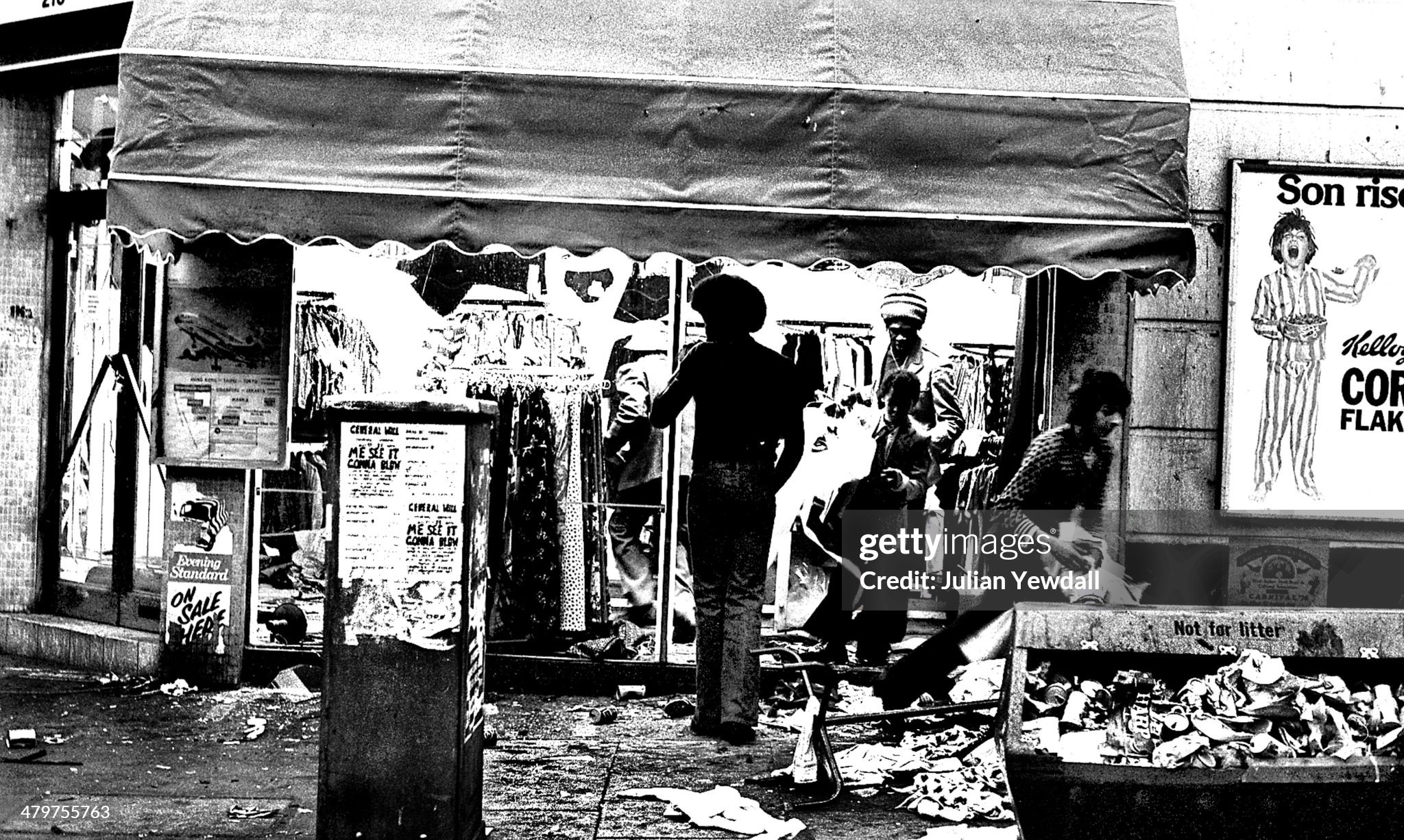
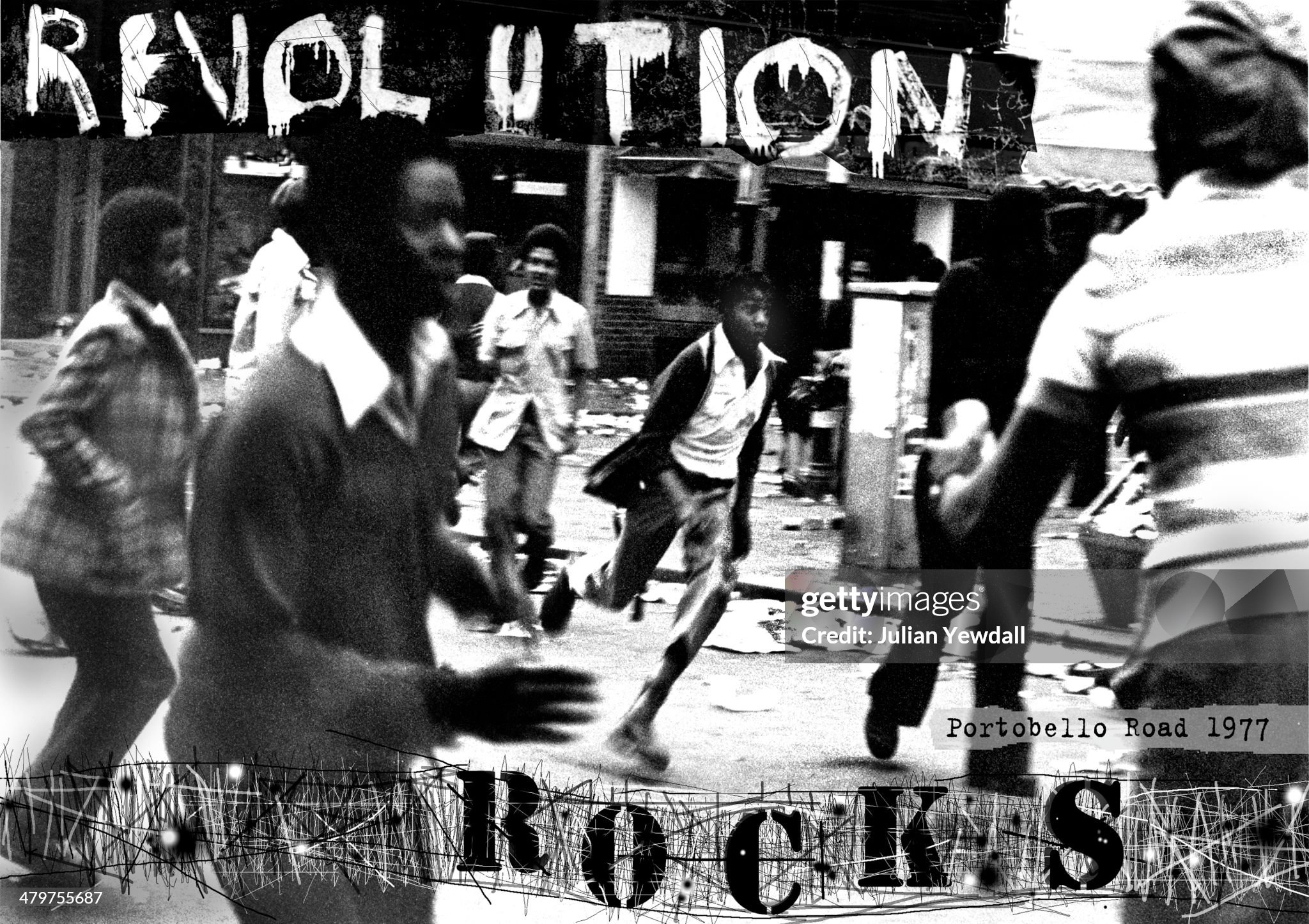
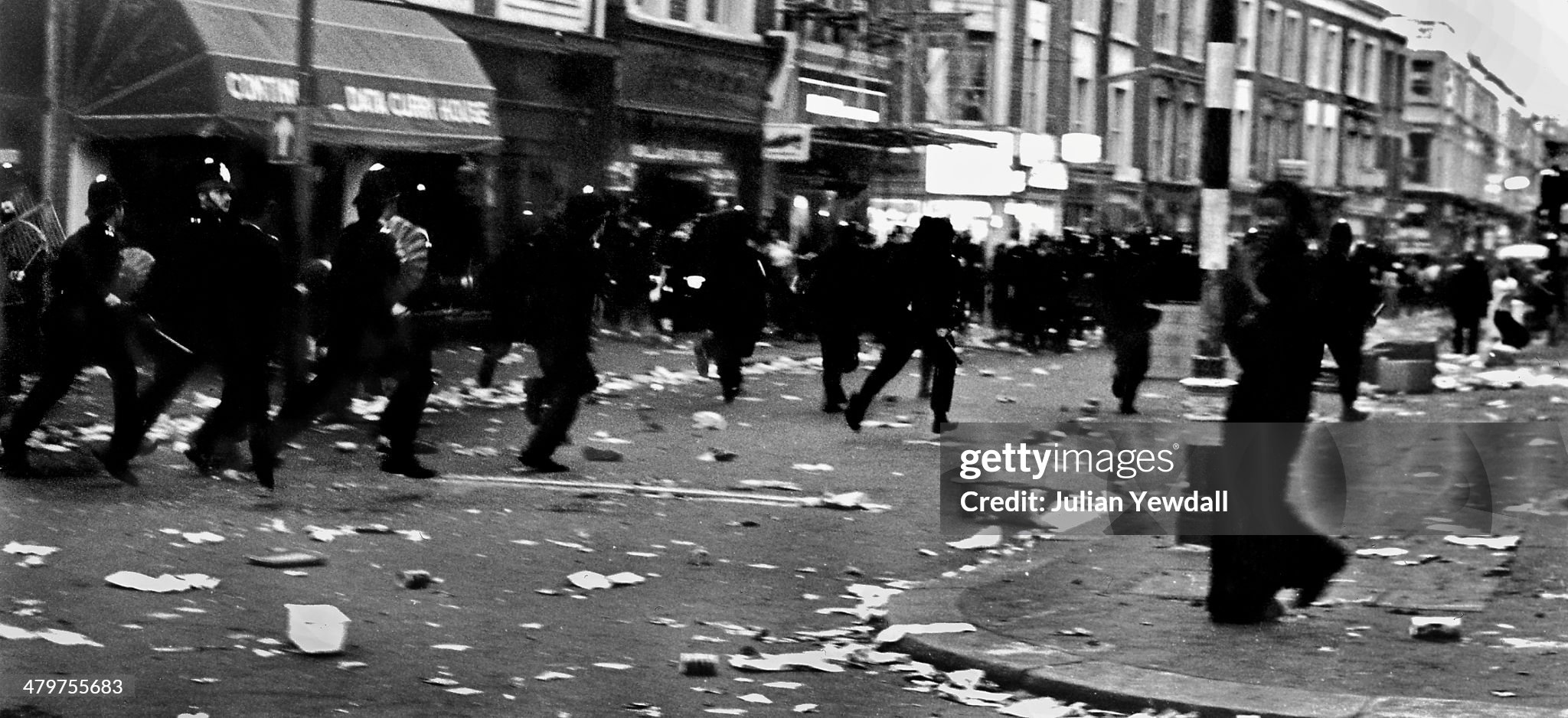
In 1976, as Darcus Howe's militant Carnival committee and the Golborne 100 group (led by George Clark, the 1967 Summer Project saint-turned-anti-Carnival sinner) joined the fray, as well as the Clash there were 1,500 white men in uniform in Notting Hill. In the Armagideon Times fanzine ‘Story of the Clash', Joe Strummer recalled getting caught up in the first incident under the Westway. After a group of ‘blue helmets sticking up like a conga line' went through the crowd, one was hit by a can, immediately followed by a hail of cans:

‘The crowd drew back suddenly and the Notting Hill riot of 1976 was sparked. We were thrown back, women and children too, against a fence which sagged back dangerously over a drop.

I can clearly see Bernie Rhodes, even now, frozen at the centre of a massive painting by Rabelais or Michelangelo… as around him a full riot breaks out and 200 screaming people running in every direction. The screaming started it all. Those fat black ladies started screaming the minute it broke out, soon there was fighting 10 blocks in every direction.' Joe later recalled failing to set a car alight with a box of matches along Thorpe Close.


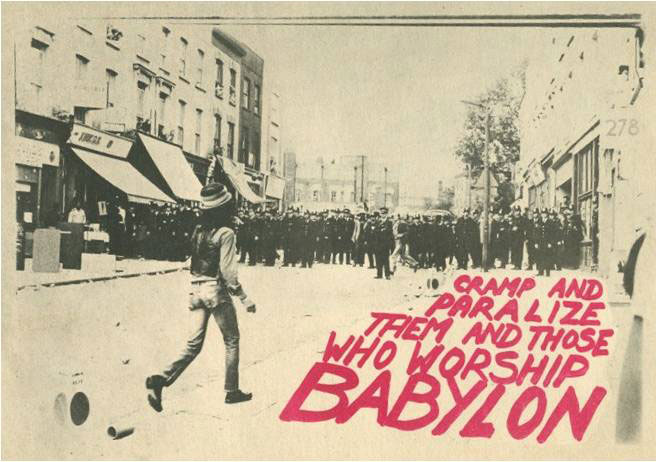
Don Letts 'Blackmarketclash' album photo

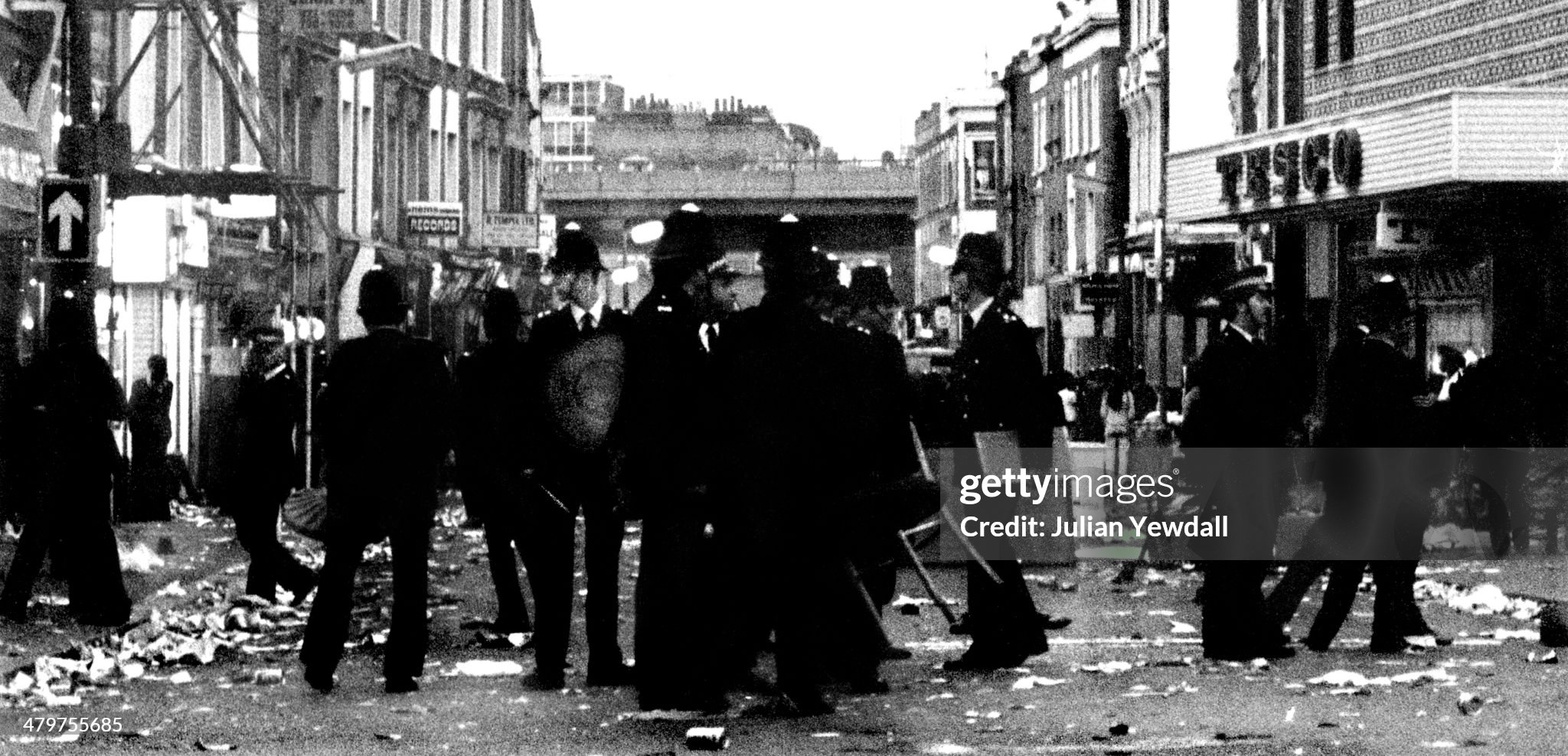
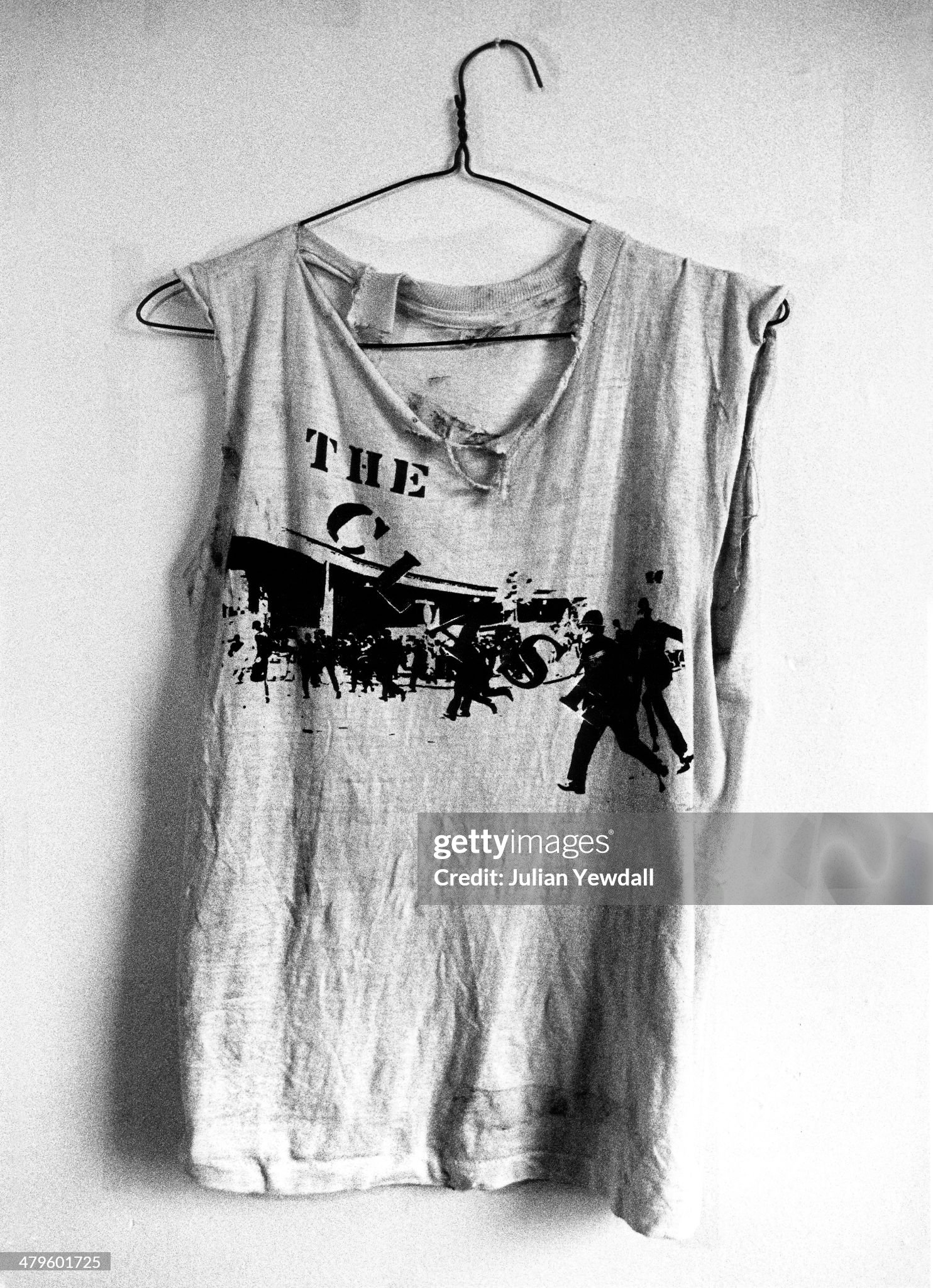
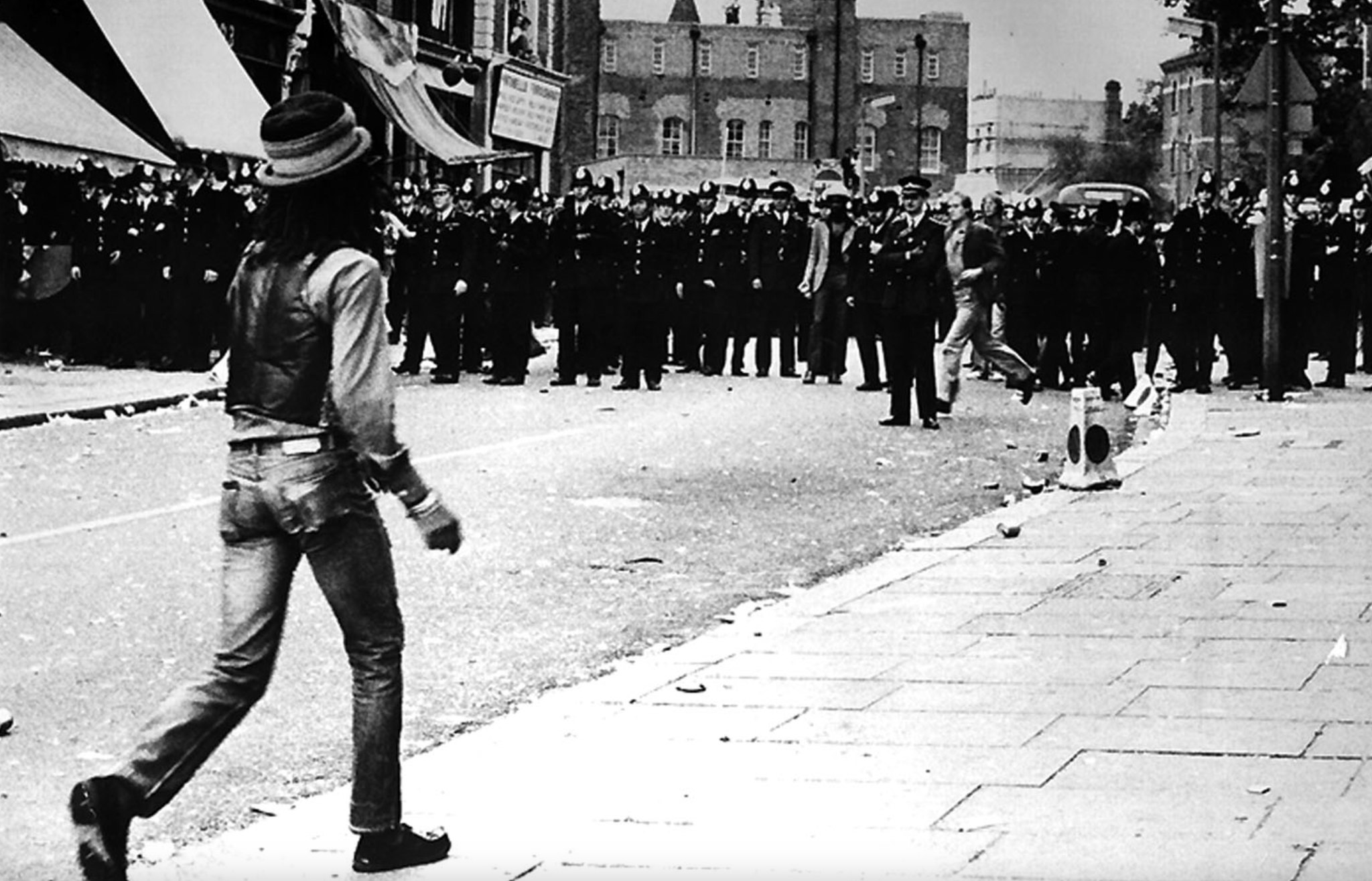
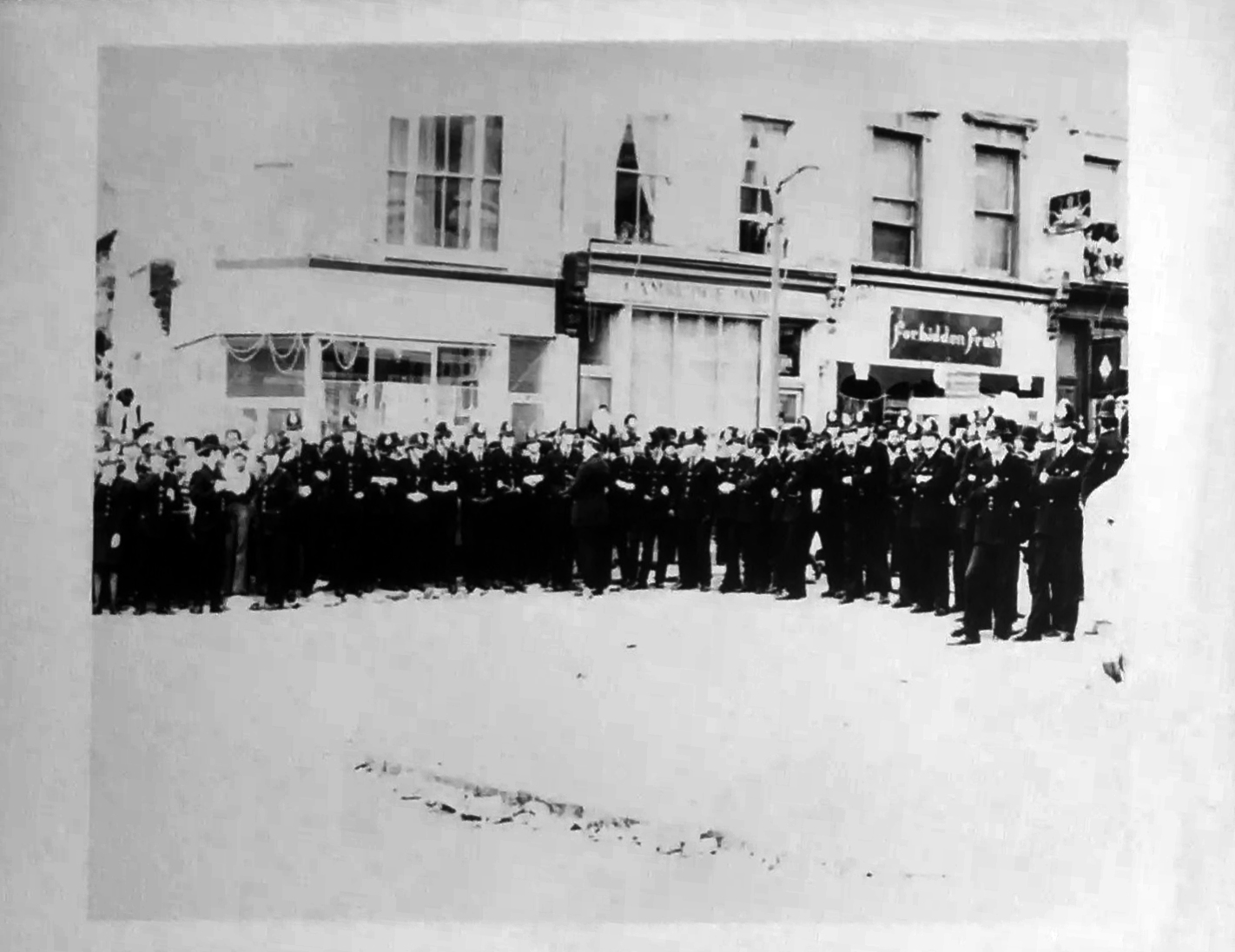
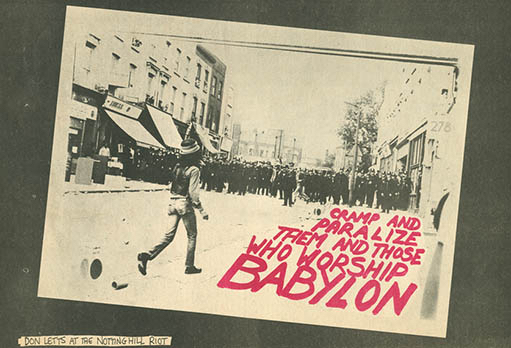
Meanwhile on Portobello Road, Don Letts (the future Clash associate film director) was walking into pop history towards Acklam Road - passing the Black People's Information Centre sound-system/disco unit, hippies looking out of the upstairs windows of numbers 305 to 9, and a line of policemen - as Rocco Macaulay began taking his famous series of pictures of the next charge. Macaulay's shot of police reaching the Westway, where the black youths had gathered (now the Portobello Green arcade) duly became the back cover of ‘The Clash' album and the ‘White Riot' tour backdrop projection. Don Letts' Wild West 10 walk first appeared on the sleeve of the ‘Black Market Clash' mini-LP in 1980.

As the riot raged under the Westway, alongside hoardings sprayed with ‘Same thing day after day - Tube - Work… How much more can you take', with the youths being driven up Tavistock Road towards All Saints Road, in what could be an apocryphal report a drunk staggered between the police and youth lines, causing hostilities to temporarily cease until he stumbled off over a wall. Later that night, Joe Strummer, Paul Simonon and Sid Vicious were warned off by a black woman when they attempted to enter the West Indian Metro youth club on Tavistock Road.


Don Letts - famous photo

enlarge


Getty Images


1976 Notting Hill Riot Photo Don Letts Classic

Classic & Iconic #FrozenMoments... | Facebook - https://www.facebook.com/

Post Punk - A Short Term Effect

Classic & Iconic #FrozenMoments in time  ... British film director, DJ, musician, @The Clash videographer (& co founder of Big Audio Dynamite alongside of Mick Jones), & #rasta #punk historian, Don Letts facing the police on this day in August, 48 years during the Notting Hill Carnival Riots circa 1976. This image by Rocco Macaulay thereafter used for The Clash's 'Black Market Clash' compilation. Read more about the story here https://bit.ly/2Pp3sr7

Mark Stewart - He's said in interviews he was trying to get away from the trouble but fantastic picture all the same

Don Letts: ‘Windrush stirred up some deep emotions. I walked down the street practically crying’ | Notting Hill carnival | The Guardian

Nat Bocking - I was there. 15 years old. The gangs 'steaming' the crowd went about with impunity. Not that it caused the riot but all day there was a sense that trouble was brewing so when the police tried to arrest a pickpocket it all kicked off. The policing attitudes and other social issues in that area had been causing tension for years.

Punk Pin Badges - The iconic image of Don Letts on Portobello... | Facebook
https://www.facebook.com/


The Clash album proofs

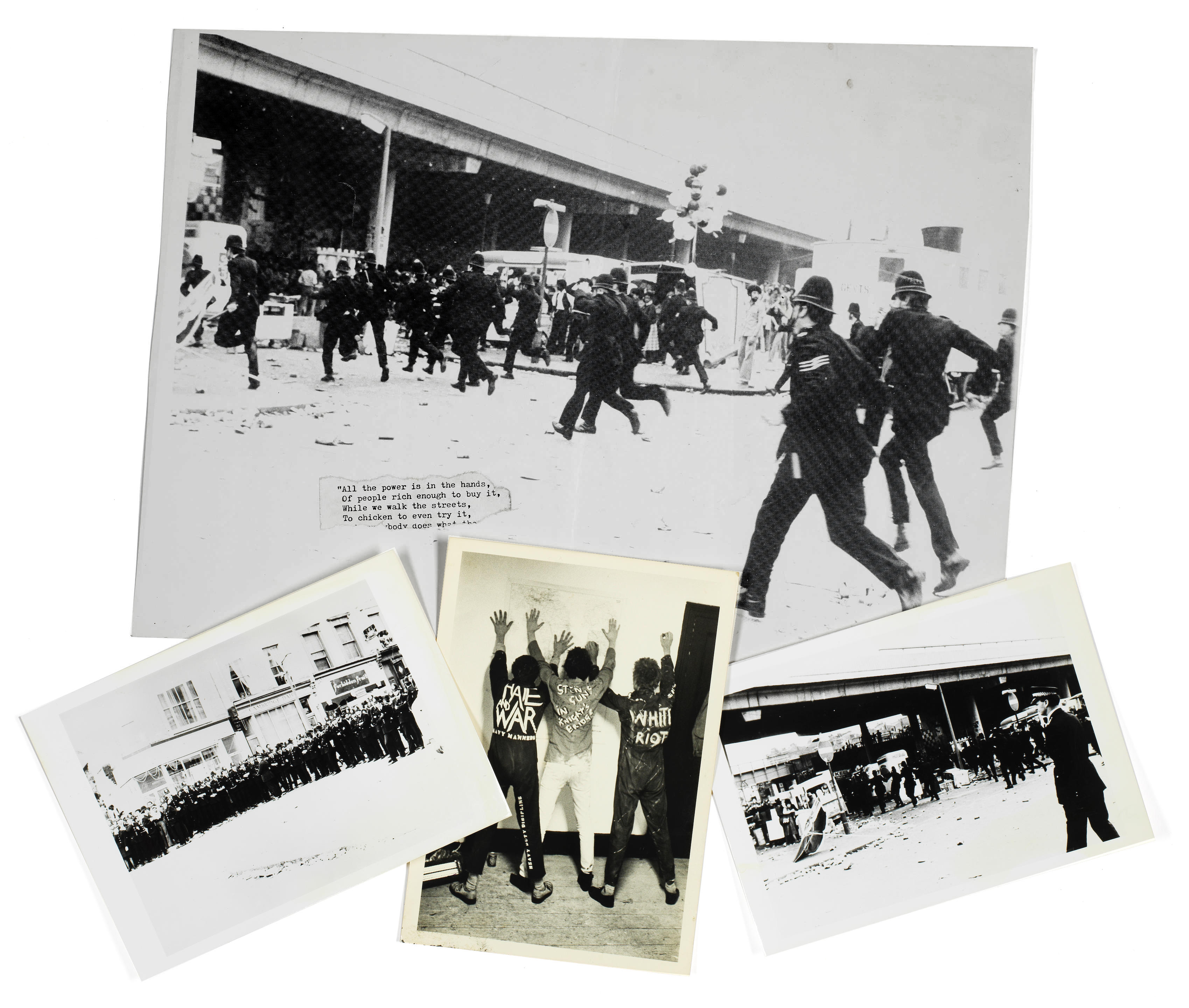
The Clash: The Clash album proof and Macauley/Coon photographs,1976/1977,comprising: two black and white photographs of the 1976 Notting Hill riots by Rocco Macauley; a 'running police' artwork proof of the back cover photo by Macauley for the album The Clash; and a photograph of the band by Caroline Coon, used for the back cover of their debut single, 'White Riot', in 1977, proof 10 3/4in x 14 3/4in (27.5cm x 37.5cm), photos 5in x 7in (12.7cm x 17.8cm)

Bonhams Auctions: The Mark Jay Collection. Lots 172-232.


Tabloid papers

The Sun's ‘Carnival of Terror' feature included the Sun ‘man on the spot' reporting on ‘How I was kicked at Black Disco' - Acklam Hall under the Westway (on the site of 12 Acklam Road/Neighbourhood nightclub). The reggae promoter Wilf Walker remembers Acklam Road in '76 as a spiritual awakening of black Britain: "It was incredible in those days to be in a sea of black faces. As a black person, that kind of solidarity we don't experience anymore… We described it as a demo of solidarity and peace within the black community. I can't imagine what it would have been like for white people… '76 showed the strength of feeling, reggae was raging in those days, young blacks weren't into being happy natives, putting on a silly costume and dancing in the street, in the same street where we were getting done for sus every day."


Carnival Defence Committee

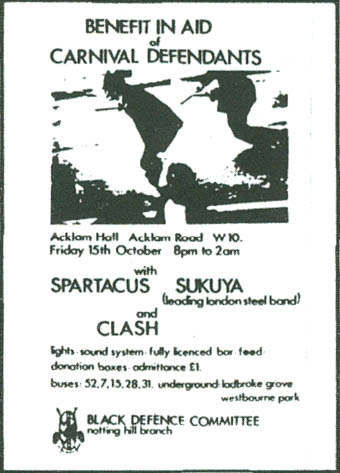
Wilf Walker's Acklam Hall punky reggae party began with a Black Defence Committee benefit ‘in aid of Carnival defendants'; featuring Spartacus R (from Osibisa), the Sukuya steel band, and ‘Clash' were billed (with no ‘The') but didn't actually play. As Joe Strummer told the NME, "It wasn't our riot, though we felt like one." Although the Clash already existed, it can be argued that they were a pop culture echo of the 1976 riot, like Absolute Beginners was of 1958.

Marcus Gray calls it ‘the catalyst that brought to the surface a lot of disparate elements already present' in the group. Not least, they got into reggae, feeding dub effects, ‘heavy manners' stencil graffiti and the apocalyptic Rasta rhetoric into the mix.

The NME reggae buff Penny Reel cites the Dennis Brown tracks ‘Wolf and Leopard', ‘Whip them Jah' and ‘Have No Fear' as portents of ‘War inna Babylon', played by Lloyd Coxsone under the Westway and Observer Hi-fi on Kensington Park Road (outside the newly opened original Rough Trade shop) in '76. In the reggae riot response, the Pioneers lamented the ‘Riot in Notting Hill' on Trojan, the Trenchtown label came up with ‘Police Try Fe Mash Up Jah Jah Children' by Mike Durane, and the Morpheus label had their own militant take on ‘Police and Thieves', ‘Police and Youth in the Grove'/‘Babylon A Button Ladbroke Dub' by Have Sound Will Travel (promoted with a punky riot headline flyer). Aswad had already recorded ‘Three Babylon' (‘Three Babylon tried to make I and I run, they come to have fun with their long truncheons') about a police incident under the Westway before the '76 riot.


"Flood Page, Mike. 'A trashy white rock 'n' roll band dealing with oppression.' Album Tracking, no. May 1977, 1977, pp. 14-15."

ALBUM TRACKING MAY 1977 - THE CLASH FEATURE

Mike Flood Page profiles The Clash at their explosive 1977 peak, capturing punk's generational revolt against rock establishment complacency, Joe Strummer, Mick Jones, and Paul Simonon detail their confrontational ethos: "We're dealing with oppression" through raw tracks like "1977" and "White Riot", Jones declares "we're a trashy white rock band"

— Reveals chaotic recording of debut album after rejecting CBS producer who demanded proper pronunciation, eventually self-producing with Mickie Foote, Notting Hill Carnival riot inspiration for "White Riot"

— Punk's "amphetamine-fast" energy with Fleetwood Mac and Eagles' polished sound, The Clash as 'heirs' to Eddie Cochran and The Who, predicts punk's brief lifespan ("maybe just two years") while asserting its necessity to revitalize stagnant rock scene

— Visual aesthetic: army fatigues, paint-splattered shoes, and "a brick through the window" attitude

Read the article ...  

PDF1  |  PDF2


Vague, T. (2021, April 3). The Sound of the Westway Part 3: Late 70s. International Times.

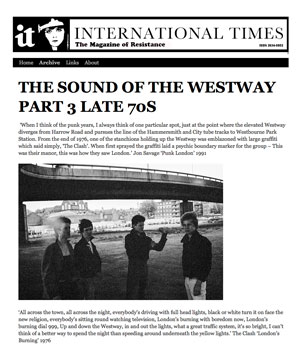
THE SOUND OF THE WESTWAY, LATE 70s

This article delves into the cultural and musical landscape of West London in the late 1970s, highlighting the influence of bands like The Clash and the significance of the Westway in the punk movement.

The Notting Hill Riots and the cover photo of Blackmarketclash album.

The Sound of the Westway Part 3: Late 70s Online or archived PDF

"Wilf Walker's punky reggae party at Acklam Hall began on October 15 with the Black Defence Committee Notting Hill branch benefit ‘in aid of Carnival defendants'; featuring Spartacus R (from the disco group Osibisa who had a hit earlier in the year with ‘Sunshine Day'), the Sukuya steel band, and ‘Clash' who were billed (with no ‘The') but didn't actually play, though they were at the gig."

Vague, T. (2021, April 3). The Sound of the Westway Part 3: Late 70s. International Times. https://internationaltimes.it/the-sound-of-the-westway-part-3-late-70s/ 

THE SOUND OF THE WESTWAY, LATE 70s

1968 Interzone International Times Fair

'Walking the Groveʼ in the May ʼ68 'Interzoneʼ International Times, Courtney Tulloch concluded that 'Notting Hill in its social aspects - housing and so on - is a huge grimy garbage heap, that is just waiting to get set on fire… In the meantime, look forward to the Notting Hill Fair especially, a human bonfire of energy and colour.

Donʼt wait for the area to change - no change in a physical environment how ever great can ever change you. Instead dig the vibrations in and around Notting Hill, perhaps the only area in London where through the differing enclaves of experimental living, a free-form and ingenious communal life-style could really burst forth...

Now there are signs that a real underground community is alive, and especially in the village around Portobello Road, down to the Gate. Each person will carry a fire in their heads despite (perhaps because of) the garbage, the ghetto poverty and the rest.ʼ

1969 King Mob Situationist Carnival

The year of 'Getting It Straight In Notting Hill Gateʼ by Quintessence, the Situationist King Mob group presented a 'Miss Notting Hill ʼ69ʼ Carnival float, featuring a girl with a giant syringe attached to her arm. This was 'a comment on the fact that there was junk and junk, the hard stuff, or the heroin of mindless routine and consumption.ʼ

1970 Notting Hill Peopleʼs Free Carnival

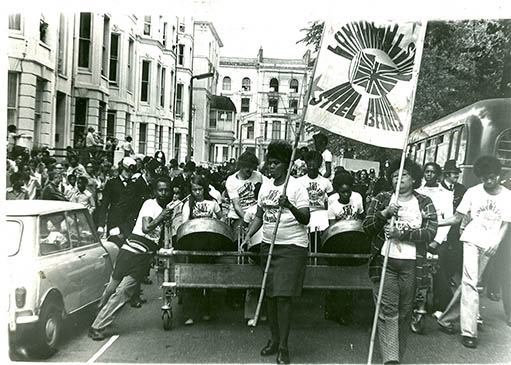
The weekend before the 1970 Notting Hill Fair/Carnival, Mick Farren and the Pink Fairies represented the Grove at a demo in Trafalgar Square, in solidarity with 'East End squatters, Notting Hill blacks, and Piccadilly freaks.ʼ The next day Hawkwind headlined a space-rock skinhead moonstomp on Wormwood Scrubs. Ironically, as the voice of the black community began to be heard at the start of the 70s, if anything Notting Hill Carnival became more of a hippy festival. After Rhaune Laslettʼs original Carnival committee pulled out due to the racial tension in the area in the wake of the first Mangrove bust, the radical street hippies took over. The 1970 Notting Hill 'Peopleʼs Carnivalʼ consisted of a procession round the area, starting and finishing in Powis Square, led by Ginger Johnsonʼs African drummers and a witchdoctor.

Proceedings ended with a rock festival in the square gardens featuring the American band Socca/Sacatash, Mataya, Stackhouse, James Metzner 'and various local musicians.ʼ
2QAA

1971 Angry Hippy Carnival

In the run-up to the Angry Notting Hill Carnival of 1971, Frendz made 'a call to all progressive people; black people smash the racist immigration bill; workers of Britain smash the Industrial Relations bill. All progressive people unite and smash growing fascism. Rally and march July 25, Acklam Road, Ladbroke Grove 2pm. Black Unity and Freedom Party.ʼ On the gatefold sleeve of Hawkwindʼs 1971 album 'X In Search of Spaceʼ, designed by Barney Bubbles, the group are pictured playing a free gig under the Westway. That summer Hawkwind appeared on several occasions at different locations under the flyover, including the Westway Theatre on the site of the Portobello Green Arcade and to the east (where Neighbourhood nightclub would later appear).

These gigs were usually benefits for local causes, during which they would merge with the Pink Fairies as Pinkwind.

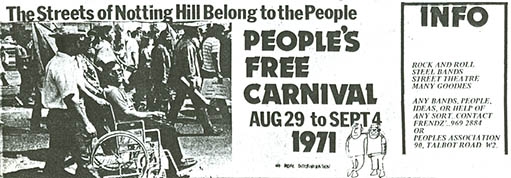
The underground press ad for the 'Peopleʼs Free Carnival August 29 - September 4 1971ʼ proclaimed: 'The Streets of Notting Hill belong to the people - rockʼnʼroll - steel bands - street theatre - many goodies - any bands, people, ideas, or help of any sort, contact Frendz or Peopleʼs Association, 90 Talbot Road W2.ʼ The FreeFrendz 'Blow Upʼ Angry Brigade special reported that the 'Peopleʼs Carnival got off to a joyous start. The street fest continues all this week so do it in the road as noisily as you can.ʼ The Pink Fairies were pictured amongst the kids in the Powis Square gardens, 'at a quieter moment during the Notting Hill Free Carnival, a fantastic week of music, theatre and dancing in the street. Everybody got it on and the streets really came alive.ʼ Pictures of Mighty Baby and Skin Alley playing on the site of Portobello Green were captioned: 'The weekly Saturday concert under Westway in Portobello Road pounds on. Next week Graham Bond, Pink Fairies and Hawkwind.ʼ

The local street hippies Skin Alley told Frendz of an anti- common market demo in Powis Square, with Julie Driscoll and some 'very far out modern jazz triosʼ who didnʼt go down too well with the kids. Powis Square, during the 1971 Carnival, was also the unlikely venue of the debut with Hawkwind of the former Hendrix roadie, Ian 'Lemmyʼ Kilmister (or Kilminster), later of Motörhead. The Carnival procession consisted of a steel band led by Merle Major,

an angry West Indian mother of 6, chanting "Get involved, Power to the People"; from her old house on St Ervanʼs Road to Powis Square, where the Peopleʼs Association had opened a squat for her. As an effigy of her landlord was burnt, Merle Major sang the ʼ71 Carnival hit, 'Fire in the Holeʼ, which included the line, 'the people of the borough pay for your car.ʼ The Angry Carnival HQ on Talbot Road was subsequently busted by the bomb squad.
2QAA

1972/3 Calypso Carnival

From the early to mid 70s, under the administration of the Trinidadian Leslie Palmer, the Notting Hill hippy 'fayreʼ was transformed into 'an urban festival of black musicʼ, based on the Trinidad Carnival model. From the first Carnival HQ on Acklam Road, Leslie Palmer established the blueprint of the modern event; getting sponsorship, recruiting steel bands and sound-systems, introducing generators and extending the route. The attendance went up accordingly from 3,000 at the beginning of the 70s to 50,000 in 1973.

1974/5 Reggae Carnival

By the mid 70s, Jamaican reggae was challenging Trinidadian calypsoʼs dominance of Notting Hill Carnival. At the 1974 flares and platforms Carnival, the Trinidadian organiser Leslie Palmer introduced reggae sound- systems and the Cimarons played, thus attracting black youth from all over London, rather than just locals. In 1975 the turnout reached 100,000, and the Carnivalʼs press profile changed from harmless hippy fair to public order problem. Back in Trinidad, as Michael X was executed, the calypsonian Black Stalin sang: 'Go rap to them baldhead, tell them, calypso gone dread.ʼ

1976 Carnival Police Clash
2QAA

In 1976, as Darcus Howeʼs militant Carnival committee and the Golborne 100 group (led by George Clark, the 1967 Summer Project saint-turned-anti-Carnival sinner) joined the fray, as well as the Clash there were 1,500 white men in uniform in Notting Hill. In the Armagideon Times fanzine 'Story of the Clashʼ, Joe Strummer recalled getting caught up in the first incident under the Westway. After a group of 'blue helmets sticking up like a conga lineʼ went through the crowd, one was hit by a can, immediately followed by a hail of cans:

'The crowd drew back suddenly and the Notting Hill riot of 1976 was sparked. We were thrown back, women and children too, against a fence which sagged back dangerously over a drop. I can clearly see Bernie Rhodes, even now, frozen at the centre of a massive painting by Rabelais or Michelangelo… as around him a full riot breaks out and 200 screaming people running in every direction. The screaming started it all. Those fat black ladies started screaming the minute it broke out, soon there was fighting 10 blocks in every direction.ʼ Joe later recalled failing to set a car alight with a box of matches along Thorpe Close.

Meanwhile on Portobello Road, Don Letts (the future Clash associate film director) was walking into pop history towards Acklam Road - passing the Black Peopleʼs Information Centre sound-system/disco unit, hippies looking out of the upstairs windows of numbers 305 to 9, and a line of policemen - as Rocco Macaulay

began taking his famous series of pictures of the next charge. Macaulayʼs shot of police reaching the Westway, where the black youths had gathered (now the Portobello Green arcade) duly became the back cover of 'The Clashʼ album and the 'White Riotʼ tour backdrop projection. Don Lettsʼ Wild West 10 walk first appeared on the sleeve of the 'Black Market Clashʼ mini-LP in 1980.

As the riot raged under the Westway, alongside hoardings sprayed with 'Same thing day after day - Tube - Work… How much more can you takeʼ, with the youths being driven up Tavistock Road towards All Saints Road, in what could be an apocryphal report a drunk staggered between the police and youth lines, causing hostilities to temporarily cease until he stumbled off over a wall. Later that night, Joe Strummer, Paul Simonon and Sid Vicious were warned off by a black woman when they attempted to enter the West Indian Metro youth club on Tavistock Road.

The Sunʼs 'Carnival of Terrorʼ feature included the Sun 'man on the spotʼ reporting on 'How I was kicked at Black Discoʼ - Acklam Hall under the Westway (on the site of 12 Acklam Road/Neighbourhood nightclub). The reggae promoter Wilf Walker remembers Acklam Road in ʼ76 as a spiritual awakening of black Britain: "It was incredible in those days to be in a sea of black faces. As a black person, that kind of solidarity we donʼt experience anymore… We described it as a demo of solidarity and peace within the black community. I canʼt imagine what it would have been like for white people… ʼ76 showed the

strength of feeling, reggae was raging in those days, young blacks werenʼt into being happy natives, putting on a silly costume and dancing in the street, in the same street where we were getting done for sus every day." Wilf Walkerʼs Acklam Hall punky reggae party began with a Black Defence Committee benefit 'in aid of Carnival defendantsʼ; featuring Spartacus R (from Osibisa), the Sukuya steel band, and 'Clashʼ were billed (with no 'Theʼ) but didnʼt actually play. As Joe Strummer told the NME, "It wasnʼt our riot, though we felt like one." Although the Clash already existed, it can be argued that they were a pop culture echo of the 1976 riot, like Absolute Beginners was of 1958. Marcus Gray calls it 'the catalyst that brought to the surface a lot of disparate elements already presentʼ in the group. Not least, they got into reggae, feeding dub effects, 'heavy mannersʼ stencil graffiti and the apocalyptic Rasta rhetoric into the mix.

The NME reggae buff Penny Reel cites the Dennis Brown tracks 'Wolf and Leopardʼ, 'Whip them Jahʼ and 'Have No Fearʼ as portents of 'War inna Babylonʼ, played by Lloyd Coxsone under the Westway and Observer Hi-fi on Kensington Park Road (outside the newly opened original Rough Trade shop) in ʼ76. In the reggae riot response, the Pioneers lamented the 'Riot in Notting Hillʼ on Trojan, the Trenchtown label came up with 'Police Try Fe Mash Up Jah Jah Childrenʼ by Mike Durane, and the Morpheus label had their own militant take on 'Police and Thievesʼ, 'Police and Youth in the Groveʼ/'Babylon A Button Ladbroke Dubʼ by Have Sound Will Travel (promoted with

a punky riot headline flyer). Aswad had already recorded 'Three Babylonʼ ('Three Babylon tried to make I and I run, they come to have fun with their long truncheonsʼ) about a police incident under the Westway before the ʼ76 riot.
2QAA

PART 3 LATE 1970s
TOM VAGUE

Online or archive PDF


Super Black Market Clash advert


Juke magazine, 6 June 1981


HMV Advert

The Bill Price remix of pressure drop on the Black market clash 10" is a unique mix thats never been issued on CD


Back to the top


Super Blackmarketclash


Rollin Stone Reviews: The Clash album rates five stars

80 12 14
The Dispatch Sun


New Clash Disc Shows Humanity

The Tampa Tribune
Friday 12 December 1980


On Music Bargain basement pop

Newsday Nassau Edition
Fri Nov 28 1980


Hey, let's have a big hand. folks, for little records

Fort Lauderdale News
Fri Oct 31 1980


The Clash - Black Market Clash [10-inch]

Punknews, EPIC. John Gentile
April 11th 2016 or PDF


www.blackmarketclash.co.uk

email blackmarketclash.co.uk@gmail.com

THE CLASH
1976  1977  1978  1979  1980  1981  1982  1983  1984  1985  THE CLASH: ALBUM BY ALBUM, TRACK BY TRACK 

STRUMMER, BAD, Pogues, films + : THE SOLO YEARS
THE 101ers: 1974-1976   SOLO YEARS: 1986-2025

STRUMMER & THE LATINO ROCKABILLY WAR
ROCK THE RICH 88-89   ROCK THE RICH 99-00  

STRUMMER & THE MESCALEROS
ROCK ART TOURS 1999   ROCK ART TOURS 2000   GLOBAL A GO GO TOURS 2001   GLOBAL A GO GO TOURS 2002   STRUMMER DEMOS OUTAKES

BOOKS, NEWSPAPERS & FEATURE MAGAZINES
THE CLASH YEARS –– 1975-1986 
THE SOLO YEARS –– 1987-2002 
RETROSPECTIVE FEATURE MAGAZINES –– 2002-2025  
BOOKS  OTHER LINKS  

THE CLASH AUDIO & VIDEO
THE CLASH INTERVIEWED – INTERVIEWED / DOCS

Sex Pistols / The Jam / The Libertines / Others
The Sex Pistols  The Jam  The Libertines  other recordings-some master

