Idol Worship --- Issue #1 - May 1980 - 75¢

A Day with the Clash

  1. Idol worship

  2. Clash

  3. The rehearsal

  4. Mick thinks he always sings

  5. The gig

  6. Backstage after the gig

  7. Spanish lesson #1 repeat

  8. Johnny Green has quit

IDOL WORSHIP --- Issue #1 - May 1980 - 75¢

NEW: SPECIAL'S CLASH MADNESS and more!

A Day with the Clash

by Lee Sherman

In 1980, the Clash faced new frontiers. Four horsemen riding out to widespread public acclaim of an album that wasn't really meant to be commercial. "Have they sold out?" cried the hard-core punks as a hush fell over the city. People needed time to absorb the various influences on London Calling and figure out what the Clash were doing. Not content to serve up countless rehashes of "White Riot", the boys had discovered that elusive ingredient known as subtlety.

Anticipation was high for their upcoming performances at the Warfield, and they didn't let us down. The old energy wasn't the least bit diffused, and their conviction and attitude remained intact (despite the fact that they now receive radio airplay on KCBS-FM). But I'm getting ahead of myself... The story begins Friday night when your dauntless Idol Worship reporters set off for the group's hotel in search of a story. We brought along a painting of Joe Strummer and one Vicki Berndt deserves credit here for putting up with being crushed by it on the way over. We encounter Kosmo Vinyl in the hotel bar and he agrees to fetch Joe for us. Joe autographs the painting and photos are taken all around. He seems quite impressed by it and takes it into the bar to examine it in a more drunken light. A variety of beverages were consumed by all present: Japanese beer, cokes, and orange juice. Joe kept nodding off at the bar until he was woken up by an awful polyester tuxedo lounge act man (Vicki's description) playing Barry Manilow's greatest hits and telling punk rock jokes for our benefit ("Hey folks! Why did the punk rocker cross the road? It was safety pinned to the chicken!!").

THE REHEARSAL

We all get invited to their rehearsal in SIR Studios on Folsom. Usually the site of practice sessions by the likes of Journey, it was an unusual place to see the Clash. That is, for those of us who got to see them. The two female reporters who had gone to park the car were locked outside a wrought iron gate by the tour manager who implied that they were groupies and belonged back at the hotel. He said they would be "too distracting", which was also the reason given for not allowing Punk Globe editor Ginger Coyote to watch Sunday's gig from the side of the stage. Later, the girls are let part of the way in and given some beer by road manager Johnny Green. Unaware of the events taking place outside, the Clash were hard at work. They did many new songs, and from the sound of them that night, the next album should be amazing. The new single is a song called "Bankrobber", a reggae workout that will be produced by Mikey Dread. There were also instrumental versions of "The Prisoner" and "Listen", songs rarely heard in live performance. They did snippets of "Brand New Cadillac" and "Rudie Can't Fail". How anyone could sleep through a Clash rehearsal is beyond me, but it wasn't beyond faithful Clash roadie Baker Glare, who nodded out on the couch. Another roadie along for this tour has a very unusual story. A fan from the early days at the 100 Club, he almost joined the Marines. When the Clash heard about this, they took him on as a roadie in order to save him from that fate. His pay comes directly out of Kosmo's and Mick's wages. (I predict a run on Army fatigues and skinhead cuts shortly before the Clash's next tour. Psychic Ed.) The rehearsal was a cautious tuning-up process that allowed the group to gather their energies for the upcoming gigs. Bassist Paul Simonon and drummer Topper Headon, aided by Johnny Green, let off steam by placing all of DJ Barry Myers' records from his monstrous collection in the wrong sleeves and taping them shut, or inside the sleeves, with handfuls of albums taped together so they couldn't be removed from the case. Barry was quite good-natured about the fact that he had to sort out hundreds of records. "If they want to be childish, that's up to them," he said later.

MICK THINKS HE ALWAYS SINGS

The gig is explosive. The previous night's rehearsal has paid off and they've reached the boiling point. They open with a hard-edged Clash City Rockers and we all pogo down the front. Realizing that the balcony is no place to experience the full force of the Clash, I manage to get all the way to the front of the stage. The set was almost perfect (Sue still wanted to hear "White Riot"). They played great, and the set was very well-paced. In concert, even the newer songs took on an energetic feel that made the recorded versions sound limp by comparison. It was quite a sight to see everyone pogoing to "Jimmy Jazz", but it worked surprisingly well. An intense version of "Garageland" was a treat with a guitarless Joe Strummer screaming out the words like he'd written them yesterday. For all their newfound popularity, the Clash remain true to their origins and still sound like they mean it. "Clampdown" sounded especially good live, a heroic call to arms. "Revolutionaries" in the audience unfurled a banner supporting their cause and also paraded around outside distributing newspapers and leaflets. Strummer was not impressed. After a couple of multi-song encores, both group and audience were too exhausted for anything more. The Clash had given their all, and I'm sure the "regular" people there had never seen anything like it.

CAPTION: HUH-WHEN'S IT GONNA BE MY TURN?

BACKSTAGE AFTER THE GIG

Backstage after the gig, a tired group talks to their fans. Topper's off doing an interview for Videowest, and Mick Jones seems quite pleased with the gig. At Joe's request, Johnny Green puts your ticketless IW reporters on the guest list for Sunday's gig. The IW staff and friends also did a little backstage shopping and so lived off the Clash's milk and sandwiches for the next week or so. They really do care. Sunday's gig is spectacular, possibly the best S.F. performance yet. The Clash are really up for the show and are very active onstage (in contrast to Friday's rehearsal, where Mick was the only one moving). They do "Protex Blue" and "Rudie Can't Fail", songs we didn't get to hear on Saturday. Great!! Someone put a huge bone on Paul's side of the stage that has to be more "distracting" than Ginger, Vicki, and Sue combined, but it remained there for the entire set. There's a huge crowd backstage afterward. The doors were opened so fans were let into the dressing room a few at a time. Mick is in extremely high spirits. A young kid who obviously thinks Mick's just about the coolest ever walks up to get his autograph, and Mick gladly obliges. ("You're my guitar hero, Jonesy.") Paul and Joe are very relaxed (and quite preoccupied). Topper is knackered. The party at Target Video is really fun—not at all stuffy and boring like most of these affairs.

CAPTION: "AND NOW FOR MY NEXT NUMBER....

SPANISH LESSON #1 REPEAT: LOS DIENTES DE CRUMBLE.

Lots of Motown is played and everyone's dancing. Johnny Green and Joe Strummer prove what great dancers they are while Mick doesn't "I don't dance," he said. The Clash leave at 5 a.m. and we all stagger out the door. They'll be back in two or three months. When you read this, Paul should be finishing up his movie in Vancouver. Joe was heading for Austin, Texas, after the tour to record with Joe Ely. The weekend reconfirmed our faith in the Clash. The only place they sold out was at the box office.

JOHNNY GREEN HAS QUIT

Johnny Green has quit his job as Clash road manager. We learned that after this last tour, Johnny flew to London to marry his long-time sweetheart, then the two of them moved to Lubbock, Texas, where Johnny will work for Joe Ely! Apparently, he's always been fond of country western music and Texas as well, so this seems like the ideal move for him. Yee-haw, Johnny!

OOOH-A PRETTY PICTURE OF PAUL

Archive PDF


SITUATION BUTALE FANZINE - March 1980

Situation Butane Fanzine: Interview with Strummer

  1. Introduction

  2. The Clash and Local Bands

  3. Thoughts on the Support Band

  4. Reaction in America

  5. Gob and Audience Behaviour

  6. Reggae Influence on London Calling

  7. Recording the Album

  8. Message to the Public

  9. Performing Capitol Radio

  10. Working with Guy Stevens

  11. The Sound and Inspiration in the Studio

  12. Production of Clash City Rockers

  13. Re-recording Capitol Radio on the Cost of Living EP

  14. The Rights to Capitol Radio's Original Version

SITUATION BUTALE FANZINE --- March 1980

INTERVIEW WITH JOE STRUMMER OF THE CLASH

Q: A lot of punks were out there tonight... like it was 76 again!
Strummer: I know, it's like some sort of 76 revival, I feel like being ill. I'd rather be a hippy... or heavy metal or something.

Q: Who thought of putting a local band on the support slot of each town on this tour?
Strummer: Well, that was me, really, yeah, it was a good idea, cos it helps you 'plug in'; not much, but a local scene; you know what I mean? Rather than just poncing though. People slag us off, say: "Well they only do that cos there's a ton of old crap on, and so no-one shows 'em up."

Q: What did you think of the support band, the Golinski Brothers?
Strummer: I only saw the sound check, but I saw all of it, and they done about five numbers. I specially like "I'm Not a Toy", they could be the new Amen Corner of the 80's! That's a bit of a faker.

Q: The biggest local band are the Piranhas... J Space Invaders? What do you think of that?
Strummer: I like it actually...

Q: What sort of reaction did America have to the band?
Strummer: Well in L.A. it's like this, it's like a British audience, but in L.A., amazingly enough.

Q: Do you continuously get all this hassle, like the gobbing?
Strummer: Oh, the gobbing... Well, not much last tour... Bit in Aylesbury... A little bit in Canterbury, but tonight was like, the worst so far...

Q: I don't suppose it happens much in America, does it?
Strummer: Not much, nah... they do the Worm in America; they just throw themselves on the ground and shake! And like it takes four blokes to grab hold of one bloke doing the Worm, and they all smoke E.P.C. or something - Horrible - and they just do The Worm all over the stage, they don't just come running on and pogo, they all come flooding up, and they're just lying on the stage and wriggling. That's in L.A., but everywhere else... bit deader than that.

Q: Is the reggae influence on London Calling derived from your American trips?
Strummer: Well, it's an untapped market, maybe The Police have got it, a lot of white, middle-class T-shirt brigade in America, they've just sort of gone mad over reggae. You see them in Boston, they're begging to hear more of it really.

Q: Did that therefore rub off on the L.P.?
Strummer: We recorded the album before we went there, see? We went in on the first of August, and we banged the whole thing out, and by the fifth of September, we were in Monterey, kickin off the tour, right? And we just laid the whole thing down, and we played the States, while Bill Price fiddled with the mixes, then we came back, listened to all the mixes; and said: "Oh, this bit here," or "That bit there", and most of it was pretty good, and that was it. So it was put down before we went over there.

Q: Have you got any sort of 'message to the public on this British tour?
Strummer: Yeah, like, ah. Do we have to use a sledgehammer? You know? To get the message across... Yeah... they want "White Riot" all the time, and it just gets bloody samey...
Strummer: Yeah, I know! I mean, we're gonna play "White Riot" again, but we ain't gonna play it on this tour. Bollocks to it.

Q: Do you play "Capitol Radio" on this tour?
Strummer: Nah, we just bung it out... you get bored with it... you just get bored with it. When you're in a group, you only wanna play the new stuff... The old ones are the good ones, but we can't keep playing the old shit. Two years ago, we were playing the same venues with the same songs, you're just... You're dead, I think.

Q: Did you like working with Guy Stevens?
Strummer: I loved it really, you know: it is a bit of a shock... But, safely now, looking back, I can say "I dug it all"; when at the time, I wanted to kill him! Well, he had this fuckin' lovely piano, right? And I was just learnin' to play the piano, a Bausandorfer, like the Gibson of grand pianos, right? No Steinway, it was a Bausandorfer, I never heard of them before, but anyway, there it is; and he, (Guy Stevens) wanted this cab fare, or somethin. He was always short of money! And, he just pulled out this can of beer, he always had beer on him, and he poured it (Joe's voice takes on a note of agony) all over the inside of the belly of this huge piano. I tell you, it cost twenty grand that piano, no kidding... at least twenty grand. And we were halfway through the session, I was using it everyday on the tracks!

Q: Really?
Strummer: Yeah! Like, we called in a piano-tuner, and he sort of, dried up the beer and tuned it back up. But, you know, I was fuckin' crazy I coulda killed the cunt!

Q: Yeah, but do you like the sound he gets with you in the studio?
Strummer: I'll tell you the truth; he doesn't have anything to do with the sound at all. This is a misconception that we've hoisted on the whole music business, right? He came in and he inspired us to do the backing tracks, and not just do ten, like, it was frigid: "Oh dear is that good?" and he inspired us to lay down twenty backing tracks, and then, after that, we had to like, tie him to a chair! And like, that's the truth. But I'll tell you, because I'm hoping that Guy will get some more work and get himself out of this terrible bender... that he's been on... like a ten-year bender.

Q: Like a rut?
Strummer: Yeah, he's like a drunk, he's always pissed, his face is a mass of cuts, he's always sort of falling over, and we wanted him to get out of the rut, and that's why we said: "You're gonna be the producer", even though, to be quite honest, Mick Jones, Bill Price, and Gerry Green were the three men who probably were most involved with the sound.

Q: Now who was it produced "Clash City Rockers" single then?
Strummer: Hmm... shit... (Joe's brow furrows with thought) that was actually produced by Mick Jones, but was credited to Mickey Foote; and he was the guy that went in, and speeded it up by nine seconds, after we fucked off somewhere... so when I heard it on John Peel, first time, it sounded like Donald Duck! I was... really! I coulda given up!

Q: Bit of a shock?
Strummer: Yeah! I thought: "That's it", to hear yourself on the radio, and Donald Duck, you know, getting yourself cranked up, then it comes out like Mickey Mouse

Q: When the "Cost of Living" EP came out, why did you re-record "Capitol Radio" when...
Strummer: Fuck it up, you mean!

Q: Well surely the thing to do, to most people, was to put out the original version and stop all the money-making on the freebie?
Strummer: Yeah, I know; but we were so egotistical, we couldn't help thinking we could do it better, but... even though I admit it now, we could!

Q: Personally, I don't think it was any better...
Strummer: Well I don't now... Like, that was a part-time thing; NME & CBS, and surely CBS had the rights to re-release that original take on another release?
Strummer: Hmmmm... tricky question... it might have been owned by IPC... who knows? In those days we just gave things away, you know? We used to think: "Ah, fuck, just give it away..."

Q: Well, they sell at big prices now, as you know.
Strummer: Bernie Rhodes has got a box of them, about fifty stashed away, cos he gave me one for a Christmas present, free X-Mas present!!

Q: Just what you needed!
Strummer: Yeah, right!

CLASH
INTERVIEW WITH JOE STRUMMER CONTINUED IN NEXT ISSUE WITH TOPPER HEADON! MAKE SURE YOU BUY IT!!!

Archive PDF


Fanzines: Great Collection

Great collection of scanned fanzines from the 1970s and 1980s


back to the top


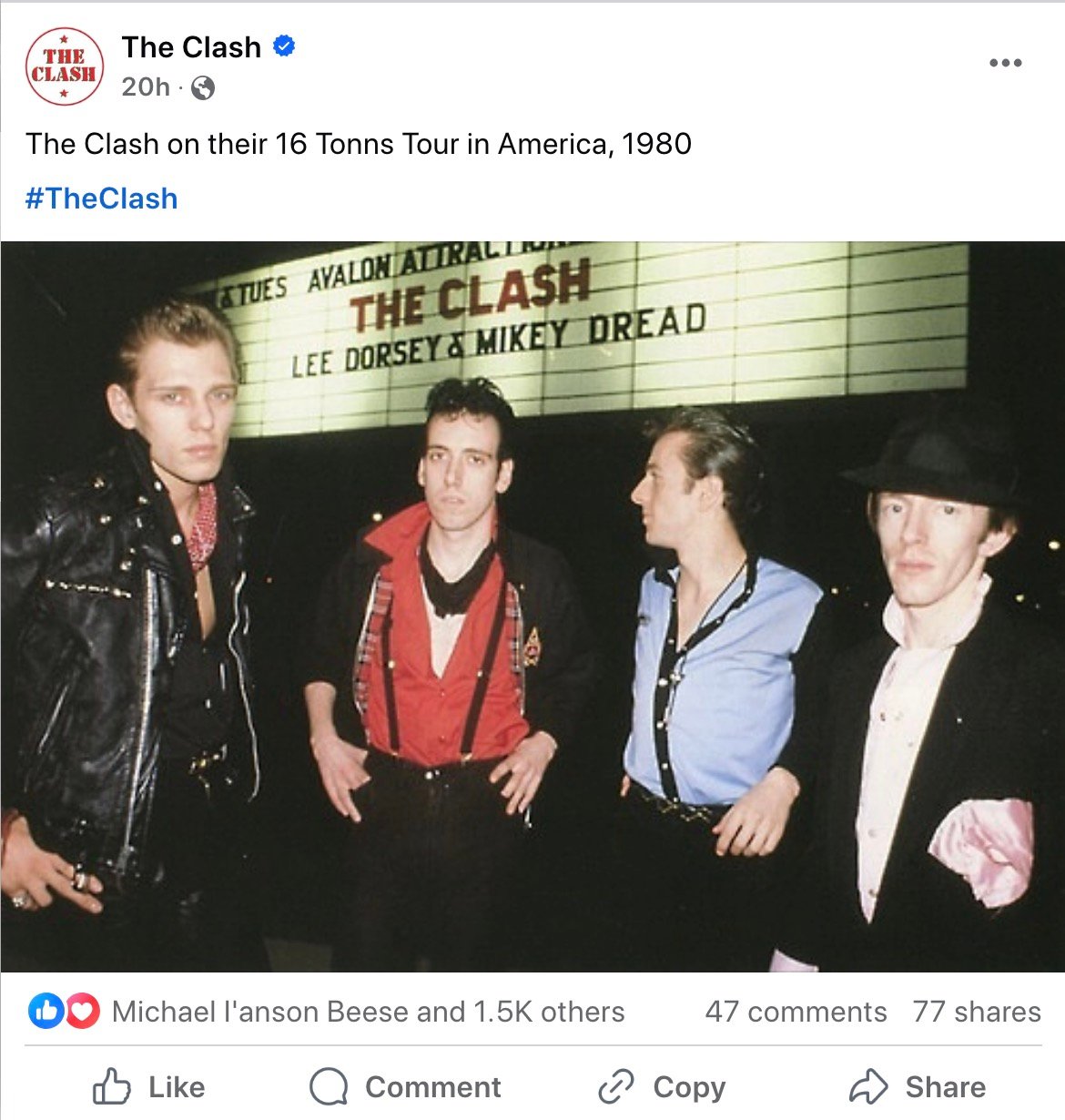
The Clash on their 16 Tons Tour in America, 1980

The Clash | Facebook

The Clash pictured in Detroit, Michigan ahead of the gig at 10 mile high stadium.


back to the top