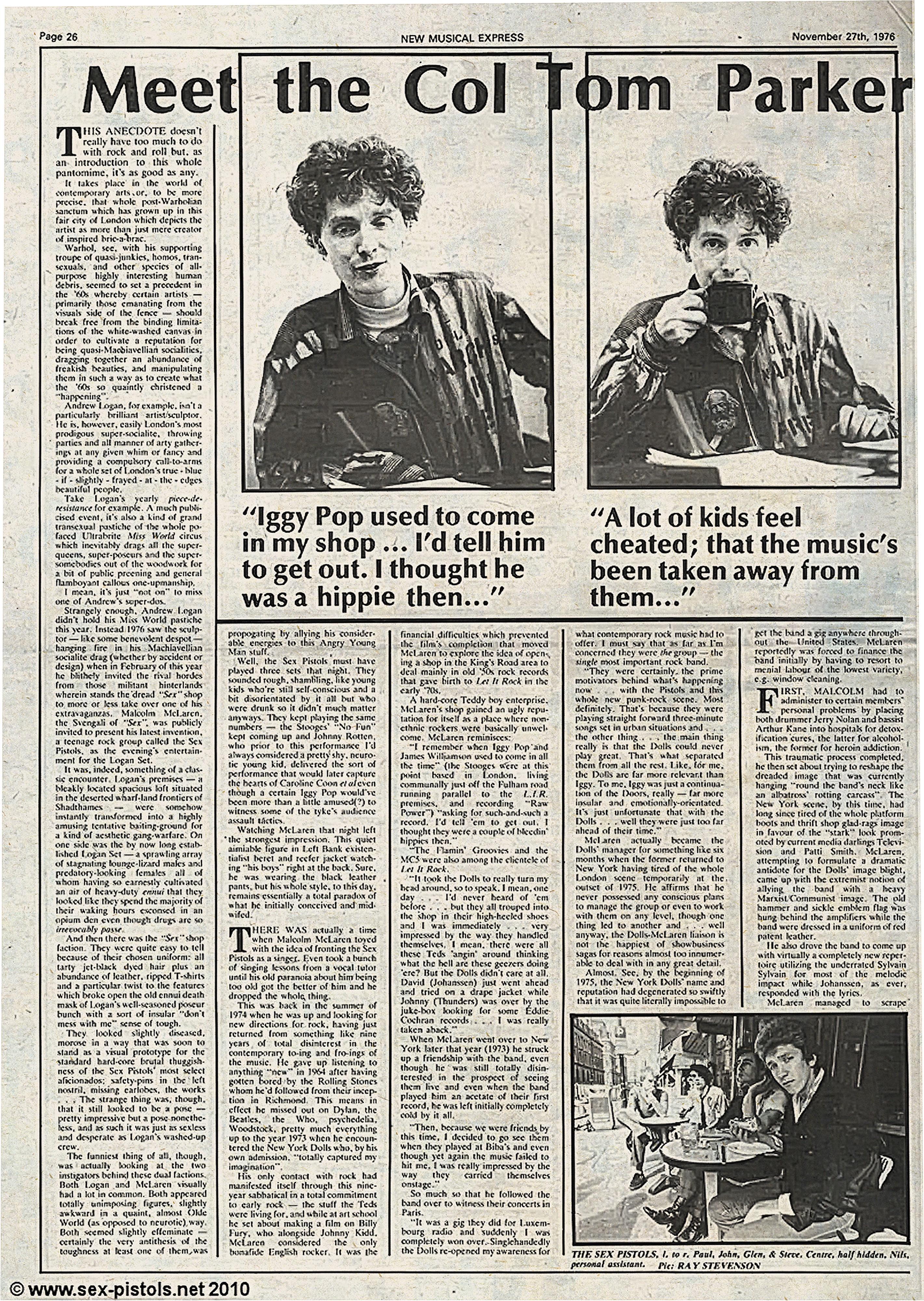
Meet the Col Tom Parker of the Blank Generation...
This anecdote doesn't really have too much to do with rock and roll but, as an introduction to this whole pantomime, it's as good as any.
It takes place in the world of contemporary arts or, to be more precise, that whole post-Warholian sanctum which has grown up in this fair city of London which depicts the artist as more than just mere creator of inspired bric-a-brac.
Warhol, see, with his supporting troupe of quasi-junkies, homos, transsexuals, and other species of all-purpose highly interesting human debris, seemed to set a precedent in the 60s whereby certain artists—primarily those emanating from the visual side of the fence—should break free from the binding limitations of the white-washed canvas in order to cultivate a reputation for being quasi-Machiavellian socialites, dragging together an abundance of freakish beauties, and manipulating them in such a way as to create what the 60s so quaintly christened a happening.
Andrew Logan, for example, isn't a particularly brilliant artist/sculptor. He is, however, easily London’s most prodigious super-socialite, throwing parties and all manner of arty gatherings at any given whim or fancy and providing a compulsory call-to-arms for a whole set of London’s true-blue if-slightly-frayed-at-the-edges beautiful people.
Take Logan’s yearly pièce-de-résistance for example. A much-publicised event, it's also a kind of grand transsexual pastiche of the whole po-faced Ultrabrite Miss World circus which inevitably drags all the super-queens, super-poseurs and the super-somebodies out of the woodwork for a bit of public preening and general flamboyant callous one-upmanship. I mean, it's just not on to miss one of Andrew’s super-dos.
Strangely enough, Andrew Logan didn't hold his Miss World pastiche this year. Instead 1976 saw the sculptor—like some benevolent despot—hanging fire in his Machiavellian socialite drag (whether by accident or design) when in February of this year he blithely invited the rival hordes from those militant hinterlands wherein stands the dread Sex shop to more or less take over one of his extravaganzas. Malcolm McLaren, the Svengali of Sex, was publicly invited to present his latest invention, a teenage rock group called the Sex Pistols, as the evening's entertainment for the Logan Set.
It was, indeed, something of a classic encounter. Logan’s premises—a bleakly located spacious loft situated in the deserted wharf-land frontiers of Shad Thames—somehow instantly transformed into a highly amusing tentative baiting ground for a kind of aesthetic gang-warfare. On one side was the by now long-established Logan Set—a sprawling array of stagnating lounge-lizard males and predatory-looking females all of whom having so earnestly cultivated an air of heavy-duty ennui that they looked like they spent the majority of their waking hours ensconced in an opium den even though drugs are so irrevocably passé.
And then there was the Sex shop faction. They were quite easy to tell because of their chosen uniform: all tarty jet-black dyed hair plus an abundance of leather, ripped T-shirts and a particular twist to the features which broke open the old ennui death mask of Logan’s well-seasoned poseur bunch with a sort of insular don't mess with me sense of tough.
They looked slightly diseased, morose in a way that was soon to stand as a visual prototype for the standard hardcore brutal thuggishness of the Sex Pistols’ most select aficionados; safety-pins in the left nostril, missing earlobes, the works.
The strange thing was, though, that it still looked to be a pose—pretty impressive but a pose nonetheless—and as such it was just as sexless and desperate as Logan’s washed-up crew.
The funniest thing of all, though, was actually looking at the two instigators behind these dual factions. Both Logan and McLaren visually had a lot in common. Both appeared totally unimposing figures, slightly awkward in a quaint, almost Old World (as opposed to neurotic), way. Both seemed slightly effeminate—certainly the very antithesis of the toughness at least one of them was propagating by allying his considerable energies to this Angry Young Man stuff.
Well, the Sex Pistols must have played three sets that night. They sounded rough, shambling, like young kids who were still self-conscious and a bit disorientated by it all but who were drunk so it didn't much matter anyway. They kept playing the same numbers—the Stooges’ No Fun kept coming up—and Johnny Rotten, who prior to this performance I'd always considered a pretty shy, neurotic young kid, delivered the sort of performance that would later capture the hearts of Caroline Coon et al. even though a certain Iggy Pop would've been more than a little amused(?) to witness some of the tyke's audience assault tactics.
Watching McLaren that night left the strongest impression. This quiet amiable figure in Left Bank existentialist beret and reefer jacket watching his boys right at the back. Sure, he was wearing the black leather pants, but his whole style, to this day, remains essentially a total paradox of what he initially conceived and midwifed.
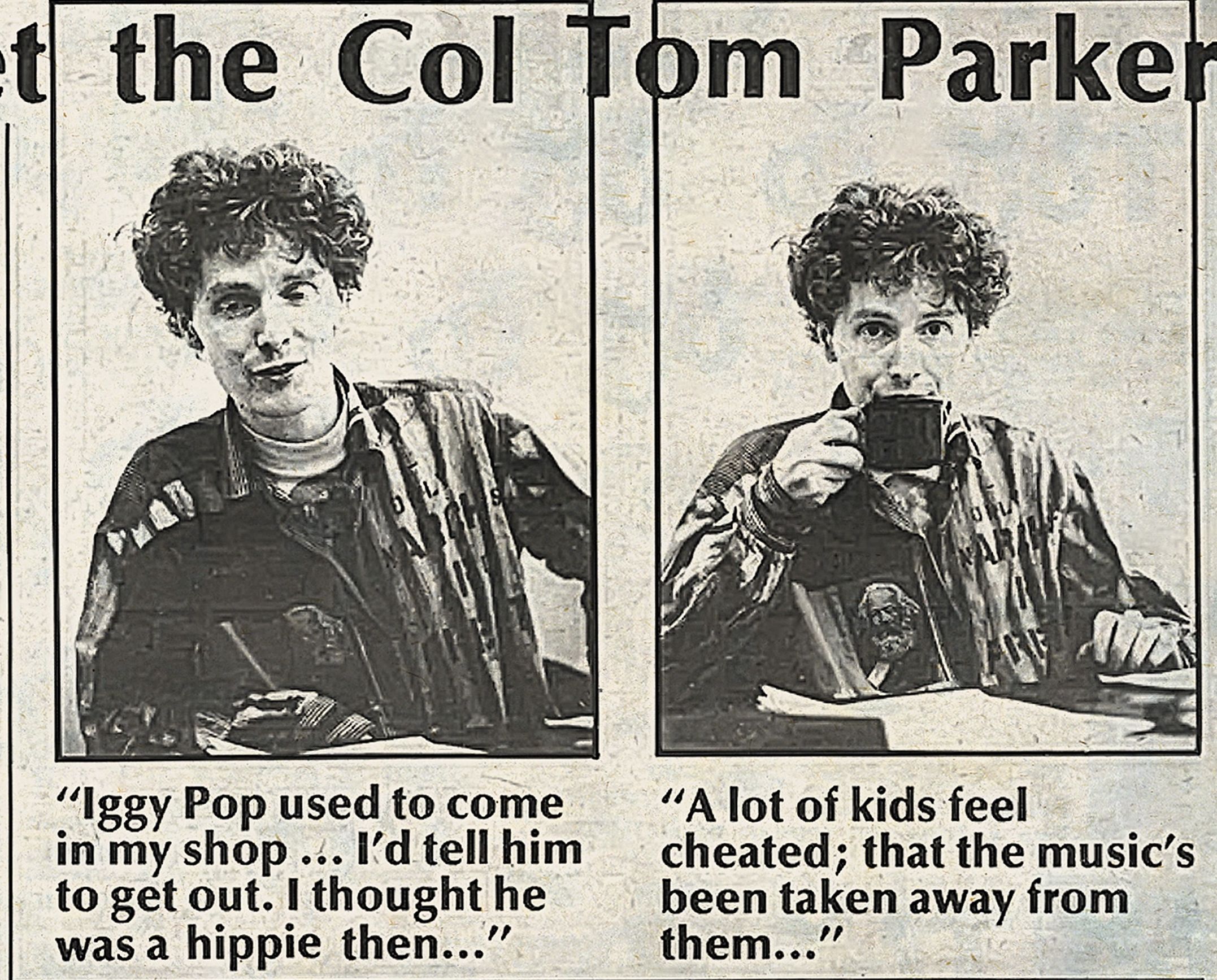
Iggy Pop used to come in my shop ... I'd tell him to get out. I thought he was a hippie then...
A lot of kids feel cheated; that the music's been taken away from them...
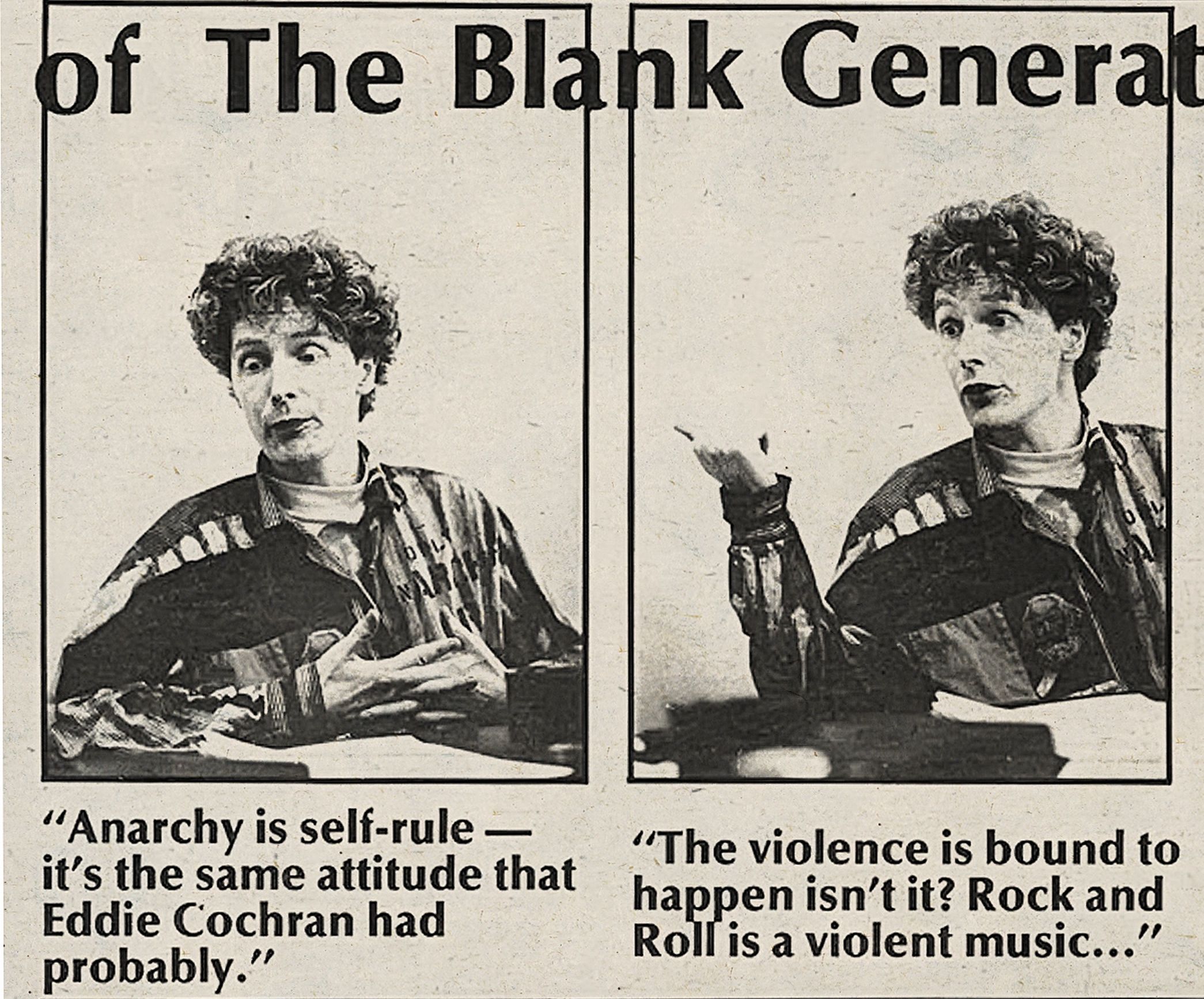
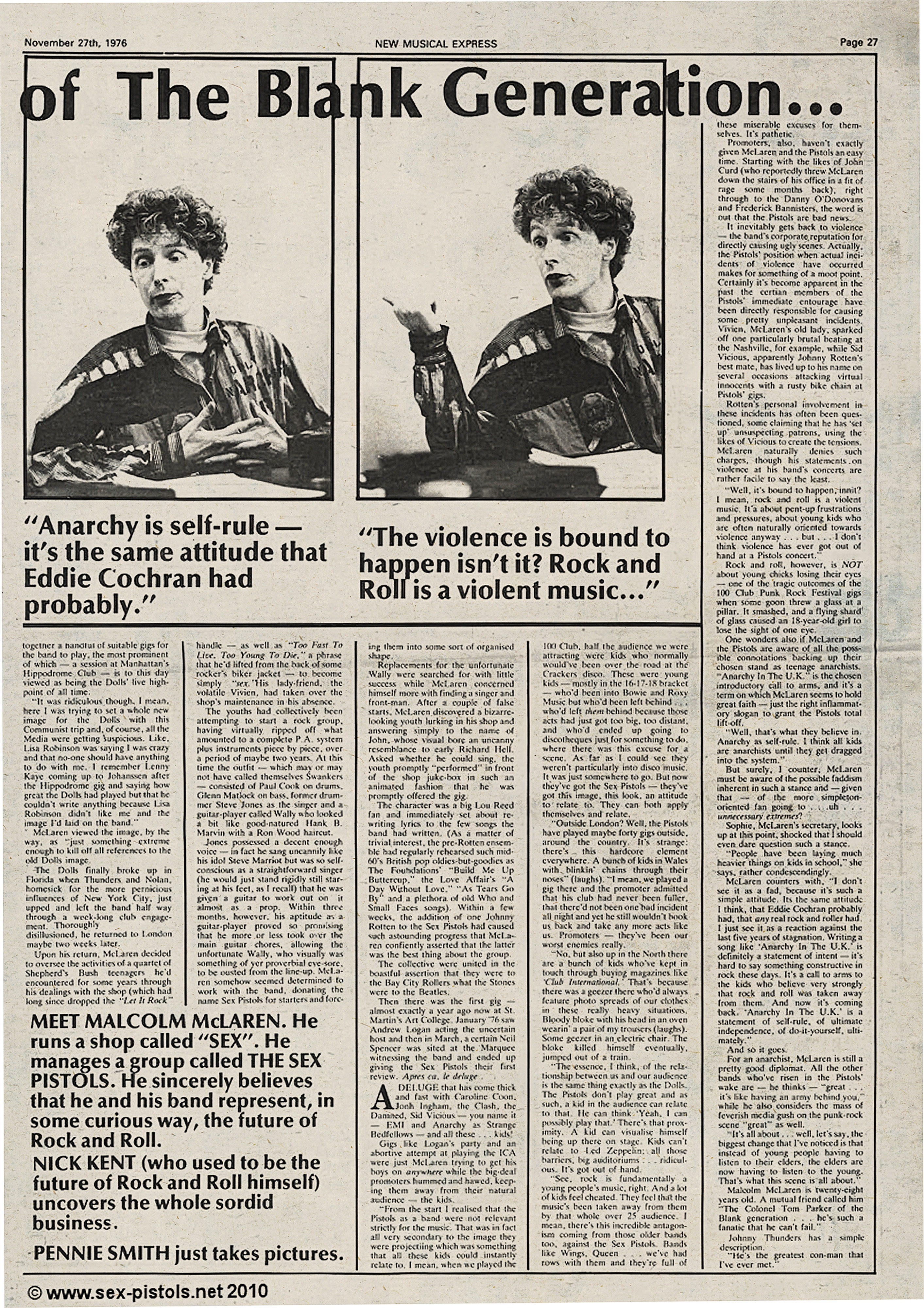
Anarchy is self-rule — it's the same attitude that Eddie Cochran had probably.
The violence is bound to happen isn't it? Rock and roll is a violent music...
There was actually a time when Malcolm McLaren toyed with the idea of fronting the Sex Pistols as a singer. Even took a bunch of singing lessons from a vocal tutor until his old paranoia about him being too old got the better of him and he dropped the whole thing.
This was back in the summer of 1974 when he was up and looking for new directions for rock, having just returned from something like nine years of total disinterest in the contemporary to-ing and fro-ings of the music. He gave up listening to anything new in 1964 after having gotten bored by the Rolling Stones whom he'd followed from their inception in Richmond. This means in effect he missed out on Dylan, the Beatles, the Who, psychedelia, Woodstock, pretty much everything up to the year 1973 when he encountered the New York Dolls who, by his own admission, totally captured my imagination.
His only contact with rock had manifested itself through this nine-year sabbatical in a total commitment to early rock—the stuff the Teds were living for—and while at art school he set about making a film on Billy Fury, who alongside Johnny Kidd, McLaren considered the only bona fide English rocker. It was the financial difficulties which prevented the film's completion that moved McLaren to explore the idea of opening a shop in the King's Road area to deal mainly in old '50s rock records that gave birth to Let It Rock in the early 70s.
A hard-core Teddy boy enterprise, McLaren’s shop gained an ugly reputation for itself as a place where non-ethnic rockers were basically unwelcome. McLaren reminisces:
I remember when Iggy Pop and James Williamson used to come in all the time (the Stooges were at this point based in London, living communally just off the Fulham Road running parallel to the LIR premises, and recording Raw Power) asking for such-and-such a record. I'd tell 'em to get out. I thought they were a couple of bleedin' hippies then.
The Flaming Groovies and the MC5 were also among the clientele of Let It Rock.
It took the Dolls to really turn my head around, so to speak. I mean, one day I'd never heard of 'em before but they all trouped into the shop in their high-heeled shoes and I was immediately impressed by the way they handled themselves. I mean, there were all these Teds hangin' around thinking what the hell are these geezers doing 'ere? But the Dolls didn't care at all. David (Johansen) just went ahead and tried on a drape jacket while Johnny (Thunders) was over by the jukebox looking for some Eddie Cochran records. I was really taken aback.
When McLaren went over to New York later that year (1973) he struck up a friendship with the band, even though he was still totally disinterested in the prospect of seeing them live and even when the band played him an acetate of their first record, he was left initially completely cold by it all.
Then, because we were friends by this time, I decided to go see them when they played at Biba's and even though yet again the music failed to hit me, I was really impressed by the way they carried themselves onstage.
So much so that he followed the band over to witness their concerts in Paris.
It was a gig they did for Luxembourg radio and suddenly I was completely won over. Singlehandedly the Dolls re-opened my awareness for what contemporary rock music had to offer. I must say that as far as I'm concerned they were the group—the single most important rock band.
They were certainly the prime motivators behind what's happening with the Pistols and this whole new punk-rock scene. Most definitely. That's because they were playing straightforward three-minute songs set in urban situations and the other thing—the main thing really—is that the Dolls could never play great. That's what separated them from all the rest. Like, for me, the Dolls are far more relevant than Iggy. To me, Iggy was just a continuation of the Doors, really far more insular and emotionally orientated. It's just unfortunate that with the Dolls, well, they were just too far ahead of their time.
McLaren actually became the Dolls’ manager for something like six months when he returned to New York having tired of the whole London scene temporarily at the outset of 1975. He affirms that he never possessed any conscious plans to manage the group or even to work with them on any level, though one thing led to another and ... well anyway, the Dolls-McLaren liaison is not the happiest of showbusiness sagas for reasons almost too innumerable to deal with in any great detail.
Almost. See, by the beginning of 1975, the New York Dolls’ name and reputation had degenerated so swiftly that it was quite literally impossible to get the band a gig anywhere throughout the United States. McLaren reportedly was forced to finance the band initially by having to resort to menial labour of the lowest variety, e.g. window cleaning.
First, Malcolm had to administer to certain members' personal problems by placing both drummer Jerry Nolan and bassist Arthur Kane into hospitals for detoxification cures—the latter for alcoholism, the former for heroin addiction. This traumatic process completed, he then set about trying to reshape the dreaded image that was currently hanging round the band's neck like an albatross rotting carcass. The New York scene, by this time, had long since tired of the whole platform boots and thrift shop glad rags image in favour of the stark look promoted by current media darlings Television and Patti Smith. McLaren, attempting to formulate a dramatic antidote for the Dolls’ image blight, came up with the extremist notion of allying the band with a heavy Marxist Communist image. The old hammer-and-sickle emblem flag was hung behind the amplifiers while the band were dressed in a uniform of red patent leather.
He also drove the band to come up with virtually a completely new repertoire, utilising the underrated Sylvain Sylvain for most of the melodic impact while Johansen, as ever, responded with the lyrics.
McLaren managed to scrape together a handful of suitable gigs for the band to play, the most prominent of which—a session at Manhattan’s Hippodrome Club—is to this day viewed as being the Dolls’ live high point of all time:
It was ridiculous though. I mean, here I was trying to set a whole new image for the Dolls with this Communist trip and, of course, all the media were getting suspicious. Like, Lisa Robinson was saying I was crazy and that no-one should have anything to do with me. I remember Lenny Kaye coming up to Johansen after the Hippodrome gig and saying how great the Dolls had played but that he couldn't write anything because Lisa Robinson didn't like me and the image I'd laid on the band.
McLaren viewed the image, by the way, as just something extreme enough to kill off all references to the old Dolls image.
The Dolls finally broke up in Florida when Thunders and Nolan, homesick for the more pernicious influences of New York City, just upped and left the band halfway through a week-long club engagement. Thoroughly disillusioned, he returned to London maybe two weeks later.
Upon his return, McLaren decided to oversee the activities of a quartet of Shepherd's Bush teenagers he'd encountered for some years through his dealings with the shop (which had long since dropped the Let It Rock handle as well as Too Fast To Live, Too Young To Die—a phrase that he'd lifted from the back of some rocker's biker jacket—to become simply Sex). His lady-friend, the volatile Vivien, had taken over the shop's maintenance in his absence.
The youths had collectively been attempting to start a rock group, having virtually ripped off what amounted to a complete P.A. system plus instruments piece by piece, over a period of maybe two years. At this time the outfit—which may or may not have called themselves Swankers—consisted of Paul Cook on drums, Glenn Matlock on bass, former drummer Steve Jones as the singer and a guitar-player called Wally who looked a bit like good-natured Hank B. Marvin with a Ron Wood haircut.
Jones possessed a decent enough voice—in fact he sang uncannily like his idol Steve Marriott—but was so self-conscious as a straightforward singer (he would just stand rigidly still staring at his feet, as I recall) that he was given a guitar to work out on almost as a prop. Within three months, however, his aptitude as a guitar-player proved so promising that he more or less took over the main guitar chores, allowing the unfortunate Wally, who visually was something of yer proverbial eyesore, to be ousted from the line-up. McLaren somehow seemed determined to work with the band, donating the name Sex Pistols for starters and forcing them into some sort of organised shape.
Replacements for the unfortunate Wally were searched for with little success while McLaren concerned himself more with finding a singer and frontman. After a couple of false starts, McLaren discovered a bizarre-looking youth lurking in his shop and answering simply to the name of John, whose visage bore an uncanny resemblance to early Richard Hell. Asked whether he could sing, the youth promptly performed in front of the shop jukebox in such an animated fashion that he was promptly offered the gig.
The character was a big Lou Reed fan and immediately set about rewriting lyrics to the few songs the band had written. (As a matter of trivial interest, the pre-Rotten ensemble had regularly rehearsed such mid-60s British pop oldies-but-goodies as the Foundations’ Build Me Up Buttercup, the Love Affair’s A Day Without Love, As Tears Go By and a plethora of old Who and Small Faces songs.) Within a few weeks, the addition of one Johnny Rotten to the Sex Pistols had caused such astounding progress that McLaren confidently asserted that the latter was the best thing about the group.
The collective were united in the boastful assertion that they were to the Bay City Rollers what the Stones were to the Beatles.
Then there was the first gig almost exactly a year ago now at St. Martin's Art College. January ’76 saw Andrew Logan acting the uncertain host and then in March, a certain Neil Spencer was sighted at the Marquee witnessing the band and ended up giving the Sex Pistols their first review. Après ça, le déluge.
A deluge that has come thick and fast with Caroline Coon, Jonh Ingham, The Clash, The Damned, Sid Vicious—you name it—EMI and Anarchy as strange bedfellows and all these kids. Gigs like Logan’s party and an abortive attempt at playing the ICA were just McLaren trying to get his boys on anywhere while the big deal promoters hummed and hawed, keeping them away from their natural audience—the kids.
From the start I realised that the Pistols as a band were not relevant strictly for the music. That was in fact all very secondary to the image they were projecting which was something that all these kids could instantly relate to. I mean, when we played the 100 Club, half the audience we were attracting were kids who normally would've been over the road at the Crackers disco. These were young kids—mostly in the 16–17–18 bracket—who'd been into Bowie and Roxy Music but who'd been left behind... who'd left them behind because these acts had just got too big, too distant, and who'd ended up going to discotheques just for something to do, where there was this excuse for a scene. As far as I could see they weren't particularly into disco music. It was just somewhere to go. But now they've got the Sex Pistols, they've got this image, this look, an attitude to relate to. They can both apply themselves and relate.
Outside London? Well, the Pistols have played maybe forty gigs outside, around the country. It's strange: there's this hardcore element everywhere. A bunch of kids in Wales with blinkin' chains through their noses (laughs). I mean, we played a gig there and the promoter admitted that his club had never been fuller, that there'd not been one bad incident all night and yet he still wouldn't book us back and take any more acts like us. Promoters—they've been our worst enemies really.
No, but also up in the North there are a bunch of kids who've kept in touch through buying magazines like Club International. That's because there was a geezer there who'd always feature photo spreads of our clothes in these really heavy situations. Bloody bloke with his head in an oven wearin' a pair of my trousers (laughs). Some geezer in an electric chair. The bloke killed himself eventually, jumped out of a train.
The essence, I think, of the relationship between us and our audience is the same thing exactly as the Dolls. The Pistols don't play great and as such, a kid in the audience can relate to that. He can think yeah, I can possibly play that. There's that proximity. A kid can visualise himself being up there on stage. Kids can't relate to Led Zeppelin: all those barriers, big auditoriums: ridiculous. It's got out of hand.
See, rock is fundamentally a young people's music, right. And a lot of kids feel cheated. They feel that the music's been taken away from them by that whole over-25 audience. I mean, there's this incredible antagonism coming from those older bands too, against the Sex Pistols. Bands like Wings, Queen—we've had rows with them and they're full of these miserable excuses for themselves. It's pathetic.
Promoters also haven't exactly given McLaren and the Pistols an easy time. Starting with the likes of John Curd (who reportedly threw McLaren down the stairs of his office in a fit of rage some months back), right through to the Danny O'Donovans and Frederick Bannisters, the word is out that the Pistols are bad news. It inevitably gets back to violence—the band's corporate reputation for directly causing ugly scenes. Actually, the Pistols’ position when actual incidents of violence have occurred makes for something of a moot point. Certainly it's become apparent in the past that certain members of the Pistols’ immediate entourage have been directly responsible for causing some pretty unpleasant incidents. Vivien, McLaren’s old lady, sparked off one particularly brutal beating at the Nashville, for example, while Sid Vicious, apparently Johnny Rotten’s best mate, has lived up to his name on several occasions attacking virtual innocents with a rusty bike chain at Pistols gigs.
Rotten’s personal involvement in these incidents has often been questioned, some claiming that he has set up unsuspecting patrons, using the likes of Vicious to create the tensions. McLaren naturally denies such charges, though his statements on violence at his band's concerts are rather facile to say the least.
Well, it's bound to happen, innit? I mean, rock and roll is a violent music. It's about pent-up frustrations and pressures, about young kids who are often naturally oriented towards violence anyway but... I don't think violence has ever got out of hand at a Pistols concert.
Rock and roll, however, is not about young chicks losing their eyes—one of the tragic outcomes of the 100 Club Punk Rock Festival gigs when some goon threw a glass at a pillar. It smashed, and a flying shard of glass caused an 18-year-old girl to lose the sight of one eye.
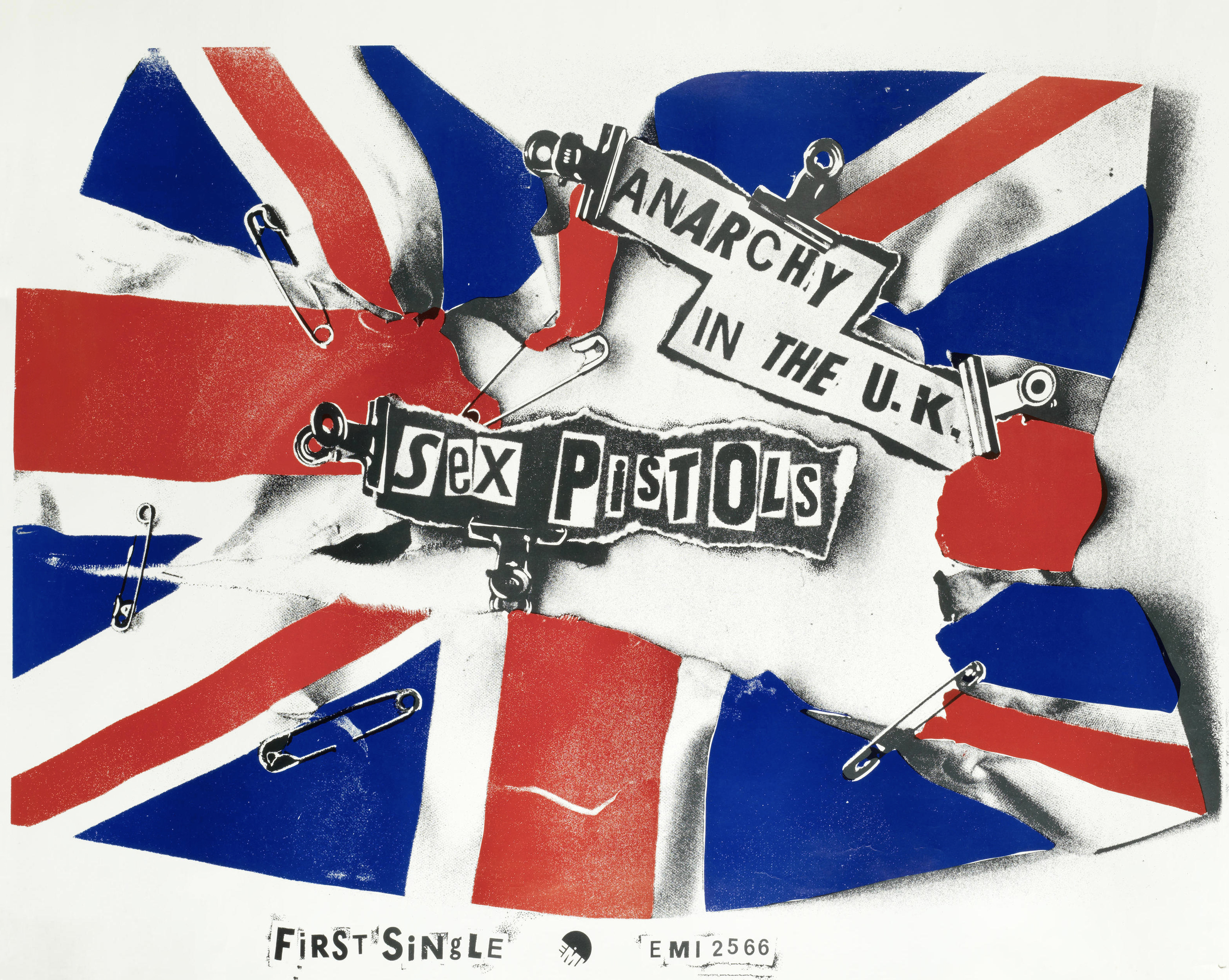
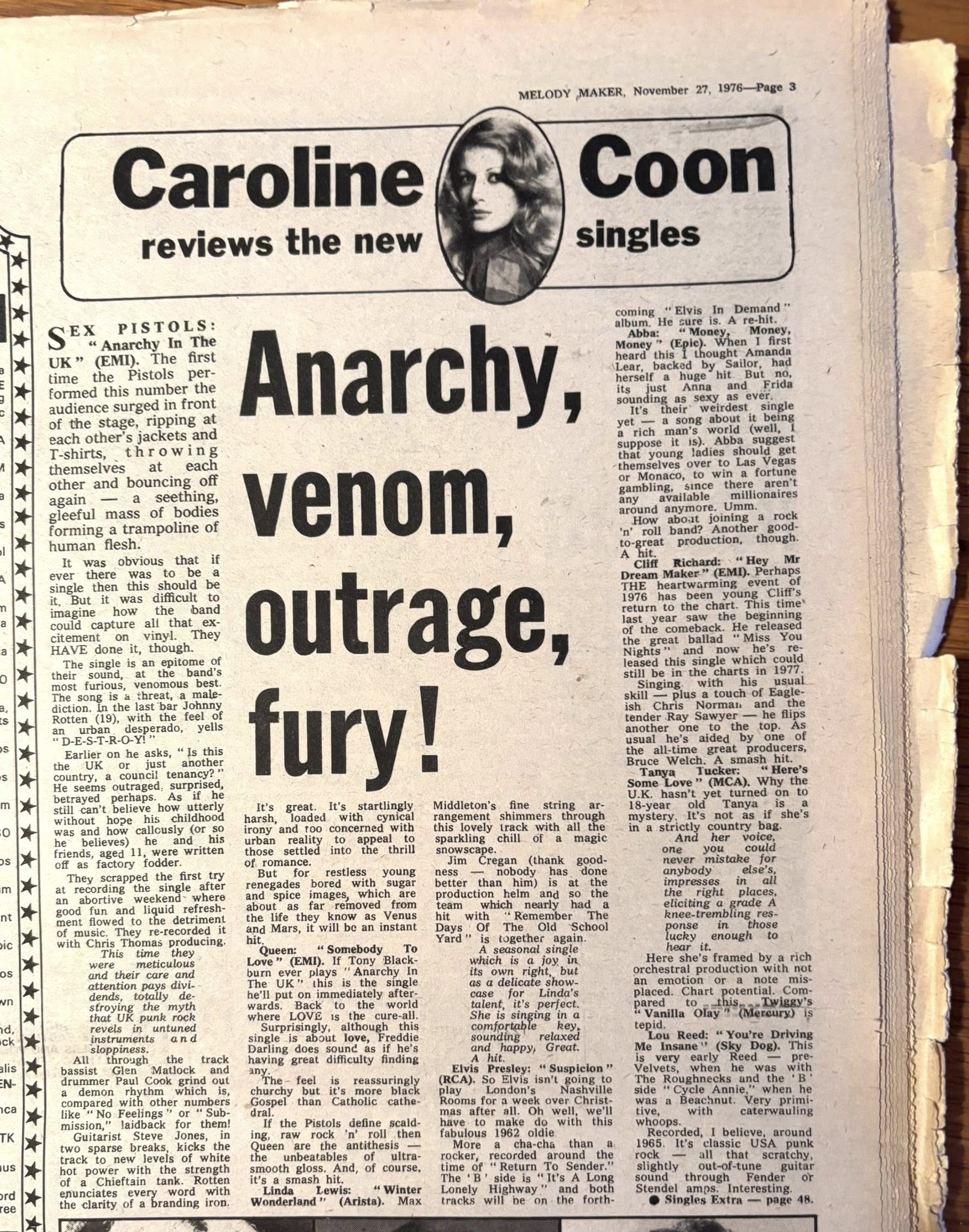
One wonders also if McLaren and the Pistols are aware of all the possible connotations backing up their chosen stand as teenage anarchists. Anarchy in the U.K. is the chosen introductory call to arms, and it's a term on which McLaren seems to hold great faith—just the right inflammatory slogan to grant the Pistols total lift-off.
Well, that's what they believe in. Anarchy as self-rule. I think all kids are anarchists until they get dragged into the system.
But surely, I counter, McLaren must be aware of the possible faddism inherent in such a stance and—given that—of the more simpleton-oriented fan going to unnecessary extremes?
Sophie, McLaren’s secretary, looks up at this point, shocked that I should even dare question such a stance. People have been laying much heavier things on kids in school, she says, rather condescendingly.
McLaren counters with: I don't see it as a fad, because it's such a simple attitude. It's the same attitude, I think, that Eddie Cochran probably had, that any real rock and roller had. I just see it as a reaction against the last five years of stagnation. Writing a song like 'Anarchy in the U.K.' is definitely a statement of intent. It's hard to say something constructive in rock these days. It's a call to arms to the kids who believe very strongly that rock and roll was taken away from them. And now it's coming back. 'Anarchy in the U.K.' is a statement of self-rule, of ultimate independence, of do-it-yourself, ultimately.
And so it goes.
For an anarchist, McLaren is still a pretty good diplomat. All the other bands who've risen in the Pistols’ wake he thinks are great... it's like having an army behind you, while he also considers the mass of feverish media gush on the punk-rock scene great as well.
It's all about... well, let's say, the biggest change that I've noticed is that instead of young people having to listen to their elders, the elders are now having to listen to the young. That's what this scene is all about.
Malcolm McLaren is twenty-eight years old. A mutual friend called him the Colonel Tom Parker of the Blank Generation. He's such a fanatic that he can't fail.
Johnny Thunders has a simple description.
He's the greatest con-man that I've ever met.
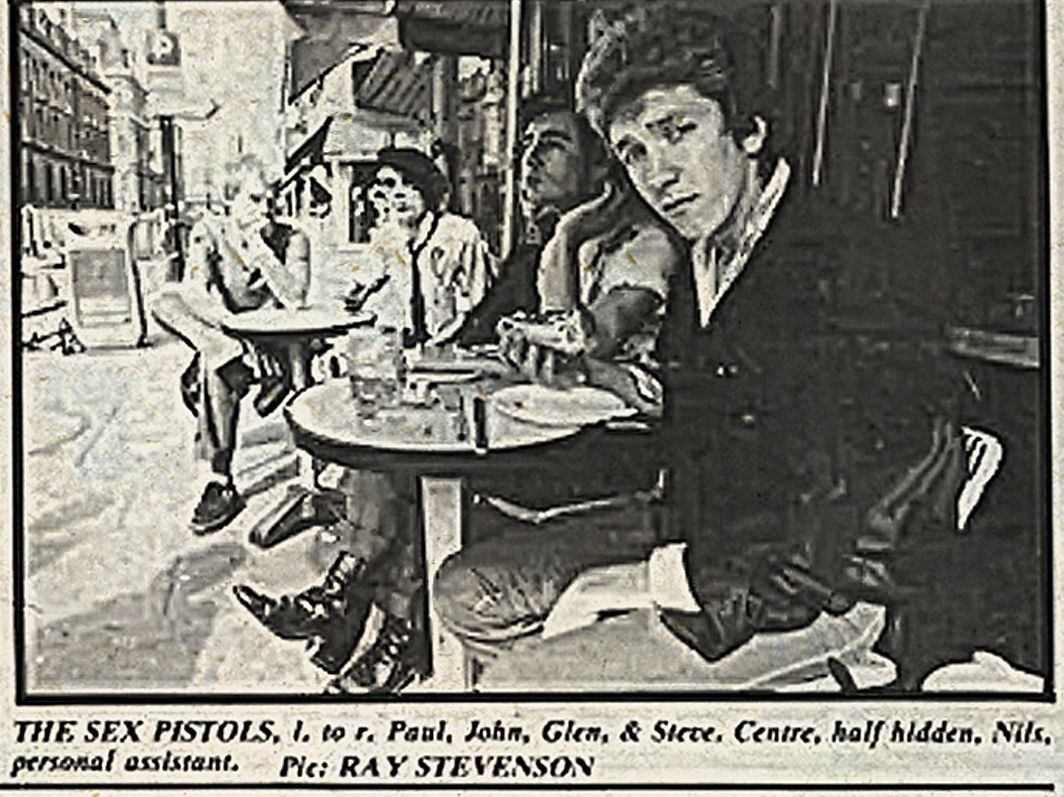
PHOTO: THE Sex Pistols, l to r. Paul, John, Glen, & Steve. Centre, half hidden. Nils, personal assistant. Pic: Ray Stevenson
New Musical Express | November 27th, 1976 | Page 26 & Page 27


.jpg)

%20nme%20nov%201976/1976%20SEX%20PISTOLS%20-%20DAMNED%20-%20CLASH%20(%20early%20daze%20)%20nme%20nov%201976.jpg)