18 March 1977

White Riot 7"


INDEX
Intro
Release
Adverts
Posters
Snippets
UK Articles
US Articles
International Articles

Fanzines
Books
Social Media
Sundry
Photos


Release

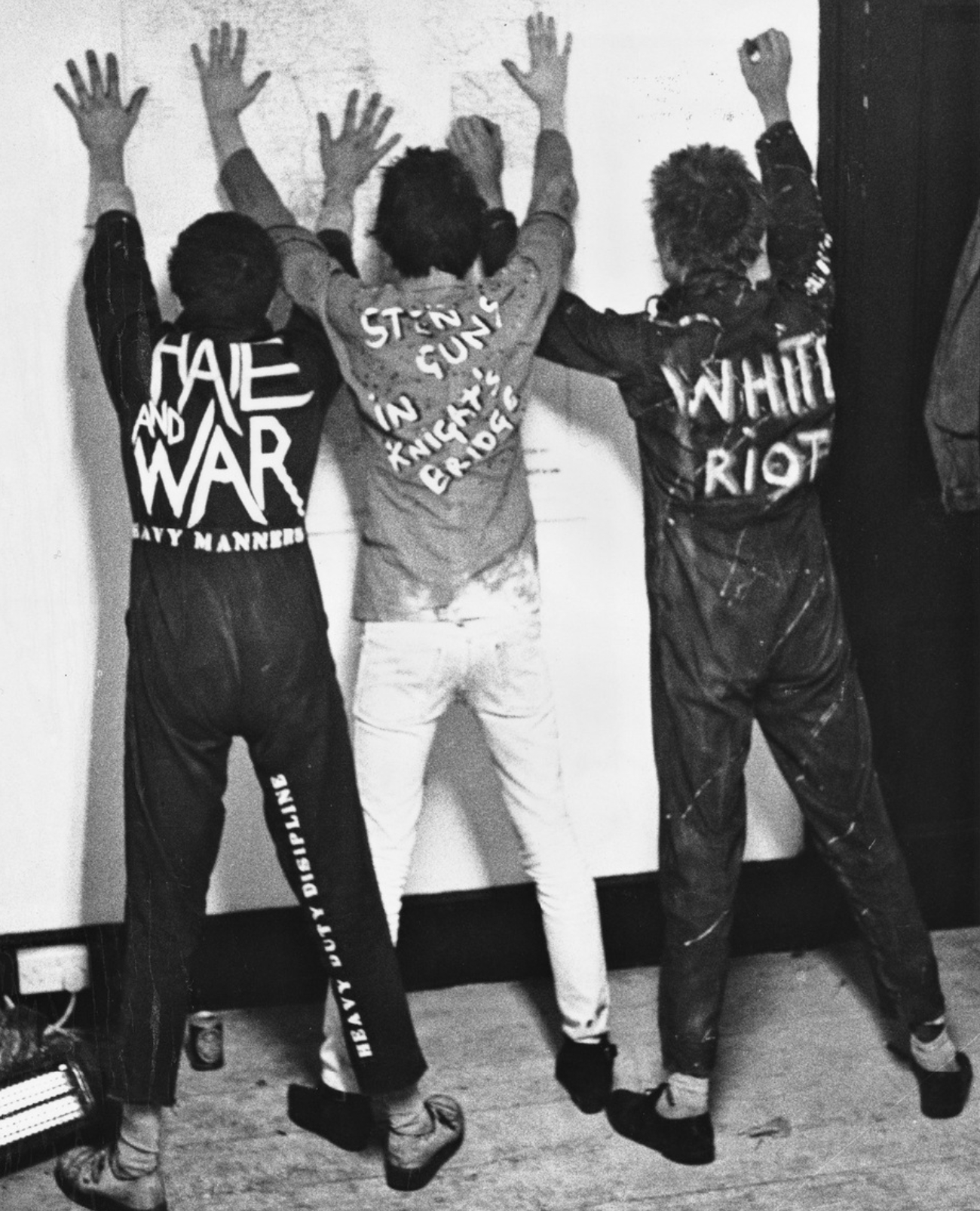
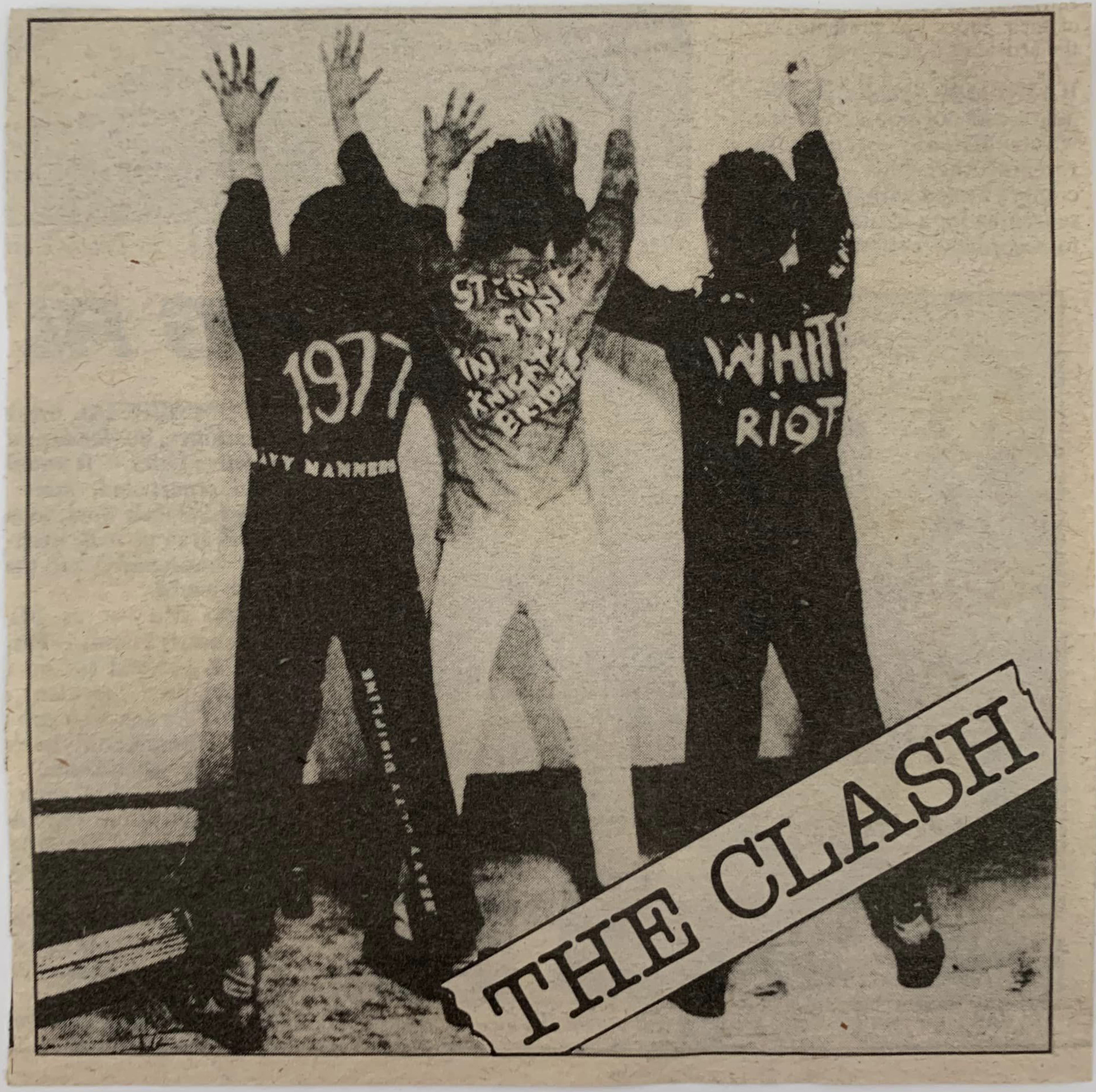
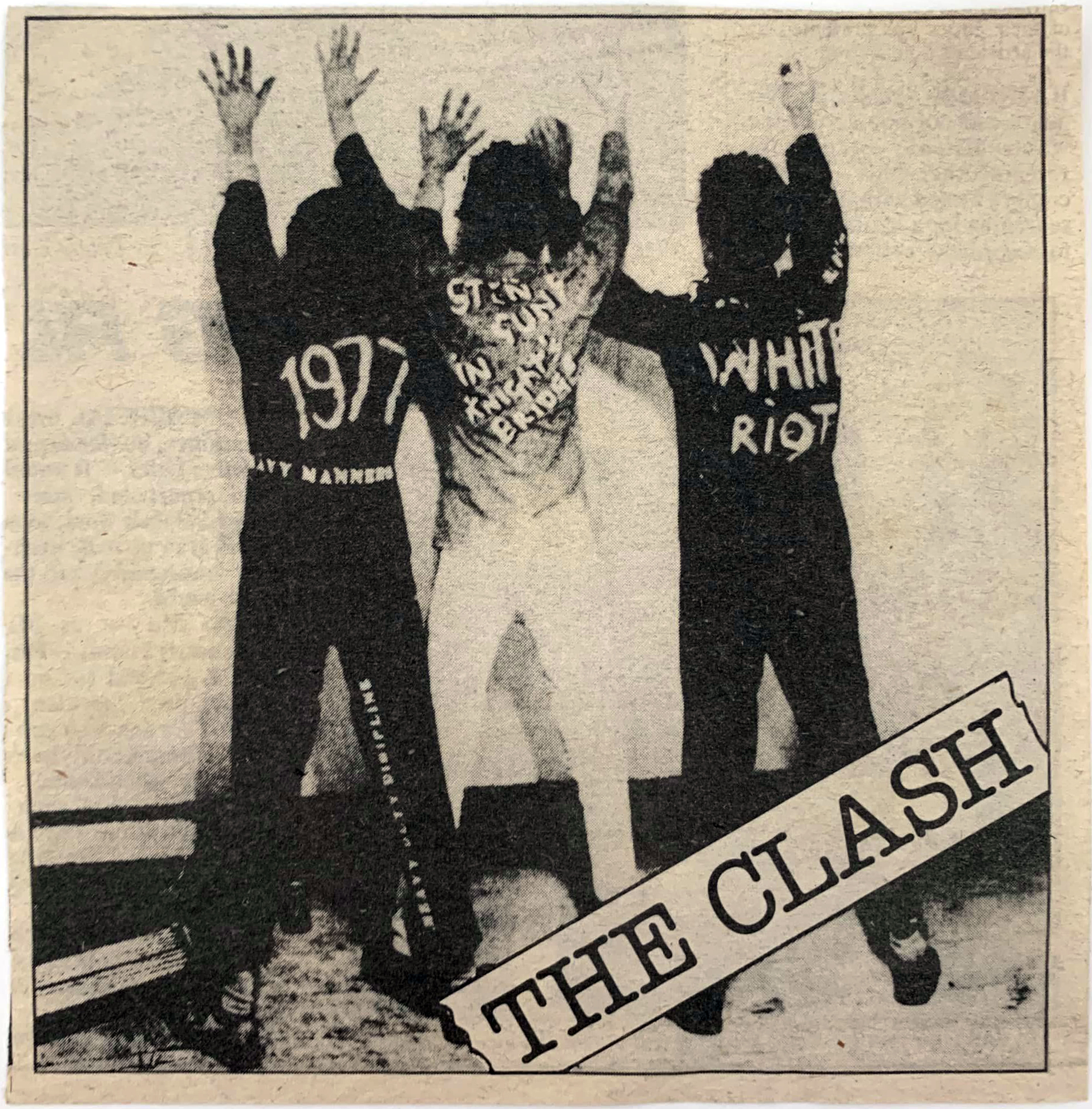
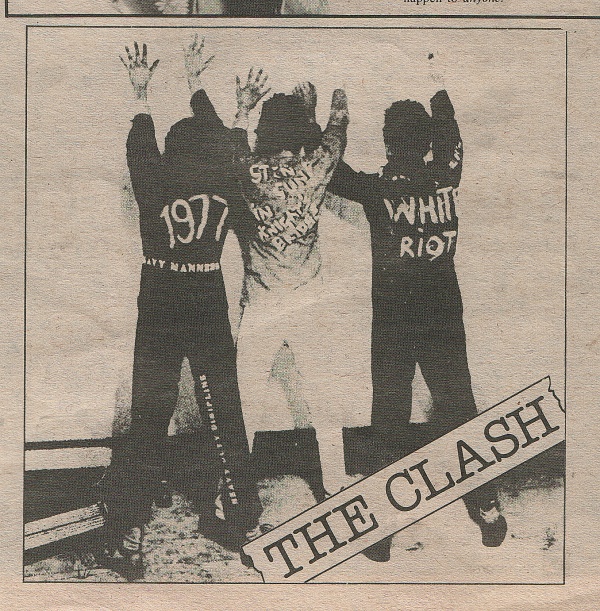
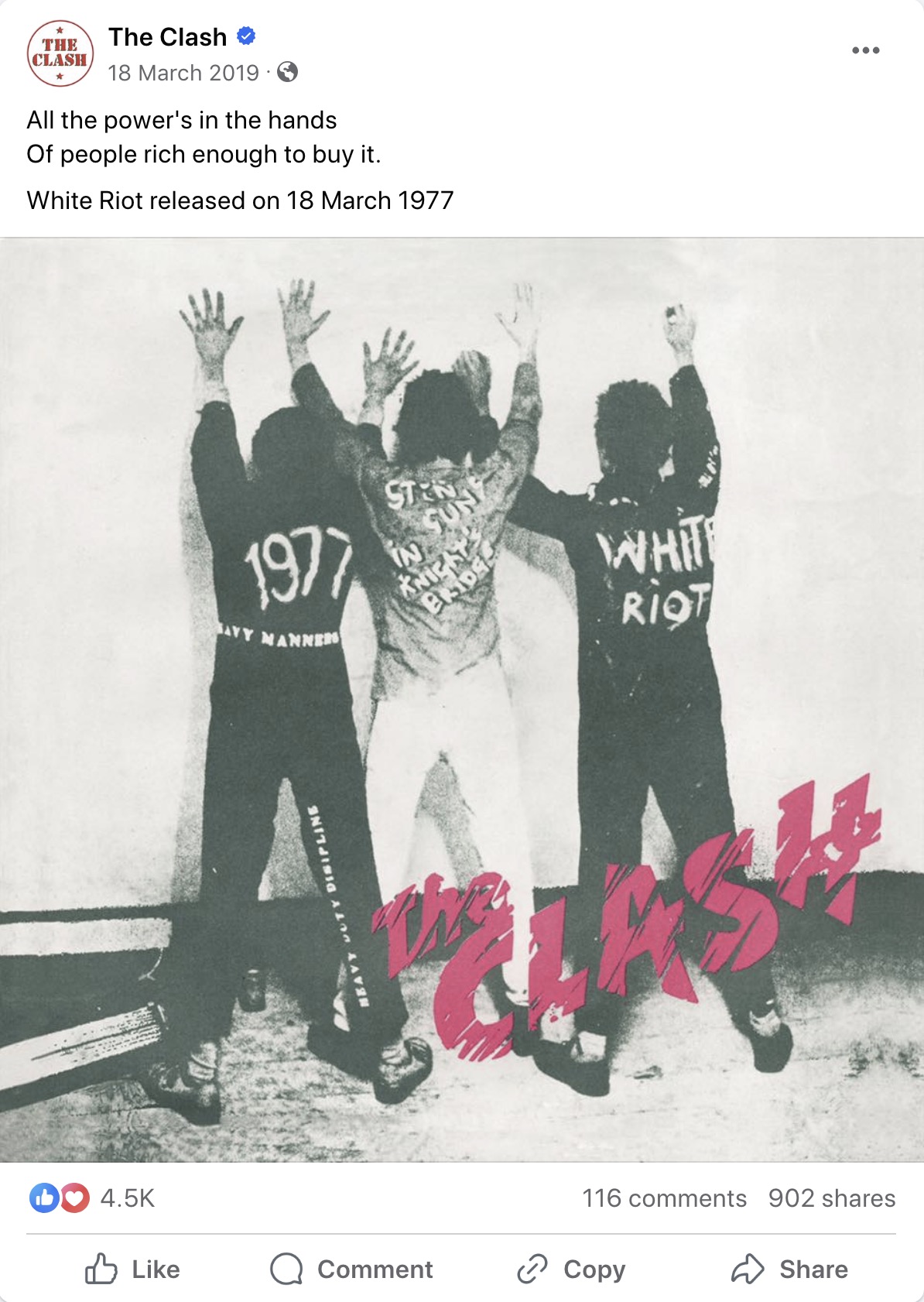
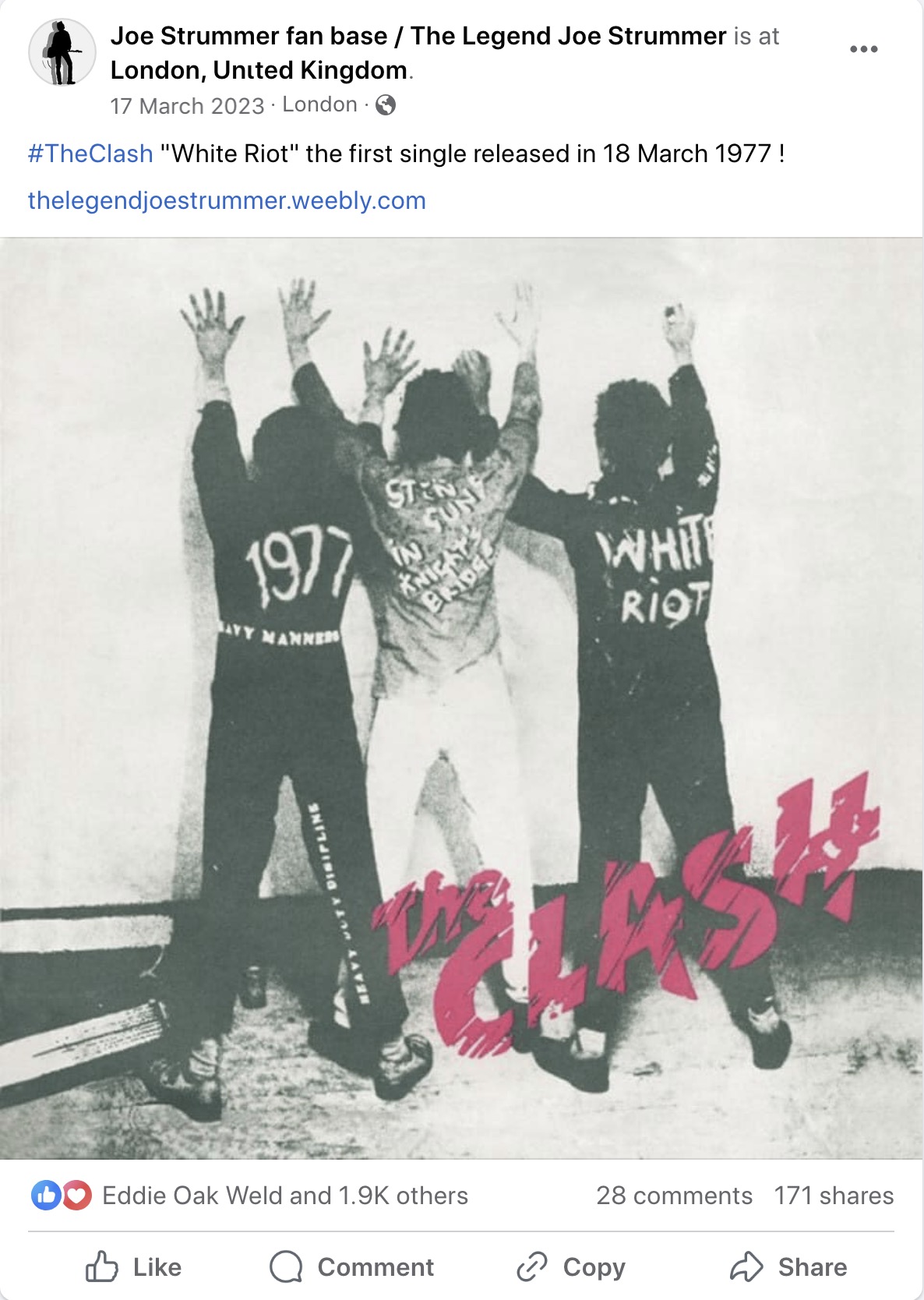
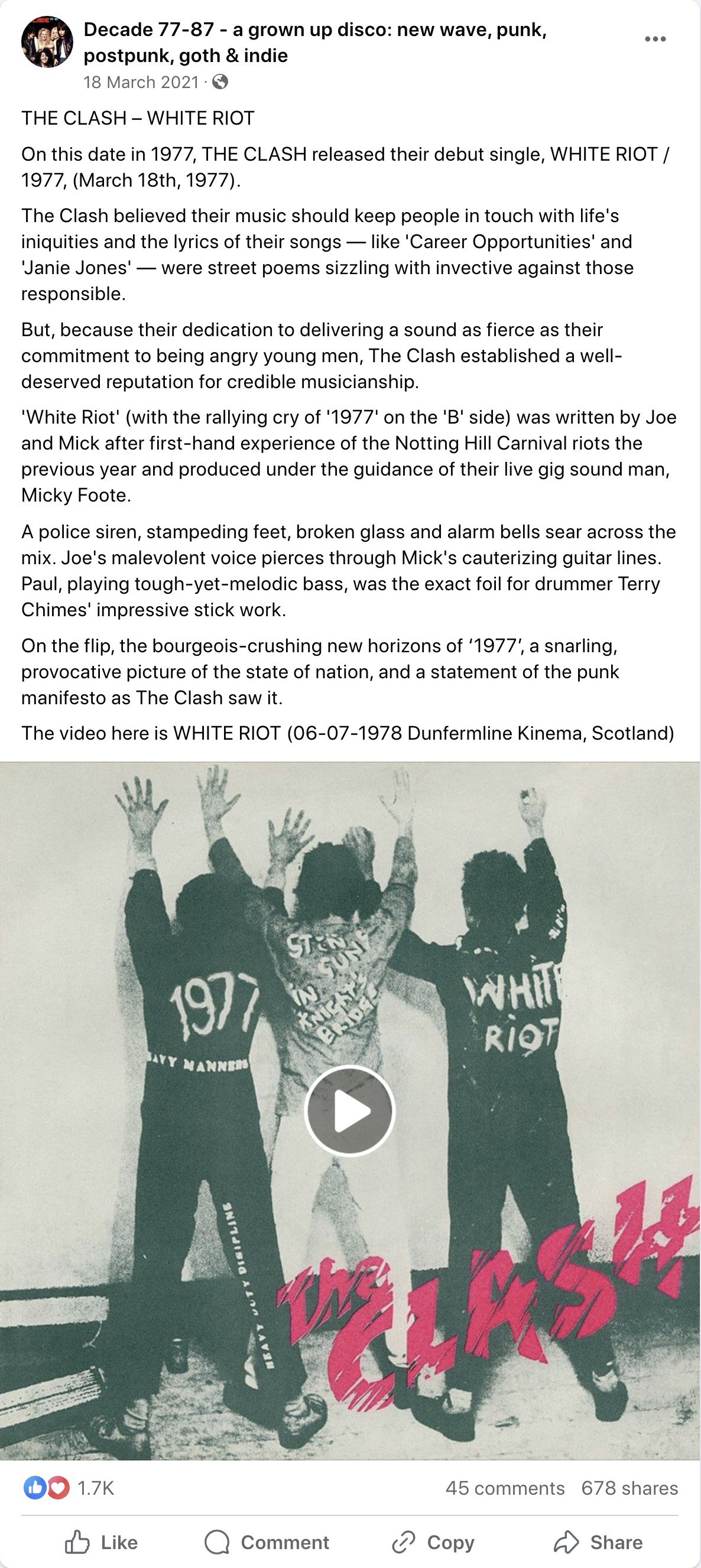
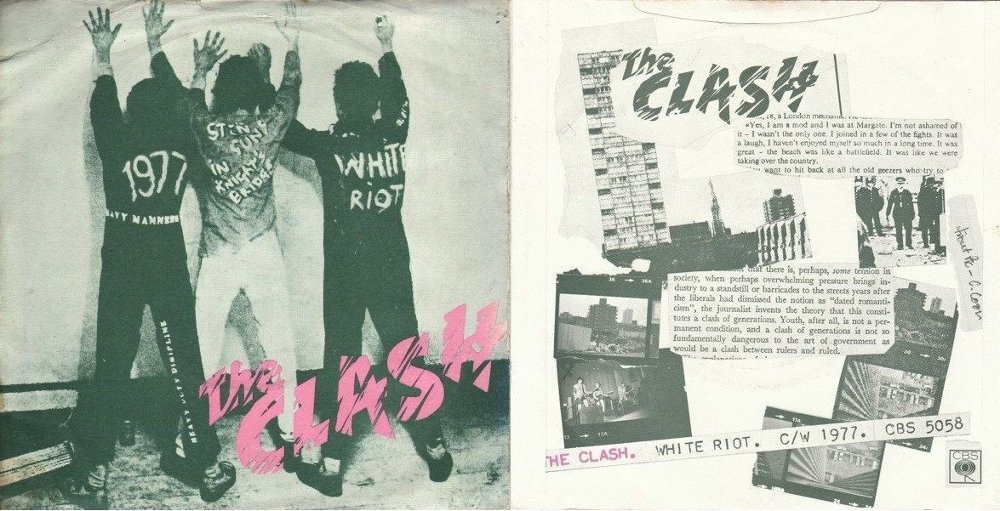
1976 the cover photo for the single "White Riot"

Taken by Caroline Coon at the band's rehearsal studio in Camden Town.
The Clash | Facebook - lots of comments
©Caroline Coon/CAMERA PRESS @centre_for_british_photography


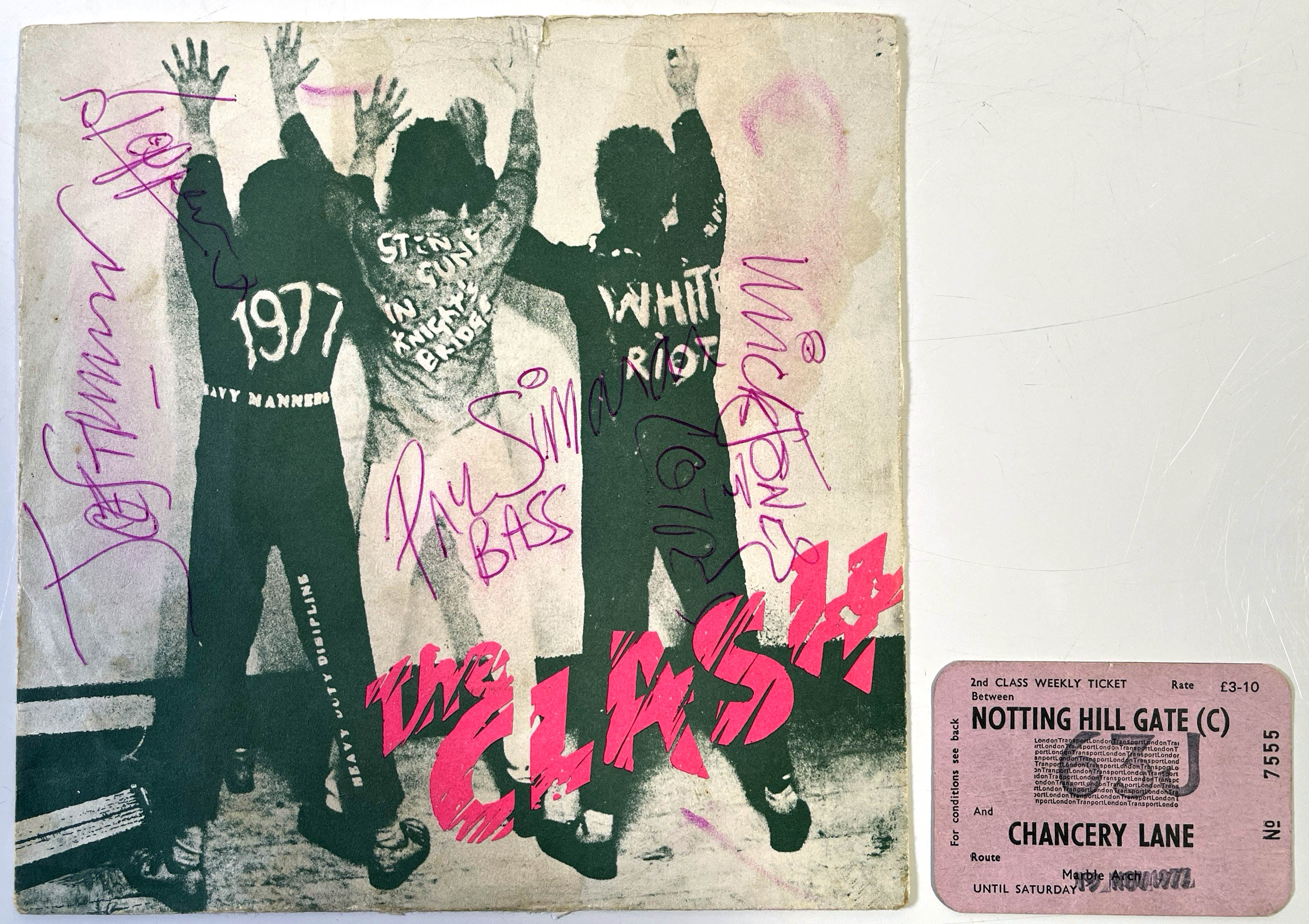
Autographed White Riot single 7"


7" single signed


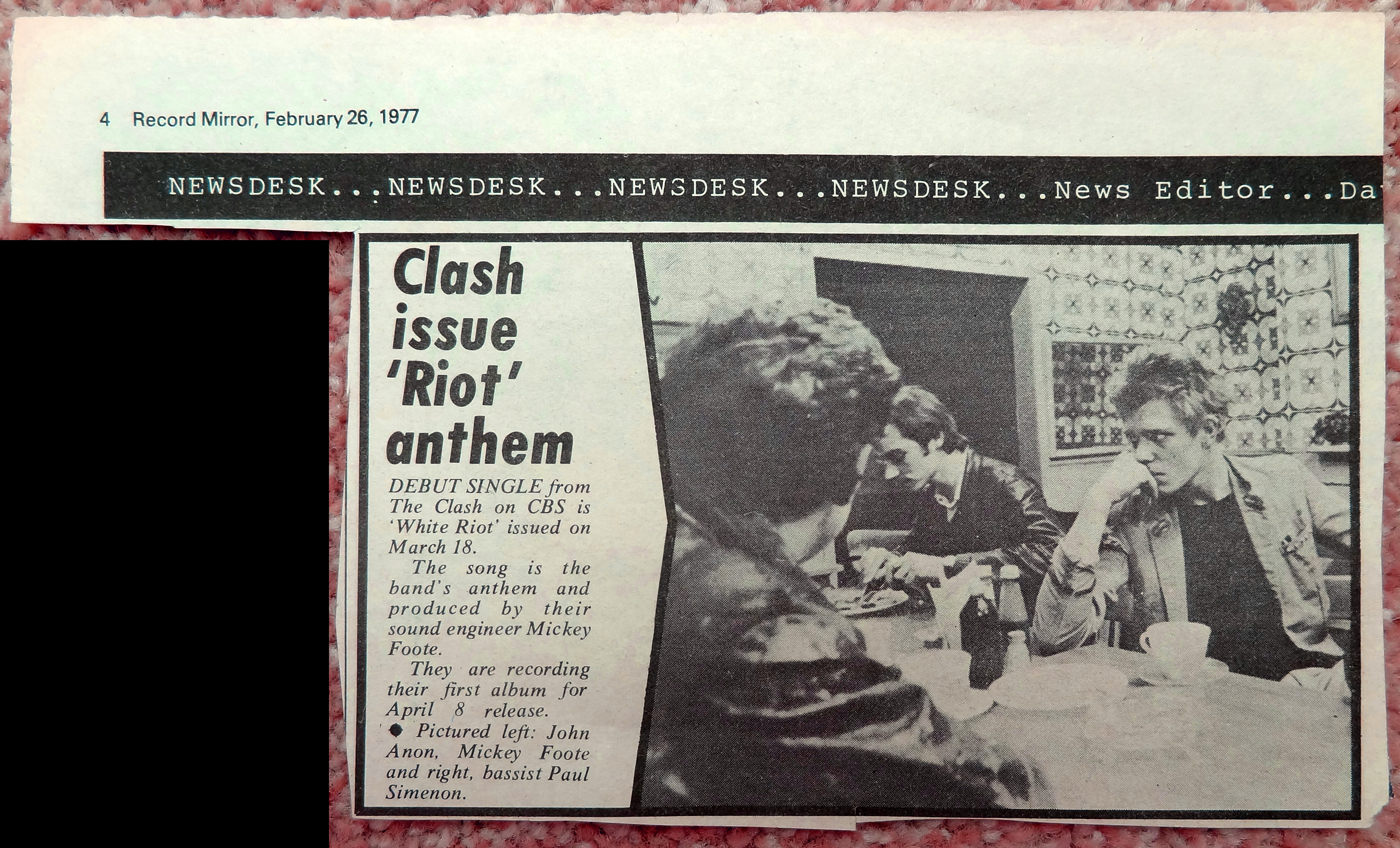
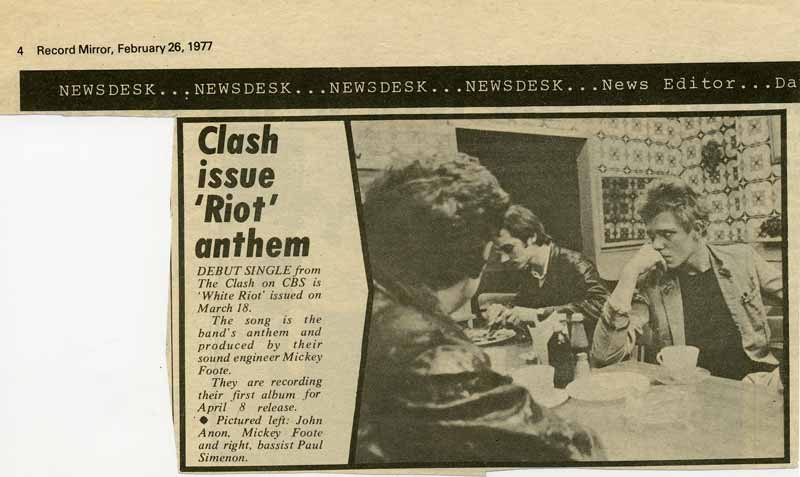
Record Mirror 26 February 1977

Clash issue 'Riot' anthem

Link or full edition

 border=


Link

 border=

Back to the top


Adverts

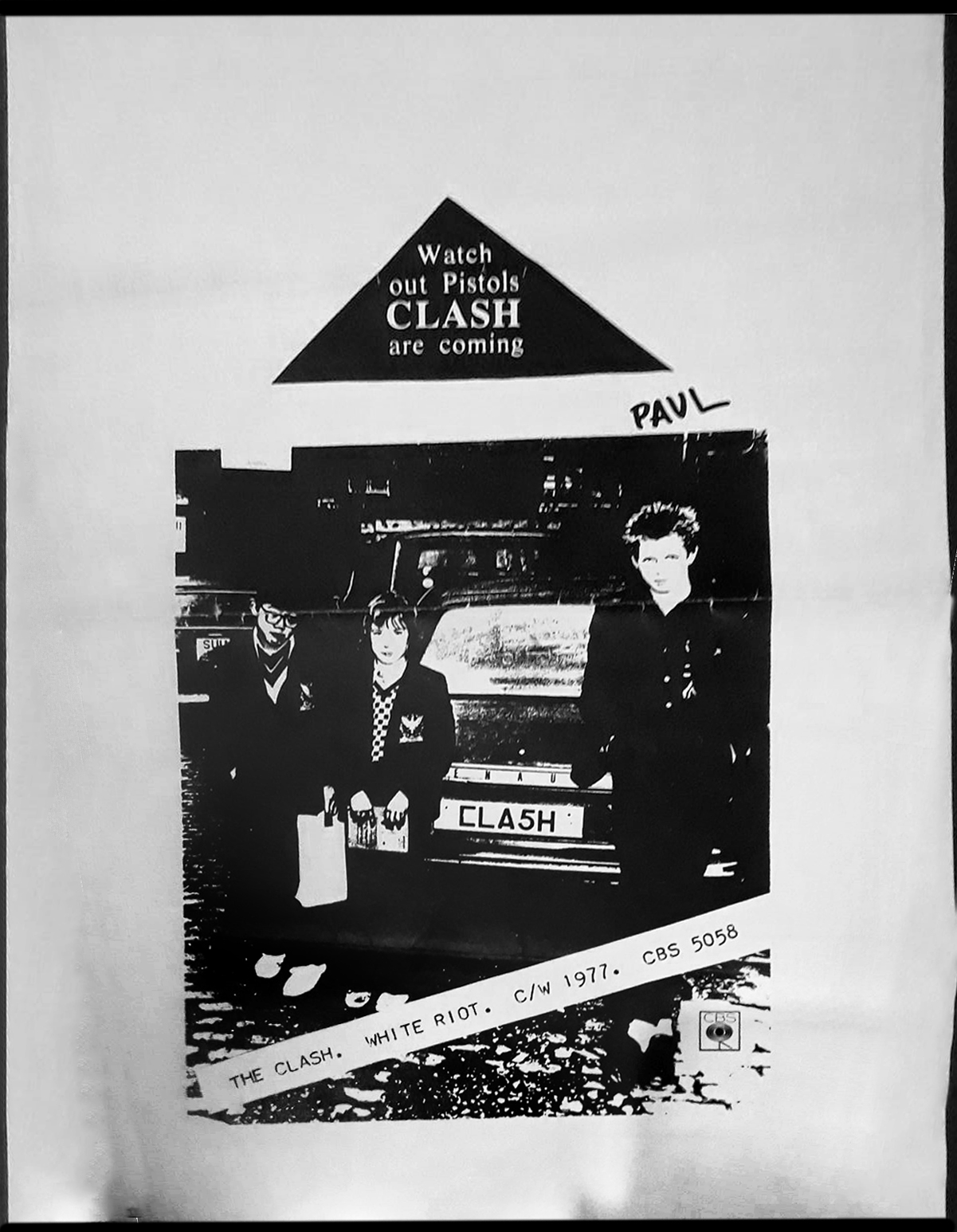
Watch out Pistols, The Clash are coming White Riot flyer

THE CLASH ON PAROLE | Facebook - https://www.facebook.com/


Adverts


Clash City Collectors | Facebook


Clash City Collectors | Facebook
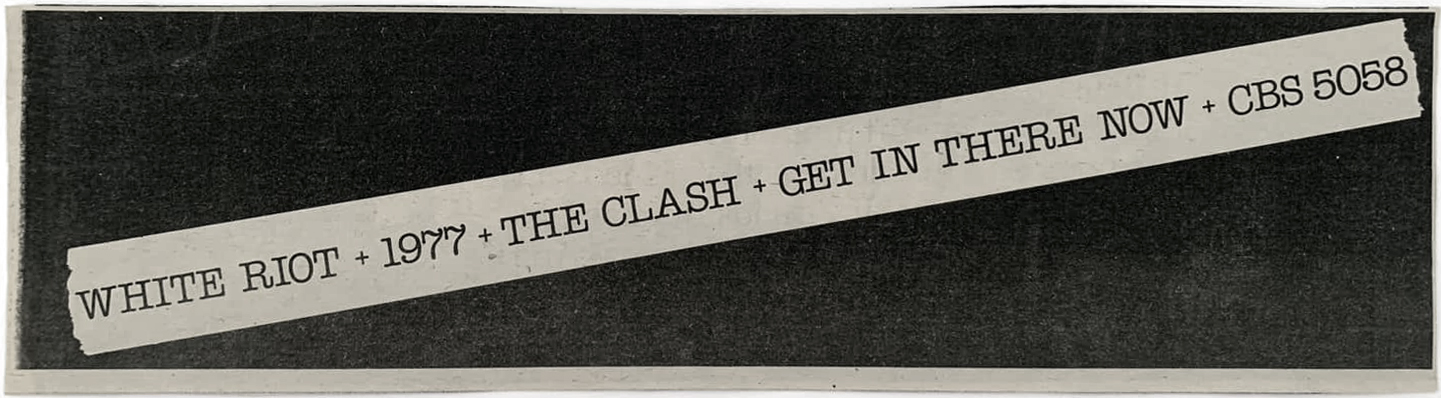
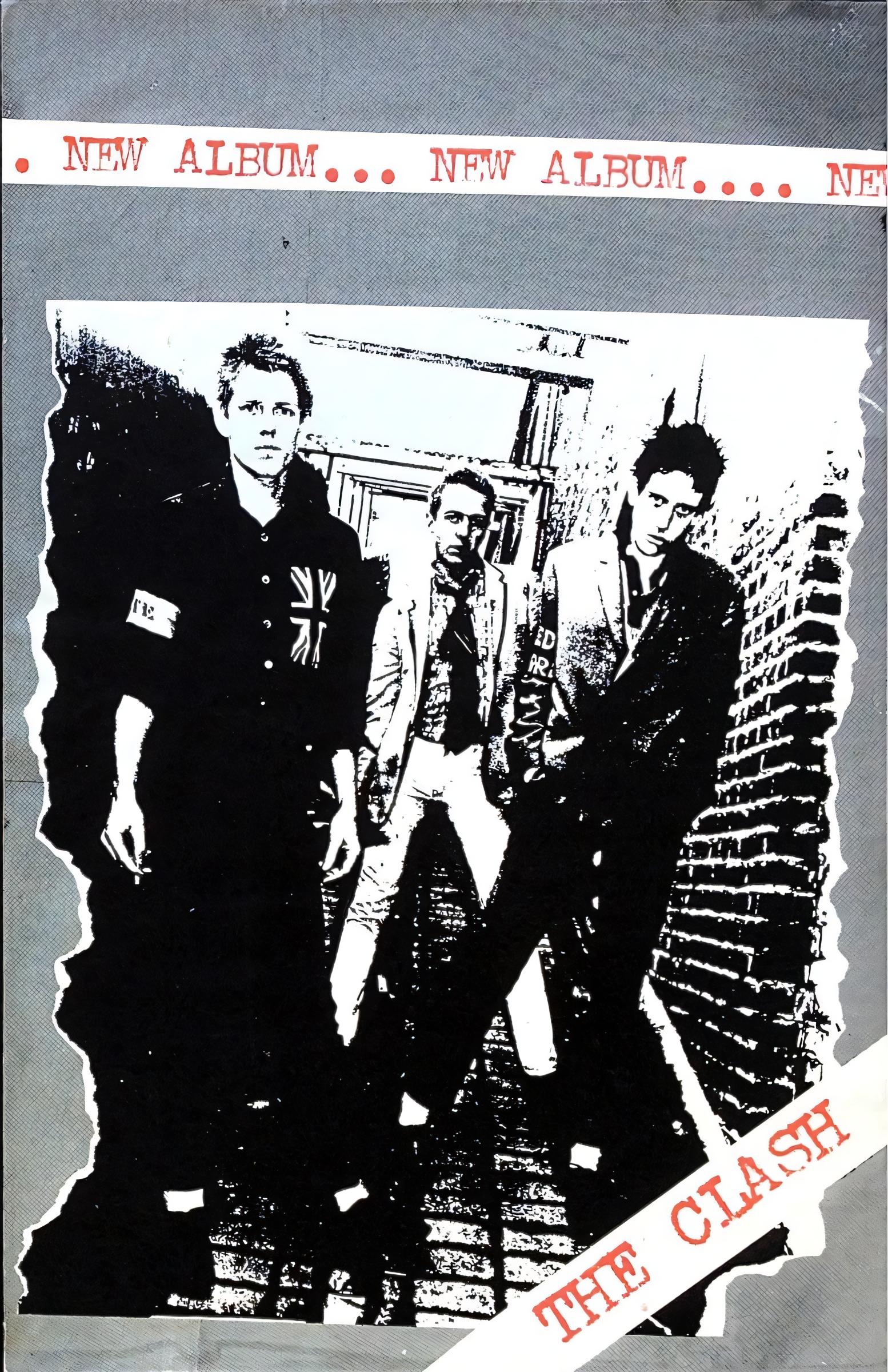
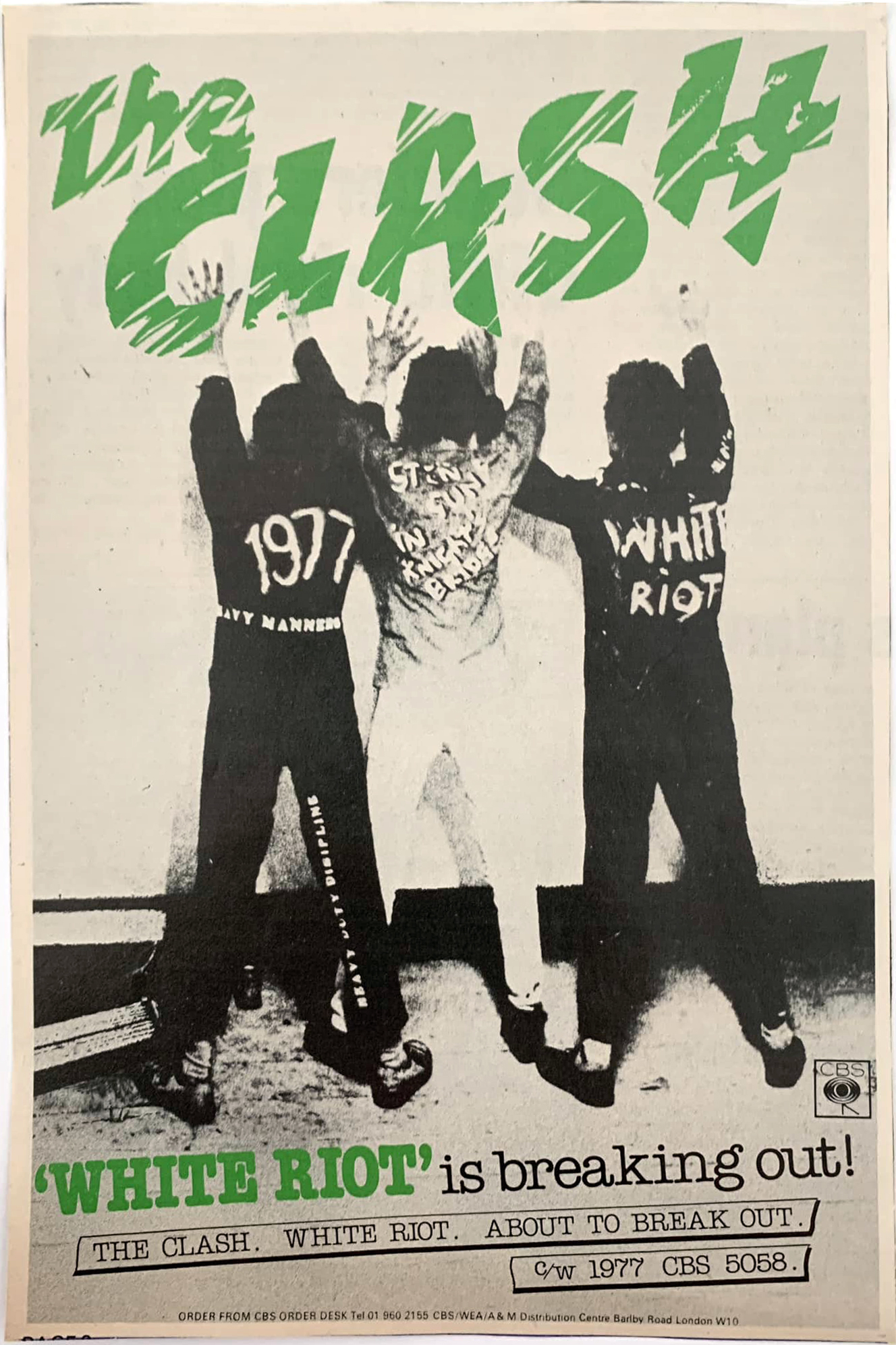
Pre Order advert for Record Shops, before the 18 March 1977 release date


Enlarge image

 border=


White Riot Tour dates full page advert

 border=

Back to the top


Posters

 border=


 border=


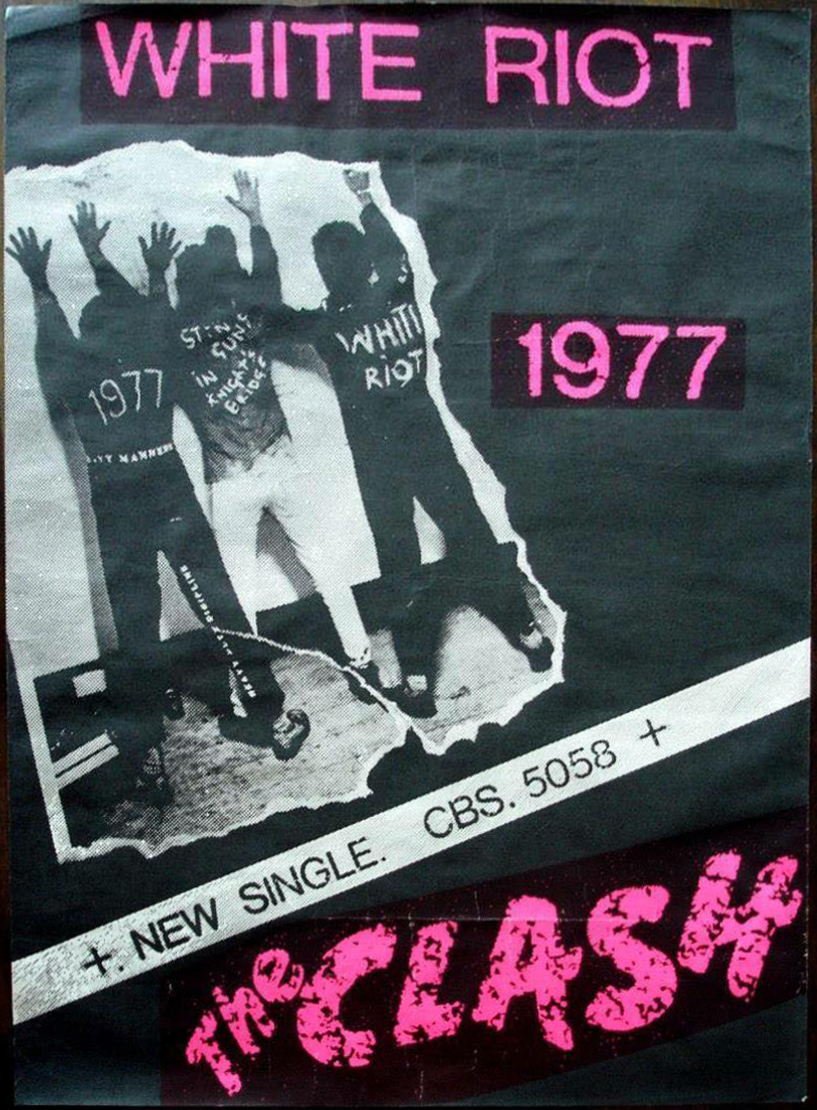
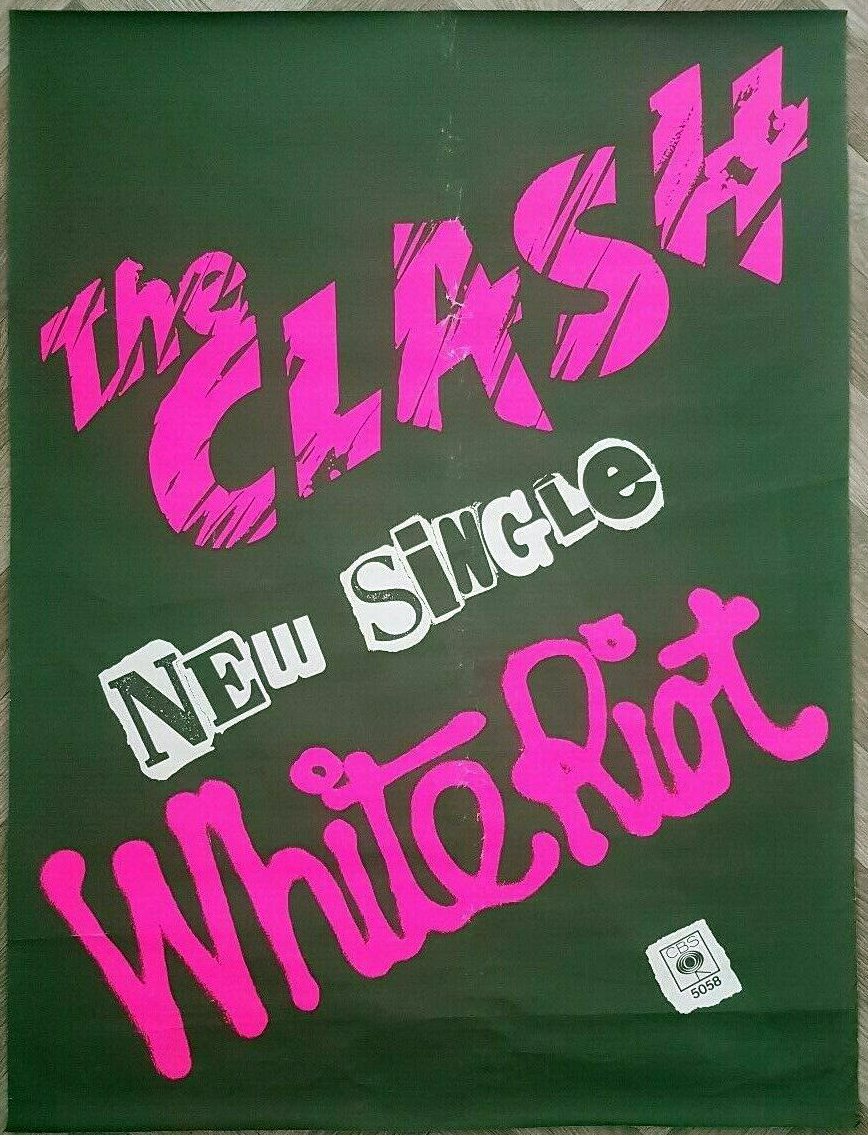
Original 1977 CBS Records UK Promo Poster

 border=

Back to the top


Snippets

Smash Hits

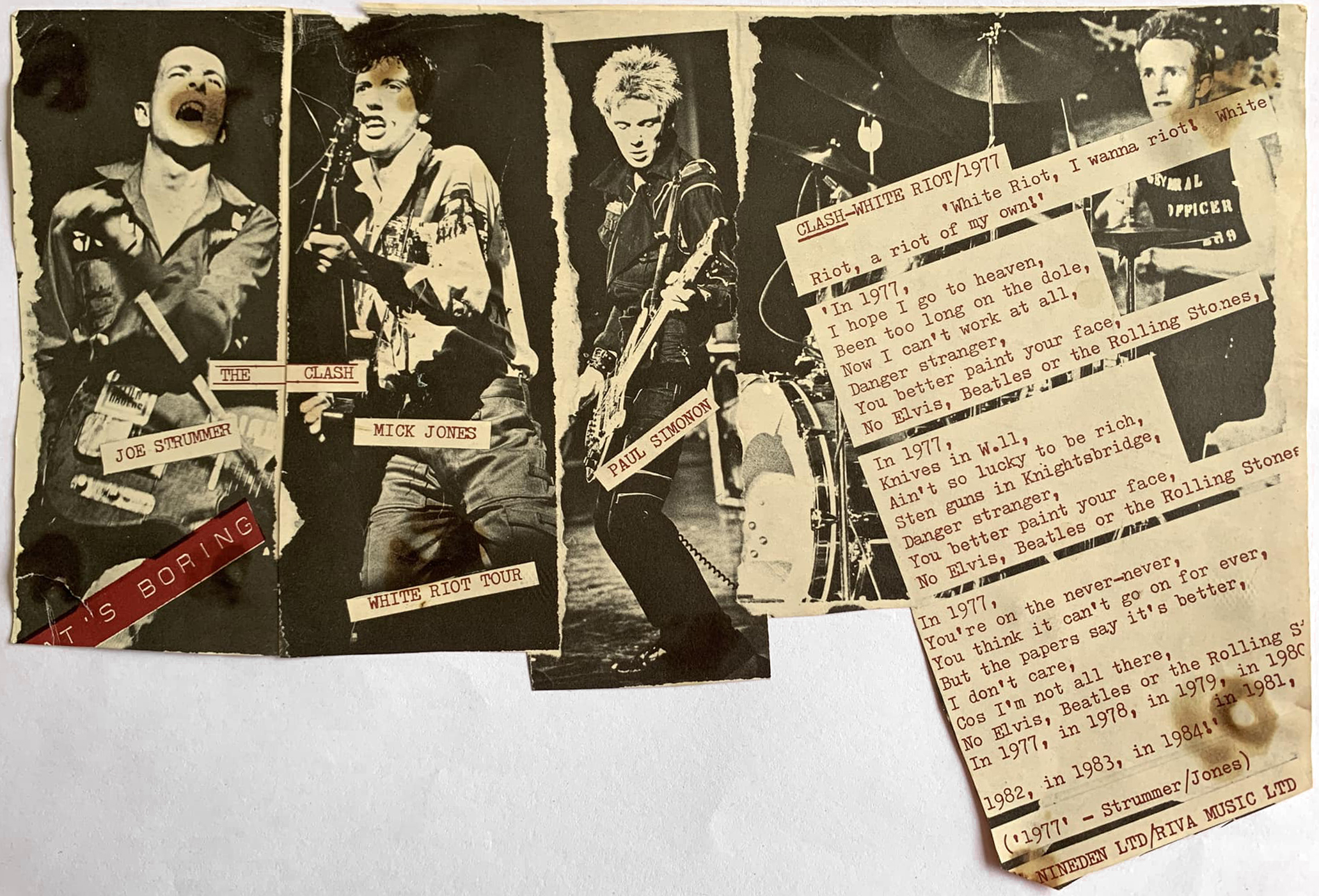
White Riot lyrics

 border=

 border=


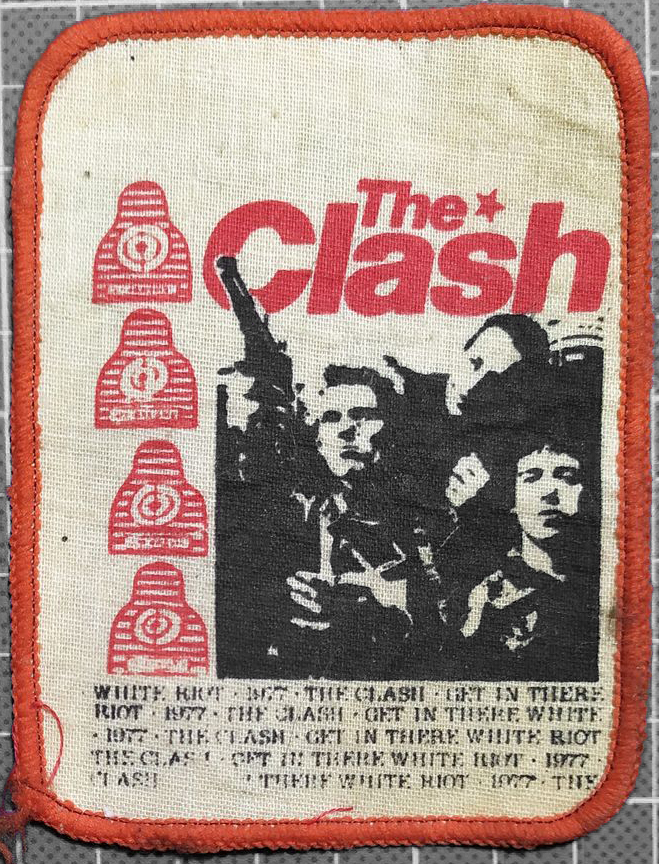
'White Riot' patch

Punk Memorabilia For Sale Or Trade | Facebook
facebook.com/


ULTIMATE CLASSIC ROCK, ultimateclassicrock.com, The Clash, ‘White Riot’ — Lyrics Uncovered

The Clash, 'White Riot' — Lyrics Uncovered

The lyrics to 'White Riot' sprouted from the real-life experience of singer-guitarist Joe Strummer and bassist Paul Simonon as observers of the riots at London's Notting Hill Carnival in 1976. The pair witnessed the confrontation, in which black youths clashed with police officers because they felt they were constantly being harassed.

The Clash, 'White Riot' — Lyrics Uncovered

Chris Moorhouse / Evening Standard, Getty Images

Just like their name suggests, the Clash were never a band to back down from a fight. With their very first single, 1977's 'White Riot,' the legendary British punk rockers came out swinging.

The lyrics to 'White Riot' sprouted from the real-life experience of singer-guitarist Joe Strummer and bassist Paul Simonon as observers of the riots at London's Notting Hill Carnival in 1976. The pair witnessed the confrontation, in which black youths clashed with police officers because they felt they were constantly being harassed.

Strummer left the event wondering why young white people didn't have the same courage to fight the establishment: "Black man gotta lot a problems / But they don't mind throwing a brick / White people go to school / Where they teach you how to be thick."

Many people originally misconstrued the tune as a call for a race war, but a deeper look into the lyrics makes it clear that the song is a call to action: "All the power's in the hands / Of people rich enough to buy it / While we walk the street / Too chicken to even try it."

'White Riot' set the tone for the Clash's modus operandi during their short, but prolific existence, as many of the band's songs had anti-establishment themes. One verse in particular served as a message the group would repeat in varied fashions throughout it's career: "Are you takin' over? / Or are you takin' orders? / Are you goin' backwards? / Or are you goin' forwards?"

In November 2002, after not playing live together for nearly 20 years, singer-guitarist Mick Jones joined Strummer onstage in London to perform three Clash songs, including 'White Riot.' Sadly, about a month later, Strummer died of a heart attack. Three months after that, the Clash were inducted into the Rock and Roll Hall of Fame.

Watch The Clash's Joe Strummer and Mick Jones Performing 'White Riot' in 2002


Bonhams Auctions

THE CLASH - WHITE RIOT. Hand annotated lyrics1977. 33 by 21 centimetres.

Annotated song lyrics, original. Typed lyric sheets for the song 'White Riot' by the Clash - the sheet includes handwritten additions by Joe Strummer c.1977.

Originally given to by the group to their one time manager, Caroline Coon, when compiling her '1984-The Punk Explosion' book, in 1977.

A facsimile letter of provenance by Caroline Coon, plus additional provenance from renowned music memorabilia specialist's. Originally from the archive of the writer and Clash manager, Caroline Coon (DECEMBER 2010, BONHAMS)

These are the songs that became the tracks for the Clash's eponymously-titled album. Some lyric sheets were typed by Strummer and were annotated/amended as detailed above for Caroline Coon so that she could quote them in articles she was writing for Melody Maker, prior to the tracks being recorded, for her book, '1988 The New Wave Punk Rock Explosion' (1977), and also for the first Clash songbook which she was helping to produce.

Included in the lot is her press pass for the 'Anarchy In The UK' tour gig at Leeds Poly Assembly Hall, 6th December 1977: some of the lyrics were annotated backstage at various venues.

Back to the top


UK Articles

Sounds 19th, March 1977

The Clash single of the week 'White Riot'

Enlarge image


New Musical Express, 19 March 1977

The answer is a brick

The Clash: White Riot/1977 (CBS).

Last year's words belong to last year's language and next year's words wait for another voice. Look out, listen, can you hear it?

NME 19 March 1977

The answer is a Brick

The Clash: White Riot/1977 (CBS).

Last year's words belong to last year's language and next year's words wait for another voice. Look out, listen, can you hear it?

It's pointless to categorise this with the other records: "White Riot" isn't a poxy single of the week, it's the first meaningful event all year. Try and discount it. Go on, say they sold out to the enemy at CBS, say it's another idle London fad irrelevant to the lives of working people, say it's all a clever hype that's conned everyone, say it's just the 60s rehashed and you can't make out the words.

Say what you like, you still can't discount it coz The Clash aren't just a band, and this is more than just a single. There's a book written by a trad fan in 1963 saying how shoddy The Beatles were, how ripped off from R'n'B, how they could never last in the world of Tin Pan Alley. They didn't last in it, they took it to pieces.

Whatever your standpoint everyone basically agrees there are two sides. You know it's coming, we know it's coming and they know it's coming. The Clash are the writing on their wall. The recorded version of "White Riot" is one minute 58 seconds of buzzsaw guitars, Simonon's pumping offbeat bass, an insolent slurred vocal and sheer musical aggro. Won't pick up much airplay coz you can't make out the words it'd pick up much less if you could: "Black men gotta lotta problems but they don't mind throwin' a brick... white people go to school where they teach you how to be thick... White riot, wanna riot of my own"

Flip is "1977", already well known to those in the know: "No Elvis, Beatles or Rolling Stones in 1977".

Hmm, so how come the riff is pure Kinks? No matter forget the medium, and massage you can get from any other single in the shops. This one has the message. Blag it, steal it, borrow it, tape it off the radio if they'll play it. Buy it an' you're a wimp, miss it and you're a real turkey. (Cuts off)

Enlarge image


Caroline Coon, "The Clash: there's a riot goin' on..." Melody Maker, March 19, 1977 Page 26, Clash City Collectors | Facebook

The Clash: There's a riot going on

The Clash: "White Riot" (CBS). Joe Strummer, the ex-crud turned king, rules! He joined The Clash last summer intent on making break-neck music with raging, up-front guitar sounds which would frame his songs like the flaming wire hoops at some Demolition Derby. And he's succeeded....

Caroline Coon, "The Clash: there's a riot goin' on..." Melody Maker, March 19, 1977 Page 26

Singles reviewed by Caroline Coon

The Clash: there's a riot goin' on...

The Clash: "White Riot" (CBS). Joe Strummer, the ex-crud turned king, rules! He joined The Clash last summer intent on making break-neck music with raging, up-front guitar sounds which would frame his songs like the flaming wire hoops at some Demolition Derby. And he's succeeded.

For more than a year he'd dragged around the pub circuit with his previous band, building up a loyal following but playing mainly to the numb butts of beer mugs. Like many musicians of his generation he was screaming mad to get noticed and break through the creeping apathy he felt was afflicting rock 'n' roll. A chance meeting made this happen. He was accosted on the street by Mick Jones (guitar) and Paul Simonon (bass) who were strolling down Ladbroke Grove with ex-Sex Pistol Glen Matlock. They told him what a lousy band he played in. He agreed.

Then Mick and Paul complimented him on his voice. Joe, in turn, thought they looked great and, from then on, three like minds forged a relationship which over the last seven months has caused a quiet (in punk terms) sensation.

This is the band we hoped would be the musical salve to the Sex Pistols more verbal exploits. The Clash believe their music should keep people in touch with life's iniquities and the lyrics of their songs like "Career Opportunities" and "Janie Jones" are street poems sizzling with often humorous invective against those responsible for urban decay.

But, because their dedication to entertaining sound is as fierce as their commitment to being angry young men, they have established a well-deserved reputation for credible musicianship.

"White Riot" (with the fine "1977" on the 'B' side) was written by Joe and Mick after first-hand experience of the Notting Hill Carnival riots last year. It is produced under the guidance of their live gig sound man, Micky Foote. A police siren, stampeding feet, broken glass and alarm bells sear across the mix. Joe's malevolent voice pierces through Mick's cauterising guitar lines. Paul, playing bass with the sensuality of Family and the aggression of Pete Townshend, is the exact foil for drummer Chimes' impressive stick work.

The overall sound is a little safe and the lyrics between verses are sadly unintelligible. Hopefully, recording this single has given the band the experience necessary to iron out these problems on the forthcoming album. As it is this debut on vinyl is almost as great as one of their best live performances. And it's catchy enough to sing in the bath! A hit.

The Clash: police siren, stampeding feet, broken glass and cauterizing guitar lines / John Martyn: toying with life and death / Ken Boothe: one of his finest tracks

Enlarge image 1 or Enlarge image 2 or Enlarge image 3 with advert


Sounds: 19 March 1977, Clash City Collectors | Facebook

Single of the Week

The Clash: "White Riot" (CBS). At first I wasn't too taken with it but now after three days and maybe 25 plays I'm convinced....

Sounds

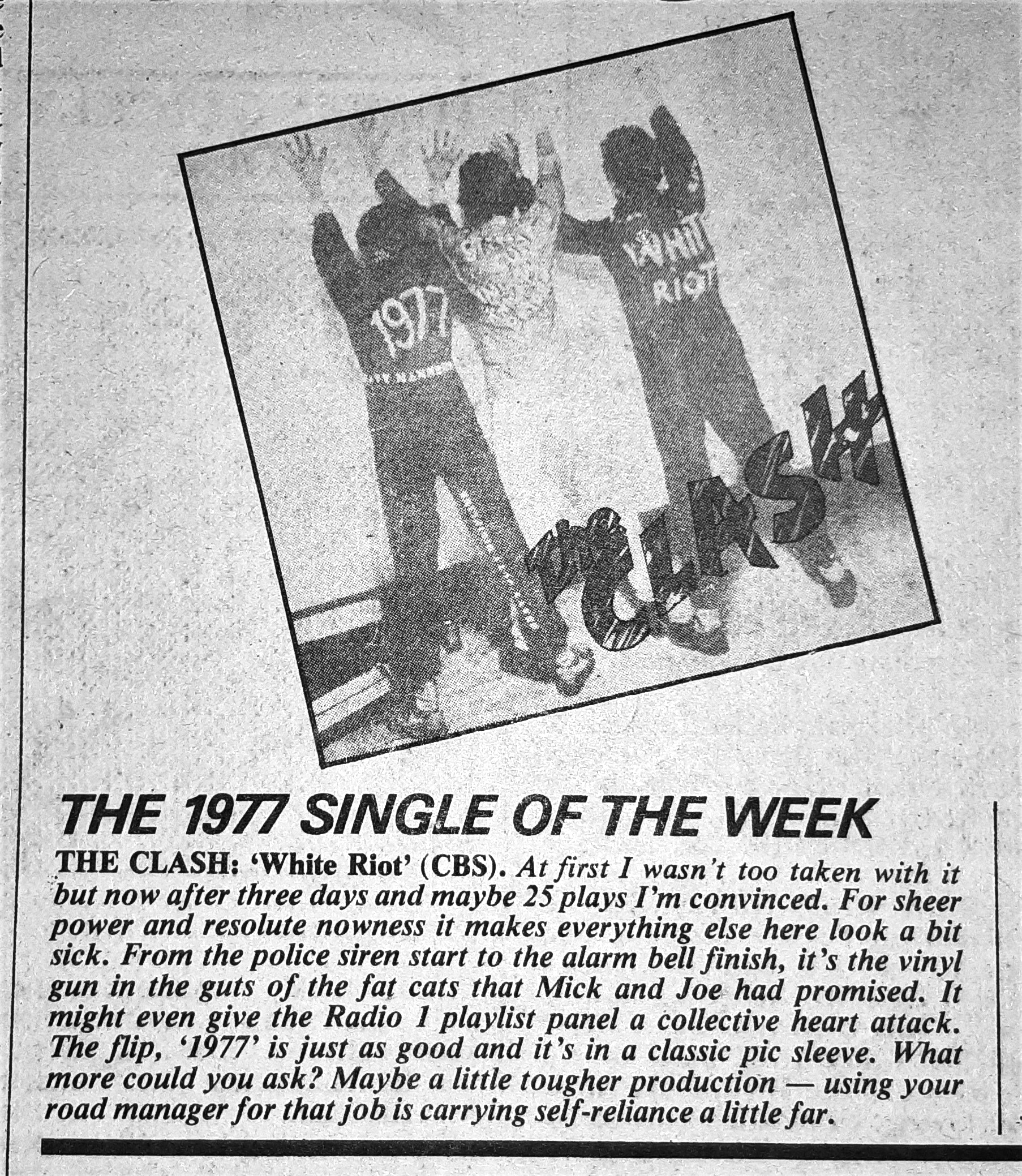
The 1977 single of the week

The Clash: "White Riot" (CBS). At first I wasn't too taken with it but now after three days and maybe 25 plays I'm convinced. For sheer power and resolute nowness it makes everything else here look a bit sick. From the police siren start to the alarm bell finish, it's the vinyl gun in the guts of the fat cats that Mick and Joe had promised. It might even give the Radio 1 playlist panel a collective heart attack. The flip, "1977" is just as good and it's in a classic pic sleeve. What more could you ask? Maybe a little tougher production - using your road manager for that job is carrying self-reliance a little far.

Enlarge image


Acton Gazette - Thursday 5 May 1977

The Clash

So far, two highly important records have emerged from the new wave to convey all the energy, attack and excitement of the style. One is the recent Damned LP; the other is this....

Acton Gazette

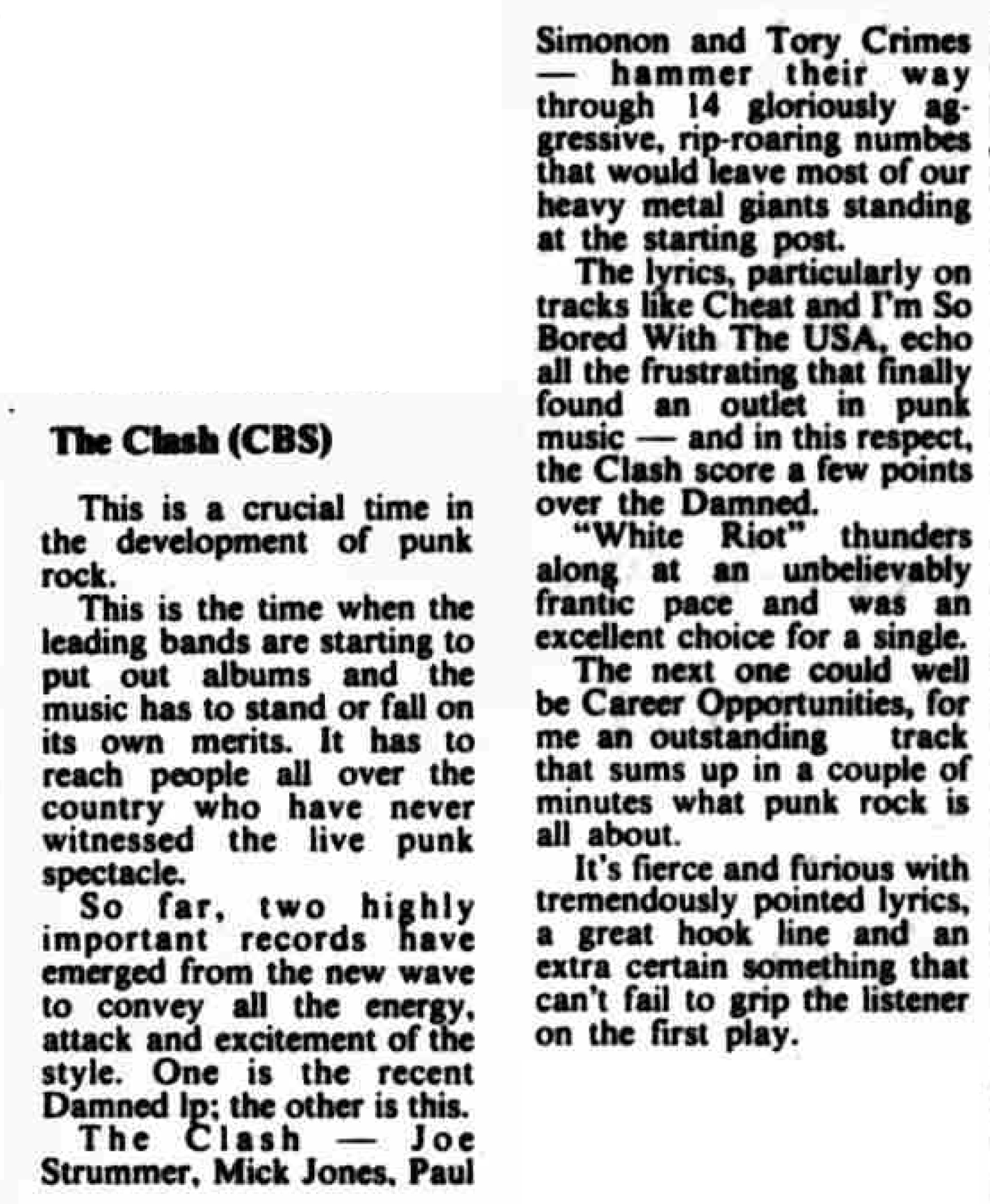
The Clash (CBS)

This is a crucial time in the development of punk rock.

This is the time when the leading bands are starting to put out albums and the music has to stand or fall on its own merits. It has to reach people all over the country who have never witnessed the live punk spectacle.

So far, two highly important records have emerged from the new wave to convey all the energy, attack and excitement of the style. One is the recent Damned LP; the other is this.

The Clash - Joe Strummer, Mick Jones, Paul Simonon and Tory Crimes hammer their way through 14 gloriously aggressive, rip-roaring numbers that would leave most of our heavy metal giants standing at the starting post.

The lyrics, particularly on tracks like "Cheat" and "I'm So Bored With The U.S.A.", echo all the frustration that finally found an outlet in punk music and in this respect, The Clash score a few points over The Damned.

"White Riot" thunders along at an unbelievably frantic pace and was an excellent choice for a single.

The next one could well be "Career Opportunities", for me an outstanding track that sums up in a couple of minutes what punk rock is all about.

It's fierce and furious with tremendously pointed lyrics, a great hook line and an extra certain something that can't fail to grip the listener on the first play.

Enlarge image

 border=


Richard Buskin, Sound on Sound / SOS ezine, Recording Classic Tracks, published October 2013

Classic Tracks: The Clash 'White Riot'

Engineer: Simon Humphrey

When the Clash entered the studio for the first time they were determined not to sacrifice their punk principles, and the fates - not to mention a sympathetic engineer and a negligent record company - were on their side...


Classic Tracks: The Clash 'White Riot'

Engineer: Simon Humphrey.

Recording
Classic Tracks

The Clash on stage at the Rainbow Theatre, 1977. From left to right: Mick Jones, Joe Strummer and Paul Simonon.Photo: Redferns


When the Clash entered the studio for the first time they were determined not to sacrifice their punk principles, and the fates - not to mention a sympathetic engineer and a negligent record company - were on their side...

On 30th August 1976 the Clash's frontman Joe Strummer, bassist Paul Simonon and manager Bernie Rhodes were attending West London's Notting Hill Carnival when all hell broke loose. Amid this annual celebration of Caribbean culture, the police were attacked for apprehending a pickpocket, resulting in the hospitalisation of more than 100 PCs and 60 members of the public, as well as widespread media reports about how black youths were involved in bloody confrontations with white officers. In fact, the rioters also included numerous whites, but their efforts apparently weren't enough for Strummer. After witnessing the debacle that unfolded before his very eyes, he felt inspired to write a song exhorting young white working-class Brits to be as outraged and proactive as their black counterparts in the face of government oppression.

"The only thing we're saying about the blacks is that they've got their problems and they're prepared to deal with them," the singer-guitarist explained to the NME in response to accusations that his band's explosive first single, 'White Riot', was encouraging a race war. "But white men, they just ain't prepared to deal with them - everything's too cosy. They've got stereos, drugs, hi-fis, cars. The poor blacks and the poor whites are in the same boat."

Released in the UK on 26th March 1977 the Clash's debut record created immediate headlines and caused concert promoters to request that the punk outfit refrain from performing it after the song provoked audience brawls at some of their shows. Before one gig, Strummer and lead guitarist-composer Mick Jones actually got into a dressing-room fight of their own when the latter didn't want to play the number. The song was never one of his favourites, yet it would come to be regarded as a classic among the band's legion of followers.

This rabid fan base had expanded rapidly since the Clash's live debut, supporting the Sex Pistols at the Black Swan in Sheffield on 4th July 1976 less than a month after Strummer had joined. On 29th August of the same year, the day before the Notting Hill Riot, following extended work in their Camden rehearsal studio and Strummer-Jones writing sessions in the office above, the Clash had then performed their second concert, once again opening for the Sex Pistols - this time in tandem with the Buzzcocks - at Islington's Screen On The Green. It was a seminal event in the annals of the British punk movement, yet it didn't take long for that movement to be undermined by what many diehards perceived as some of its central artists selling out.

A prime example was the Clash signing a £100,000 contract with CBS Records in January 1977, even though the group had still played relatively few gigs, all as a support act for the Pistols, never as the headliner. By then, guitarist Keith Levene had departed the line-up and several men had occupied the drummer's seat: Pablo LaBritain, Terry Chimes and Rob Harper, before Chimes rejoined in time for the group's initial recording sessions that February inside CBS Studio 3 on Whitfield Street in Central London.

An Education

"'White Riot' captures the quintessential sound of the Clash and I think I had a lot to do with that," says Simon Humphrey, who engineered the track as well as the band's self-titled first album. "They were given free rein by the record company and at no point did I question the validity of what they were doing. So many other engineers would have tried to polish that recording, and it isn't polished. It just is what it is - a working-class riot, not a middle-class one - and that's why it's great."

A native of South-East London, 18-year-old Humphrey landed a job as a tape-op/tea boy at CBS Whitfield Street in 1973 and soon began assisting on a wide variety of sessions. Within two years, he was engineering, and among the eclectic array of artists whom he recorded were guitarist John Williams, jazz singer George Melly, actors Michael Crawford, Peter Ustinov and Vincent Price, poet laureate Ted Hughes, comedian Tommy Cooper, the English Chamber Orchestra and chart acts such as Abba, Argent, Marc Bolan, Bill Haley, Duane Eddy, the Glitter Band, Hot Chocolate, Tina Charles, Sailor, Smokie and David Essex (even making a brief cameo appearance in Essex's 1975 film Stardust).

"In the morning you could be doing a classic session, followed by a pop session in the afternoon and then a jingle the next day," Humphrey recalls. "The music at CBS Whitfield Street came in all shapes and sizes, and so my education as an engineer taught me to be very open-minded about who I worked with. It didn't matter if I liked or understood the material I was recording, I just had to be professional and do the best possible job for whichever client walked through the door. I'd be sitting there with no idea as to what kind of session had been booked - an avant-garde piano recording, jazz, classical, pop, spoken-word, you name it - and have to turn my hand to anything using the same basic tools. There were no special techniques that I applied to one thing that I didn't apply to another; at least, if there were, no one bothered to teach me them. I just made it up as I went along, applying what I'd picked up from other people and, what with the variety of artists, every day was a joy."

Before Retro Was Cool

CBS Whitfield Street had three studios and a mix room, as well as several cutting rooms and dubbing suites.

"Studio 1 was a huge room, used for classical, Studio 2 was the mid-sized room, and then up top was Studio 3, where I was placed as a junior engineer," says Simon Humphrey. "It had a very basic 25 x 25 foot live area - like a moderately large lounge, with no windows, no vocal booths - and an 18 x 15 foot control room with an old 30-channel Neve console that had been there since the late '60s, when the place was known as Bond Street Studios. Although the MCI desks downstairs were much more up to date, this one had a great heritage in terms of the artists it had recorded, but it also predated phantom power. As a result, Studio 3 only had valve microphones - mainly [Neumann] U67s and KM 64s - and so we were left to deal with a vintage setup that was pretty odd in 1977 when I recorded the Clash.

"Back then, a desk that needed valve microphones was regarded as a bit of a joke. After all, when I started in the early '70s, valves were something that your granddad used. There was no fashion for them whatsoever. What's more, if you have 20 valve microphones running at the same time, two or three of them will usually pack up on you, so it was a very unreliable setup. That's why Studio 3 was basically seen as the demo studio; not the best-sounding studio, more of an afterthought. Of course, all these years later we love the old Neves and anything to do with valves, but that wasn't the case in the mid-'70s. Shortly after I left in 1979, that desk with all its heritage was just scrapped and thrown away. It was seen as having no value, which is a shame, and all of those old microphones were packed up and put in a cupboard. Only 10 years later did another generation of engineers come along and dig them out of there."

The other not-so-state-of-the-art equipment housed inside Studio 3 included a Studer A80 16-track tape machine, a Studer A80 quarter-inch machine for mixing and JBL 4350 main monitors, along with Neve in-console compressors, Urei LA4 and 1176 outboard compressors and EMT 140 echo plates, supplemented by no less than four basement echo chambers.

"CBS Whitfield Street actually owned a couple of Fairchild limiters and some parametric EQs, but as a junior engineer I wasn't allowed to use any of that equipment," Humphrey recalls. "There was a sort of hierarchy and you had to be a senior engineer to use that gear, so the choice of equipment in Studio 3 was very, very limited.

"Without a doubt, the Clash were very deliberately booked into there. The record company wanted them out of the way, four floors up, where those unruly punks couldn't cause any trouble. The studio's management never went up there, but I loved it; almost like an attic that you could make your own, with no passing traffic and lots of privacy. The room itself was square, and it had a parquet floor and absorbent walls, so the sound in there was pretty dead. Looking from the control room I could see the drums in the far-left corner, the bass amp in front of the drums and then the guitar amps at near left. This meant they were positioned in a straight line, separated by screens, while Joe Strummer, Mick Jones and Paul Simonon could occupy the rest of the space that wasn't taken up by the acoustic piano."

Communication Problems

"The second time I met Joe, he came in and plonked his amp right next to Terry's drum kit. I said, 'You can't put your amp there, Joe, because we'll need to get some separation between you and the drums.' That was the standard procedure, but his reply was, 'I don't know what separation is and I don't like it,' said in that very aggressive, punky way. He later said that he did in fact know what separation was and he was just having a joke with me, and that's probably true, but all I can say is that the initial recording setup was me trying to wrestle with them in terms of how things were going to get done. I only knew what I had been taught and these guys were coming in with an attitude.

"Joe knew I had recorded Abba, and the next conversation we had, very soon afterwards, started with him asking me, 'How do you normally record? Where do you mic stuff up and what do you do with the drums?' So, I told him, 'I normally do this and that,' and he said, 'Well, we don't want you to do any of that.' I thought, 'This isn't going to work. I can't avoid doing what I've learned works best. This is just punk bullshit.' Clearly, they were trying to assert themselves and, while I was trying to figure out if there was an element of joking in all of this, they were definitely attempting to make their mark early on. Unsure as to whether this was going to work out, I also had to get on and do my job.

"Joe telling me not to do anything I'd done before really resonated with me. I knew this was punk and this was new, but I also wasn't stupid enough to just go along with whatever they wanted. Still, it did stick with me, and so I subsequently had to figure out a way of recording them that would work for all of us. This meant jockeying for position early on, and the idea of not doing what I'd learned before was really at the heart of how I approached recording the band. I felt there was some relevance to what they were saying; they didn't want to sound like what had gone before and they certainly didn't want to sound like the sort of things that I had done before. Those mid-'70s drum sounds had been very dead, damped and ploddy, everything had been isolated, and I knew they didn't want that. Instead of separation on the instruments they wanted to kick doors down, but I also had to make a recording that worked.

"As a house engineer, I wasn't allowed anywhere near a production credit at that time. So, they brought in a guy named Mickey Foote who was essentially their live sound engineer and gave him the job of producing, acting as a sort of intermediary between me and the band. He was a communicator, someone they trusted, but I don't recall him having anything to do with what I actually did. I think they just used him as a foil. Until the mid-'70s, most musicians were very much expected to be on the other side of the glass and not interfere with what took place on our side. The Clash, however, wanted to look through the glass to the control room and see someone they knew, trusted and could occasionally communicate with. Mickey was that person, even though I don't remember him taking on the role of producer at all. In fact, after the initial sessions, once Mick and Joe had worked out I was someone they could communicate with and that I wasn't a dickhead, Mickey became surplus to requirements.

"I have got nothing against Mickey. He's got his name on the album, he was a good friend to them and he was a good professional, but he didn't necessarily need to be there. The band needed to record, they needed a studio and they needed an engineer, and so that was the important relationship that had to be cultivated. They absolutely were not going to work with an established producer of the day because they weren't going to be told what to do.

"Having been given the job of recording the band, that responsibility was on my shoulders. While they wanted to get on with it, I had no idea if they'd recorded before. All the evidence was that they hadn't and they were giving nothing away whatsoever, including the fact that Joe and Mick had previously been in other bands. And even if they did have prior experience, they didn't want to apply that knowledge to these particular recordings. They wanted them to be fresh and different, which is why I had to take on board all of their suggestions.

"In 1975 and '76, I was a long-haired hippy whose favourite band was Crosby, Stills, Nash & Young. Then punk came along and, having recorded Abba and been into very well-crafted Californian harmony rock, it was quite a shocker in 1977 to suddenly hear this raw sound. Mick and Joe would play something in the studio, look at Mickey and me and shout, 'How was that?' They'd want a reaction but I genuinely didn't know if it was good or not. So, trying to be diplomatic, my default answer as an engineer was 'Well, it wasn't bad, but you can probably do better.' Their response would be 'Oh great, we'll keep it then!' They'd always try to second-guess you. If you said it wasn't very good, they'd almost certainly want to keep it, and if you said it was brilliant, they'd probably want to get rid of it. In other words, anything I liked was obviously wrong whereas anything I hated was obviously right.

"After a few days, we reached the stage where I began to second-guess them. If Mick played a terrible guitar solo, I'd say, 'Yeah, that's great, Mick,' and he'd go, 'Are you fucking joking? It's terrible!' That's how our relationship initially developed until, eventually, we learned to trust each other. There were certainly tiring and exasperating elements to the whole experience, one of which was that the band had a lot of hangers-on and external people who'd want to angle in on what we were doing.

"Sometimes one of them would come in and say something along the lines of 'What this needs here is the sound of a machine gun going off.' I'd think, 'Oh Christ, what's going to happen next?' before someone would then bring in an air pistol and I'd have to record them firing it. Of course, it would sound terrible, but we'd still have to go through the process of recording these terrible things: bashing a sheet of corrugated metal, throwing it down the stairs or kicking in a plate glass window. 'Why don't we record that?' 'Oh God, here we go again...' It was that whole punk ethos.

"Another fairly exasperating thing was the fact that Paul, the bass player, wasn't interested in talking to me at all. And I also had to earn Joe's trust over a period of time. I don't think he was reticent towards me; he was just reticent towards anyone or anything connected to all the things he didn't like. He was still smarting from all the bad press he and the other guys had got for signing to CBS; they were suffering the consequences of that whole corporate connection and were therefore sparring with the likes of me because I was employed by a company. And their manager Bernie Rhodes was a fairly disruptive influence. He'd wander in, say something controversial and just wind everyone up. Even Mick would tell him, 'Why don't you piss off? You're just getting in the way.' So, there was a lot of posturing going on and, although it was fun, it was hard work to get to the fun bit."

(Mostly) Smash The Conventional!

Despite Joe Strummer admonishing Simon Humphrey to break with convention when recording the Clash, the latter took a fairly standard approach in terms of miking the instruments: an AKG D12 on the bass drum, a Neumann KM64 on the snare, Sennheiser 421s on the toms and valve Neumann U67s as overheads. The guitar amps were also close miked with U67s while the bass was DI'd and miked with a Neumann U47. A U67 was used to track Strummer's vocals.

"Back then," Humphrey explains, "the attitude of a lot of engineers was 'You're the musicians, I'll handle the sound. If you've got a bad sound, I'll fix it. I'll take away your crappy amp and put a nice one in its place.' When it came to the Clash, however, the sound they made was what I was going to record. There was no question of me saying, 'Your guitar doesn't sound acceptable so I'm going to give it a magical sound that will make you think I'm a genius.' I knew very early on that they wanted me to record them, warts and all, and that's what I did.

"Joe had this Fender Telecaster which was like this beaten-up old rusty guitar - obviously his punk special; it was very much him - and he plugged it into this Fender Twin reverb. It made a horrendously toppy, hideous sound, and Mick said, 'God, that's awful.' However, we never, ever thought about trying to improve it, we just thought, 'This is what it sounds like and this is what we're gonna have.' I didn't try to change them. I was only interested in recording them the way they wanted to be: the truth of how they sounded and what they wanted to be, in the raw. As a result, that first album sounded raw beyond belief - shockingly raw - whereas the Sex Pistols' records sounded fantastic. They were very radio friendly and very well produced. Well, the Clash record didn't sound like that at all, but it did sound like them.

"Previously, I had recorded the Glitter Band with [producer] Mike Leander, and to achieve his drum sound he'd quite literally place a blanket over the entire kit. That was the most extreme case of damping I ever saw, but in the mid-'70s most producers and engineers did do the same in a slightly toned-down way, with two towels on the toms and that kind of thing. Everything sounded neat, tidy and damped, but I knew the Clash didn't want any of that, so I had to be very hands-off. When I miked the kit, there was no damping, there was no tuning, and this suggested what New Wave was going to be: the whole New York/Blondie sound. Drum sounds would explode in the late '70s.

"The heavy damping of drums had stemmed from the Pink Floyd Dark Side Of The Moon sound, and that's what I'd spent the past few years trying to get right. Now, I was going for the exact opposite, and it was very exciting. Being that the room we were in wasn't particularly geared towards that, we ended up with a sort of thin quality, and while it wasn't fantastically sophisticated, it totally suited the mood of how the band wanted to sound. It's just so uncompromising when you hear it and just so unsubtle. Famously, the American record company wouldn't release the album because they didn't think it was technically good enough for radio. Yet, when the first single, 'White Riot', came out, it charted immediately in the UK, and on the radio it stood out because of what we hadn't done to make it sound 'nice' like everything else. It wasn't a case of what I did, it was a case of what I didn't do.

Rough Edges

"Joe was a brilliant frontman, a brilliant vocalist and I loved recording him. He just went for it. I don't think he spent more than 15 minutes doing any of the lead vocals. Two or three takes and that was it. When the Clash performed live on stage, Joe was a very physical performer, singing and playing at the same time, and when we'd ask him to do his vocals in the studio he couldn't do so without playing the guitar. He had to do both together. Being that he didn't sing when we recorded the backing tracks, he overdubbed the vocals on his own, and he had to face away from us as he didn't want to see the control room while performing the songs and playing the guitar at the same time even though it wasn't plugged in. If you listened to his isolated vocal tracks, you could hear his Telecaster being hit all the way through because he couldn't detach one from the other.

"You couldn't take the guitar off him and I thought that was great. Other people might have said, 'Listen, Joe, you've got to put the guitar down, learn how to use the mic and learn that connection between you and the microphone.' That's the stuff most singers learn, but Joe wasn't interested in any of that. He just wanted to get the lyrics out and onto the record. It was a physical process for him and he wanted it done as quickly as possible. All day long he'd be drinking honey and lemon while moaning about his throat, and he'd always give it 110 percent. He was a great performer. When you listen to those vocals, what he was bawling out really comes across. I love it.

"Joe wasn't interested in double-tracking or editing vocals. When you recorded a lead vocal with him, it was basically a performance from start to finish. Afterwards, he'd ask whether it was good or not and, based on the answer, he'd either do it again or he wouldn't do it again. You see, if I said, 'Maybe you could do that second verse better, Joe,' or 'Do you really think that was in tune at the end?' he'd immediately go, 'Great, we'll keep it.' I learned very quickly that he and the other guys didn't want the rough edges knocked out in any way, shape or form, so they all got left in and that's one of the reasons why what you hear is so great.

"The reason I was able to do that is because the record company execs never A&R'd the album at all. They simply left the band in the studio with me. We recorded it and mixed it, they put it out, and not once did they question what we did. I wasn't asked to remix anything and not once was I sent back into the studio to repair anything."

All of which is a bit puzzling since Mickey Foote was a novice producer with absolutely no track record and Simon Humphrey wasn't yet a fully fledged engineer in the eyes of his CBS employers.

"I knew this A&R guy, Robin Blanchflower," Humphrey recalls. "He phoned me on the Wednesday and asked, 'What are you doing at the weekend?' I said, 'I don't know,' to which he said, 'Right, I've just signed this band called the Clash. I don't know what they've got, but they've got something. I'll send them 'round now to say hello and then on Saturday and Sunday you'll record and mix two tracks for the A and B sides of a single.' Robin never came to the studio, I never had to play him a rough mix and there were no demos. They just pressed the record, stuck it out two weeks later and it went straight onto the chart."

That was in March 1977, when 'White Riot' peaked at number 34 in the UK.

"No one was more amazed than the record company," Humphrey continues. "It had no idea what it had unleashed at that point. It was incredible, and I think I got the job because I was the youngest engineer. As such, I was the least cynical engineer at the Whitfield Street studio; less likely to complain and more willing to indulge the band members. The biggest fear they had was that someone would come along and stick on harmonies or mix the record in such a way that it would sound cute when they wanted it to sound angry. They just wanted it done, and the record company, to its credit, gave them free rein with that initial record and their first album."

Two Guitars Better

Reportedly produced on a £4000 budget, The Clash was recorded in February 1977 over the course of - as Humphrey now recalls - between eight to 10 days before another three were spent on the mix.

"Joe didn't show much enthusiasm for overdubbing," Humphrey says. "His vocals largely consisted of single takes, he played his guitar live on the backing tracks and there was very little fixing of the bass. When we put a track down, the drums, bass and two guitars were played live and they mostly would have been retained. However, the person who very quickly learned the art of overdubbing was Mick. He was the one who clocked that you could drop in and out, double track and add other guitar parts. Of course, he didn't tell me he'd been in another band, recorded before and probably knew this stuff anyway, but I got the sense that, over the course of recording the Clash album, he really got into the concept of layering guitars and what that could do to the sound of the record. As a result, it was embellished more by his work than by anyone else's.

"Mick started to use other guitars and other amps while looking for other sounds. He was interested in what the studio could do in terms of tracking. From my perspective, that was dangerously close to going away from the original philosophy of it all being totally raw. But then, everybody knows that, most of the time, two guitars are going to sound a lot better than one, so it didn't make sense to tell Mick, 'Hold on a minute, you said we couldn't do this because Abba double-tracked guitars.' Once he understood that more guitars made a louder record, we went in that direction and he more or less took over the production by making the studio a creative space."

Joe Strummer and Mick Jones wrote and composed 12 of the 14 tracks that appeared on the UK release of the Clash's eponymous debut album. The exceptions were 'What's My Name?' which they had co-written with Keith Levene and the reggae number 'Police & Thieves', recorded by falsetto singer Junior Murvin in 1976 after he had written it with producer Lee 'Scratch' Perry.

"The Clash were very well rehearsed," Simon Humphrey continues. "Aside from 'Police & Thieves', all of the songs ranged from under two minutes in length to just over three minutes and they had them down pat. Joe and Mick were feverishly writing lyrics in the studio - most of the songs' lyrics had already been half-written and they were knocking them out on a daily basis. However, the music was pretty well rehearsed, the songs went down quickly, and although a lot has been said about Mick Jones playing the bass instead of Paul Simonon, I can absolutely assure everybody that Paul played all of the bass and that Mick just taught him some of the parts.

"Mick was a pretty competent guitarist by that time. He knew what he was doing. He was the musical side of the band and none of them were amateurs. For his part, Terry Chimes did a perfectly good job, but I don't think I really did him any favours in terms of the drum sound. When I listen to the record, the drums are quite lightweight, and that's partly because of Terry's kit and me being told to not do anything special to it, and it's also because it was quite obvious that he was more a session man than a member of the band. So, he was just doing his job before Topper Headon came in and really crystallised everything by giving the Clash a different sound. It's not that Terry was a lesser drummer; it's just that Topper came in with an attitude and helped everything step up a gear."

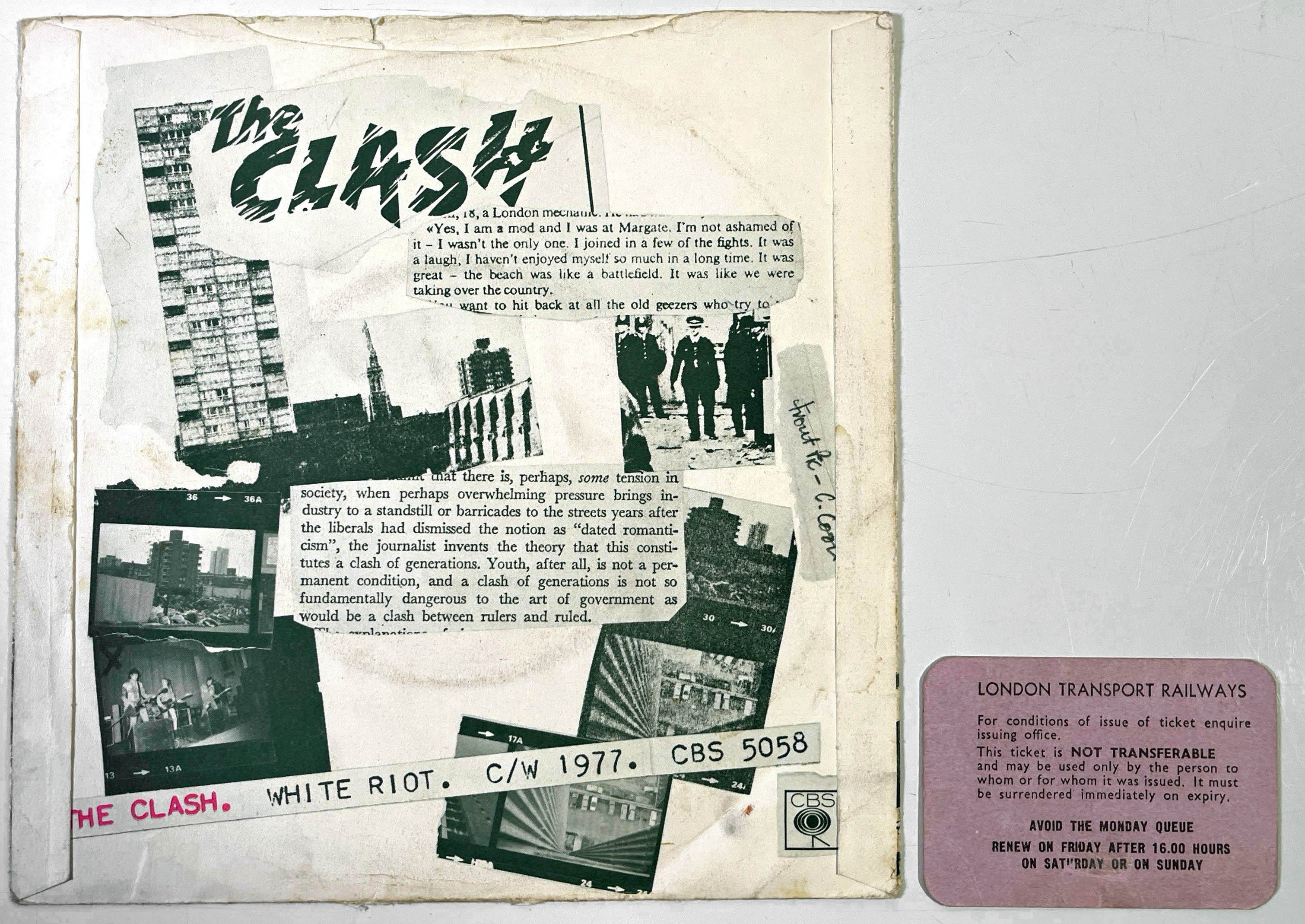
Departing the Clash soon after the sessions for the album ended, Terry Chimes wasn't featured in its front-cover photo - taken in an alleyway facing the band's Camden rehearsal studio - and was acerbically credited as 'Tory Crimes' for his efforts. Meanwhile, the back-cover photo of charging police officers was taken during the August '76 Notting Hill Carnival insurrection that inspired 'White Riot'; a song that was accorded different recordings for the versions that were issued on the album and as a single; the former (running time 1:55) commencing with Mick Jones' "one-two-three-four" count-in, the latter (running time 1:58) with a police siren grabbed from a BBC sound-effects record. Ditto the subsequent, anarchic sounds of an alarm bell and breaking glass, while that of stomping feet was contributed by assorted friends in the studio.

"When I engineered the single - the first recording that I did with the Clash - I didn't know that they had already recorded another version at the National Film & Television School in Beaconsfield," says Humphrey. "That live version, which had been recorded on eight-track for a very early video, was the one that they decided they wanted on the album, even though the record company would have never put it out as a single because it was terrible in terms of its technical quality and the band agreed. I think it was just one of those punk/New Wave ideas to give the fans value for money... Or maybe they were just trying to be perverse, undermining the record company, because they did genuinely say, 'God, this sounds a bit ropey.' It was below demo quality. In the punk spirit, it was a case of 'This is what we sounded like when we went to the film studio,' and so I remixed it for the album to try to bring it up to spec. It was so horrible, it perfectly suited punk."

Prog off

Recorded and mixed within three days along with the non-album B-side '1977', the single version of 'White Riot' also appeared on the altogether different 1979 North American release of The Clash, issued after the band's second album Give 'Em Enough Rope. This was in the wake of CBS deciding that the original UK album, despite reaching number 12 on the chart following its 8th April 1977 release, was too raw and unsophisticated to garner radio airplay in the US... only to see it become the best-selling import of the year there with sales of more than 100,000 copies.

"Having had no previous affiliation to punk, working with the Clash was a real education for me," says Simon Humphrey whose other credits include anyone from the Vibrators, XTC, Tom Verlaine and David Byrne to Culture Club, the Beach Boys, Bros and Smokie, and who now resides in Yorkshire, where he is resident producer at the ChairWorks studio complex and delivers music production lectures at the University Of Leeds. "Once I saw what was possible with the band, a light went on in my head and I thought, 'Blimey, maybe all this prog rock stuff that I love is a load of bollocks. The Clash were the total antithesis of that and I could have easily recoiled from working with them, but fortunately I just got on with it. I respected them, and I think I really contributed to that first album by not screwing it up for them whereas a lot of other people probably would have done."
Online or archived PDF or archive PDF2


Unknown review

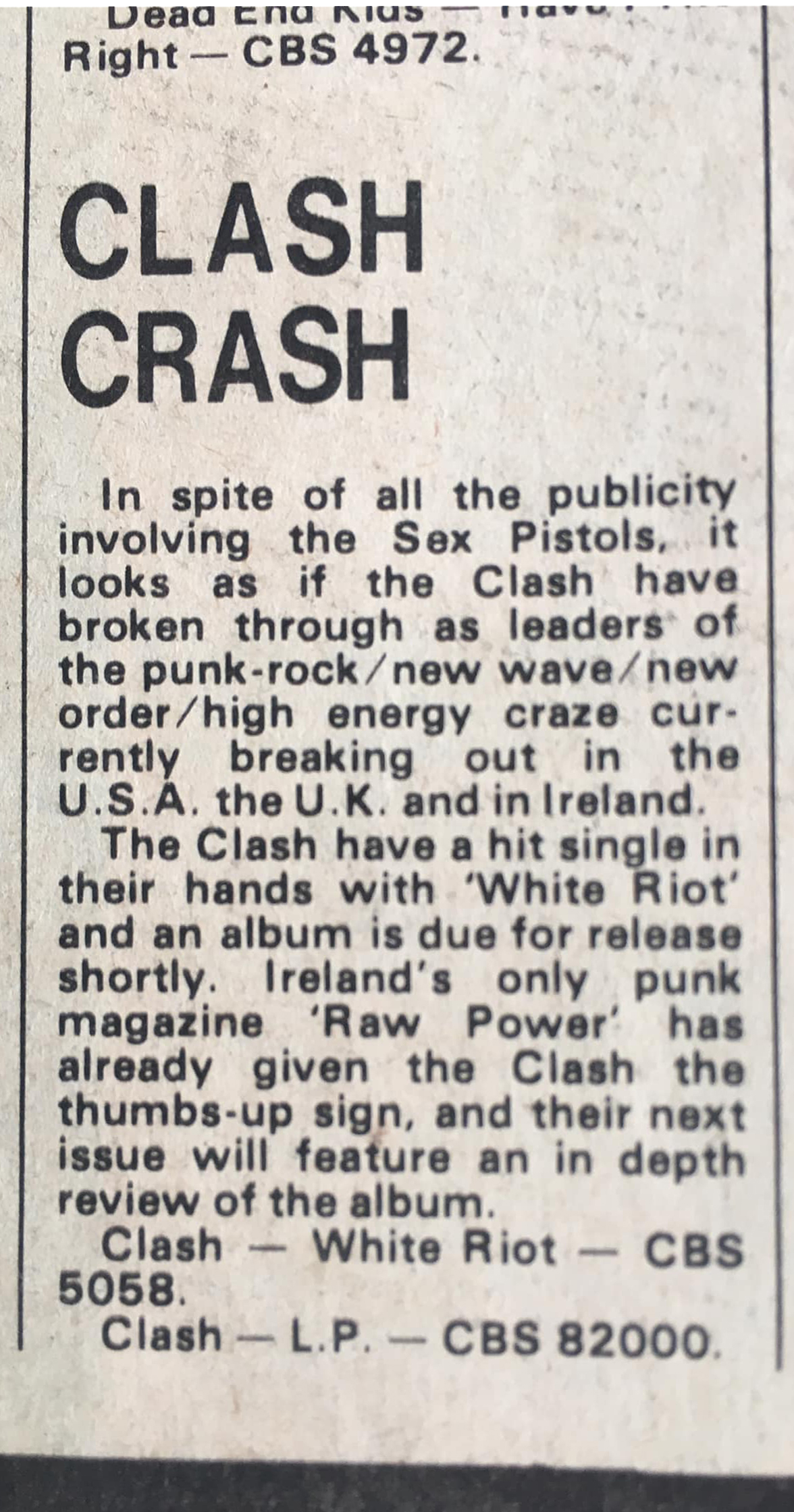
Clash Crash

In spite of all the publicity involving the Sex Pistols, it looks as if The Clash have broken through as leaders of the punk-rock/new wave/new order/high energy craze currently breaking out in the U.S.A., the U.K. and in Ireland.

The Clash have a hit single in their hands with "White Riot" and an album is due for release shortly. Ireland's only punk magazine "Raw Power" has already given The Clash the thumbs-up sign, and their next issue will feature an in-depth review of the album.

The Clash "White Riot" - CBS 5058. The Clash LP - CBS 82000.

 border=


Record Hunter, February 1991 # pages

The Clash: The First 12 Months

— Danny Kelly's 1991 article for Record Hunter charts the first year of The Clash, from their 1976 formation after seeing the Sex Pistols to their landmark releases and tours.

— Recording their debut album and early singles "White Riot" and "Complete Control," produced by Lee Perry.

— Their first gig at The Black Swan supporting the Sex Pistols and the "White Riot" Tour and the London's Rainbow Theatre gig.

Read the article

PDF1 ––– PDF2


Jack Whatley, Far Out Magazine, "The Story Behind The Song ‘White Riot'" Thu 18 March 2021, PDF

The Story Behind The Song ‘White Riot'

The Clash's misunderstood punk masterclass. On this day in 1977, The Clash released their debut single. A song that would go down as one of their most iconic tracks of all time-a new bar with which to measure the immeasurable fury of punk rock. The punk standard, the powerful yet poetic brilliance of Joe Strummer's foghorn for the masses, 'White Riot', is still revered to this day but not without clearing away any confusion beforehand...


Jack Whatley, Far Out Magazine, "The Story Behind The Song ‘White Riot'" Thu 18 March 2021

The Story Behind The Song: 'White Riot' The Clash's misunderstood punk masterclass

Music » Features


Credit: Alamy

On this day in 1977, The Clash released their debut single. A song that would go down as one of their most iconic tracks of all time-a new bar with which to measure the immeasurable fury of punk rock. The punk standard, the powerful yet poetic brilliance of Joe Strummer's foghorn for the masses, 'White Riot', is still revered to this day but not without clearing away any confusion beforehand.

Featuring on the band's self-titled debut record, we're looking back at The Story Behind The Song of 'White Riot', a track that refuses to be beaten down. We're finding the nugget of hope in this rallying call to arms and why it spent so much time being misunderstood by a particularly ignorant part of the public.

It's an easy mistake to make, especially looking back. Here in 2021, when you take a brief look at the lyrics of The Clash's 'White Riot' you may be forgiven for thinking that Joe Strummer, Mick Jones, Paul Simonon and Topper Headon were advocating for some kind of race war or, at the very least, an 'uprising.' But that notion couldn't be further from the truth.

Joe Strummer and Paul Simonon were living in Notting Hill during the summer of 1976. Though the leafy suburb is now considered one of the most desirable locations in London, at the time, it was largely split into factions. On one side of the neighbourhood lived the affluent members of the capital's high society and, on the other, lived a high proportion of low-income families and, more often than not, Jamaican immigrants. Strummer and Simonon's immersion in this culture would greatly influence the band and their debut record.

In fact, the city's temperature was reaching a fever pitch, and the Jamaican traditions that had been building in the capital would influence almost all of the punk bands as they exploded across the capital. For those involved in the punk scene, it was clear that, upon closer inspection, the oppression being felt across the poor working classes transcended race and culture. This notion would intertwine these two juxtaposing rhythms and not only feature on their debut in the form of 'White Riot' and their cover of 'Police & Thieves' but also on their seminal album London Calling. However, it was something Strummer and Simonon would lay down on The Clash's debut single, 'White Riot', most clearly.

The duo were surrounded by police brutality and oppression as they lived in their predominantly Black neighbourhood. Seeing members of their community stopped and harassed by police was a near-daily occurrence. The tension between Notting Hill's residents and the police was beginning to overboil, and it came to a head at the Notting Hill Carnival. The 1976 event combusted into a scene of riots and police violence as the neighbourhood refused to be bullied any further and stood up for themselves. It was a spark of rebellion that Stummer had been waiting to see for a long time.

Leaving the event, Strummer and Simonon pondered on why white kids weren't fighting the good fight too, and they used 'White Riot' to do it: "Black man gotta lot a problems / But they don't mind throwing a brick / White people go to school / Where they teach you how to be thick." It was a deliberate foghorn to the masses. Take direct action or be acted upon.

After all, it had been a crushing few years for the working class. The economy was in a deep, dark slump, with inflation topping twenty per cent and, in 1975, unemployment had passed two million - an astronomical number. When you couple that with the kind of pop music drivel that was topping the charts at the time, you could feel the energy of punk bubbling up.

Strummer explained to NME about the song's contentious lyrics: "The only thing we're saying about the Blacks is that they've got their problems and they're prepared to deal with them. But white men, they just ain't prepared to deal with them-everything's too cosy. They've got stereos, drugs, hi-fis, cars.

"The poor Blacks and the poor whites are in the same boat."

'White Riot' wasn't a call for a race war; it was a demand for a focusing of issues and a rallying call to pick up your bricks and stones and follow one another into a new, freer world. While it may not have heralded a new age of libertine thinking as hoped, it did incite many political punks to begin their further reading and continue to fight the good fight in the name of political and social justice. In truth, it set the blueprint for Strummer and The Clash's modus operandi.

Sadly, without a continuous dialogue about the song, it was picked up by undesirable and disreputable factions. Some punks became so enamoured with the track that it began to be misused in racial rallies and was often misquoted as a document of white power. Strummer remained determined to keep control of the narrative and tried to play it wherever he could after some venues asked the band to stop performing the track. While The Clash would always ignore that request, Mick Jones was also keen to drop the song, and during a heated conversation backstage in 1979, Strummer thumped Jones during an argument about the track. It left Jones wearing bandages to complete the group's encore.

Their rebel attitude, combined with a razor-sharp wit and politically charged lyrics, raised the bar for what was possible in the embryonic moments of punk rock. Billy Bragg once said of the band: "were it not for The Clash, punk would have been just a sneer, a safety pin and a pair of bondage trousers." And he's right.

While other groups may have burned brighter or indeed just been a flash of smoke, The Clash were a furnace of ideals and ethics, the kind that could solidify the porcelain thoughts of punk rock. They churned out the kind of steam that pushed locomotives off the tracks and kept them going through dirt and gravel. And while much of it was propelled by punk tunes, there was a heavy dose of ideology attached too.

'White Riot' made The Clash the only band that mattered.

Far Out Magazine or PDF1 or PDF2


Hassan Mahamdallie, dreamdeferred, "the-clash-a-riot-of-our-own/" 8 January 2018

The Clash: a riot of our own

Punk and New Wave exploded onto the musical stage in 1976-77. The new music brought the bloated rock scene that came before it crashing down - and punk has shaped much of the music that has come since. Two years ago Hassan Mahamdallie began his occasional series on this blog - a personal, musical and political journey. He ends the series looking at one of the most important - if not the most important - punk bands of all time, the Clash....

Retrospective review of

White Riot 7"
Police and Thieves
Clash City Rockers 7"
Compleet Control 7"
Armagideon Time (LC12)
Live at Lyceum December, 1978


Pic%20credit%20Sonic%20Collective

(The Clash. Pic credit: Sonic Collective)

Punk and New Wave exploded onto the musical stage in 1976-77. The new music brought the bloated rock scene that came before it crashing down - and punk has shaped much of the music that has come since. Two years ago Hassan Mahamdallie began his occasional series on this blog - a personal, musical and political journey. He ends the series looking at one of the most important - if not the most important - punk bands of all time, the Clash.

Next week we will posting Hassan's list of his 10 favourite punk debut singles. We also intend to publish a downloadable compilation of Hassan's music posts here, with an introduction by a very special guest.


The Clash. Single No 1: White Riot (1977)

clashwhite-600x614

It's quite something, when you think about it, that the debut single of the most successful punk band of all, and my personal favourite, clocked in at just one minute fifty-eight seconds and was widely misinterpreted at the time as having racist overtones.

The Sex Pistols' Anarchy in the UK exploded in November 1976 like a random depth-charge, blowing all the accepted musical rules out of the water, but instant converts like myself had to wait another six months until we had something else to compare it to. So we could begin to join the dots: "That song is punk, and this one is also punk, so this must be what punk is. This is what it sounds like and this is what it is all about." All we could do in the intervening period was tune into the BBC Radio One John Peel show in the evenings to hear what new bands he was raving about.

If Anarchy in the UK had slashed a big X in the centre of a new soundscape, the Clash's debut single White Riot, released in March 1977, would be an arrow pointing us in a particular direction. Or at least that was the theory. But what direction? What exactly was a White Riot I asked myself? Wasn't that something that the razor-wielding Teddy Boys had been up to in Notting Hill in 1958 when they had attempted to pogrom the local West Indian population? Or what the Enoch brigade and the National Front (NF) would like to do us 'pakis' given half a chance?

It wasn't until the Clash included their interpretation of one of my all-time favourite songs, Junior Murvin's masterpiece Police and Thieves on the first album, that I realised where the Clash stood.

Police and thieves in the streets (oh yeah) Fighting the nation with their guns and ammunition Police and thieves in the street (oh yeah) Scaring the nation with their guns and ammunition…


Junior Murvin's Police and Thieves: 12" version. Produced by Lee 'Scratch' Perry (1976)

clashjunior

Later I came to understand that White Riot was a song of praise for the Black youth who had bravely fought the Met police to a standstill during the 1976 Notting Hill Carnival, and an admonishment to white youth who had yet to find their own route to confrontation with the state. Indeed White Riot was composed out of the first-hand experience of Clash singer Joe Strummer, bass player Paul Simonon and manager Bernie Rhodes, who had been caught up in, and participated in the rebellion against state repression and racism that flared in Notting Hill in the August of that searing long hot summer of '76.

White riot - I wanna riot White riot - a riot of my own White riot - I wanna riot White riot - a riot of my own

Black people gotta lot a problems But they don't mind throwing a brick White people go to school Where they teach you how to be thick

…All the power's in the hands Of people rich enough to buy it While we walk the street Too chicken to even try it

Everybody's doing Just what they're told to Nobody wants To go to jail!

White riot - I wanna riot White riot - a riot of my own White riot - I wanna riot White riot - a riot of my own

Are you taking over or are you taking orders?

Are you going backwards, Or are you going forwards? the song concluded, echoing CLR James's eloquent insight:

Times would pass, old empires would fall and new ones take their place. The relations of countries and the relations of classes had to change before I discovered that it is not the quality of goods and utility which matters, but movement, not where you are, or what you have, but where you have come from, where you are going and the rate at which you are getting there.


Single No 4: Clash City Rockers (1978)

clashcityrockers

The Clash were as much an expression of the UK reggae scene and Caribbean culture and rebel politics as they were of the pub rock and art-school scene. Joe Strummer had lived in a communal squat in Maida Vale, just north of Notting Hill. Mick Jones had been a south London schoolboy in Tulse Hill. Paul Simonon had been raised in Brixton and Ladbroke Grove, had grown up in and around London's Black community, and was a huge reggae fan - clearly manifested in his ska/reggae bass-playing style.

Before going on to manage the Clash, Bernie Rhodes had run a record shop in Kilburn specialising in reggae imports. Apart from using photo imagery from the '76 riot as backdrops to their gigs and on their record sleeves, the Clash were visually inspired by artwork they came across adorning Jamaican reggae album covers.

In 1977 the journalist, cultural activist and maybe best chronicler of punk Vivian Goldman wrote an insightful article in Sounds magazine that traced out the punky-reggae conversation that was going on at the time. Goldman wrote that, setting aside Don Letts' famed reggae DJ sets at punk gigs:

The main impetus for punk enthusiasm for reggae is down to the musicians. The Clash definitely lead the way - their cover of 'Police And Thieves' is the strongest vinyl evidence to date of new wave sympathy for their black peer group. Even down to the shot of the rioting under the Westway at the '76 Notting Hill Carnival on their album sleeve, the Clash have always laid their souls on the red, green and gold line. Bernie Rhodes was right when he described them as "a roots band.


Single No 3: Complete Control (1977)

clashcomplete

Complete Control

In September 1977 the Clash released their third single Complete Control. I rate it as one of their best. The composition, the guitar wall-of-sound, Strummer's incomprehensible growl, Mick Jones plaintive backing vocals, Nicky 'Toppe'r Headon's energetic beat, all come together - perfectly formed from start to finish.

Complete Control was produced by unique and hallowed Jamaican musical innovator Lee 'Scratch' Perry, who had admired the band's version of Junior Murvin's hit (although its disputed how much of his studio mix made it to the final cut), and the front cover was a photo of a reggae sound system bass speaker set.

In June 1978 the Clash were to return to the inspiration of Police and Thieves with the distinctive single (White Man) In Hammersmith Palais:

White youth, black youth Better find another solution Why not phone up Robin Hood And ask him for some wealth distribution.

And then of course there were the covers - notably Frederick 'Toots' Hibbert's (of Toots and the Maytals) Pressure Drop and Willi William's Studio One anthem Armigideon Time, as well as their own songs - including Paul Simonon's personal tribute to The Frontline - The Guns of Brixton - complete with reference to the anti-hero of the famous crossover 70s Jamaican rude boy movie:

You see, he feels like Ivan Born under the Brixton sun His game is called survivin' At the end of the harder they come


Single No 10: Armagideon Time. The flip side to London Burning (1979)

clasharma

Single No 9: The Cost of Living EP included a version of 1960s Bobby Fuller standard I Fought The Law. The EP was released in May 1979 to coincide with the General Election which put Margaret Thatcher in power.

Between 1977 and 1979 the Clash never stopped evolving their sound and subject material, and widening their political reach into areas I could appreciate and agree with, the opposite of their early "rivals" the Sex Pistols, who, for whatever reason you like to give, never moved forward musically, rapidly descended into both tragedy and farce.

In the same month as (White Man) In Hammersmith Palais was released, what was left of the Pistols messily exited musical history with the 12" single No One Is Innocent - a seedy karaoke sing-a-long with sad-sack train-robber in exile Ronnie Biggs:

God save Martin Boorman and Nazis on the run God save Myra Hindley God save Ian Brady Even though he's horrible and she ain't what you call a lady

Charming.

The icing on the cake? The Clash were the most exciting live band I have ever experienced - even beating my old favourites The Damned. I saw the Clash perform at The Rainbow, Finsbury Park in December 1977, at the Victoria Park Rock Against Racism gig in April 1978, Harlesden Roxy in October 1978 and at the Lyceum Ballroom on the corner of The Strand, central London, in December 1978.

In those days you had to rush to the venue ticket office as soon as the weekly music press announced that tickets had been released, queue up for hours, put up with passers-by stopping to gawp at the assorted rabble slumped untidily in the road (me and my fellow Clash fans), and hopefully make it to the box-office grill before the gig sold out, passing over some greasy bank notes to the ticket lady who had drawn the short straw that day. I remember going up to The Strand and queuing up to buy two tickets for a fiver -and thinking at the time that was a bit steep and it had better be worth it.


December 1978: The Lyceum ballroom in The Strand

clashsort

It was a phenomenal gig - Strummer spitting out lyrics through his crooked teeth, his left leg furiously pumping up and down to the beat, Mick Jones fronting up to his left, Paul Simonon, low slung bass across his hip to the right and Topper Headon hard at it on the drum kit at the back.

Tune after tune rocketed out from the stage into the auditorium one after the other in feverish bursts of hot energy - White Riot, City of the Dead, Remote Control, Janie Jones, What's My Name, Garageland, Tommy Gun, Drug-Stabbing Time, Capital Radio, Police and Thieves, I Fought The Law, Stay Free…I staggered away at the end, drenched with sweat, my ears ringing (as they would continue to do so for days after), completely numbed, on autopilot I crossed The Strand and over the Thames towards Waterloo Station and home.

Whatever individual thoughts and emotions that had been with me that day had been burned clean out of my skull. Strummer later recalled that those were the nights "when it burns. When you cease to be even anybody at all. Your just part of something. You don't know what your doing or saying. It burns and that is was the audience want to be part of, that burn".

You can watch a very good 9-minute film of the Clash live, from October 1977 below.

Online or archived PDF, archived PDF2


Facebook, Decade 77-87 - a grown up disco: new wave, punk, postpunk, goth & indie

Video: This cultural immersion greatly influenced The Clash's debut record.

On this day in 1977, THE CLASH released their debut single, WHITE RIOT, a powerful song that would become one of their most iconic tracks. Despite being frequently misunderstood, 'White Riot' is a rallying call to arms for unity and hope...

On this day in 1977, THE CLASH released their debut single, WHITE RIOT, a powerful song that would become one of their most iconic tracks. Despite being frequently misunderstood, 'White Riot' is a rallying call to arms for unity and hope.

The song was written by Joe Strummer and Paul Simonon, who lived in Notting Hill during the summer of 1976. The neighbourhood was divided between affluent high society members and low-income families, including Jamaican immigrants. This cultural immersion greatly influenced The Clash's debut record. The oppression felt by the working class transcended race and culture, and this idea became a driving force behind 'White Riot'.

The duo witnessed police brutality and oppression in their predominantly Black neighbourhood. Tensions between residents and the police reached a breaking point at the 1976 Notting Hill Carnival, where riots and police violence erupted. Strummer and Simonon wondered why white kids weren't fighting for justice too, and 'White Riot' was their call to action.

Strummer explained the song's controversial lyrics to NME: "The only thing we're saying about the Blacks is that they've got their problems and they're prepared to deal with them. But white men, they just ain't prepared to deal with them—everything's too cosy. They've got stereos, drugs, hi-fis, cars. The poor Blacks and the poor whites are in the same boat."

Despite the true intentions behind 'White Riot', the song was often misused by undesirable factions and misinterpreted as a document of white power. Strummer, determined to maintain control of the narrative, continued to perform the song even when venues asked them to stop. The band's political and social justice-driven approach to punk rock solidified their place as an important force in the movement.

Billy Bragg once said of The Clash, "were it not for The Clash, punk would have been just a sneer, a safety pin and a pair of bondage trousers." Their razor-sharp wit and politically charged lyrics raised the bar for what was possible in punk rock. They were a furnace of ideals and ethics, the kind that could solidify the porcelain thoughts of punk rock and propel the movement forward. Decade 77-87 - a grown up disco: new wave, punk, postpunk, goth & indie


Facebook, Decade 77-87 - a grown up disco: new wave, punk, postpunk, goth & indie

"WHITE RIOT" — PURE PUNK ENERGY, OR DOES "1977" SAY MORE?

WHITE RIOT itself exists in two official versions. The single cut – which also appeared on the American edition of The Clash’s debut album in 1979 – was recorded at CBS Studio 3 on Whitfield Street in Central London and runs for one minute fifty-five seconds. It begins with a police siren that instantly grabs the listener’s attention. However, the group decided to use an earlier 1976 demo, recorded at Beaconsfield Studios with Julien Temple, for the UK edition of the album...

"WHITE RIOT" — PURE PUNK ENERGY, OR DOES "1977" SAY MORE?

On this day in 1977, THE CLASH released their debut single, WHITE RIOT, a fierce call to arms that rattled the music scene and soon became a core reference point in British punk. Written by Joe Strummer and Paul Simonon, who were living in London’s Notting Hill during the sweltering summer of 1976, the track combined urgency with a sense of social duty. Their neighbourhood at the time was sharply split between wealthier residents and lower-income families, including a sizeable Jamaican community. Joe and Paul had witnessed escalating police harassment, culminating in riots at the Notting Hill Carnival, and WHITE RIOT was their unapologetic challenge for white youth to tackle injustice with equal conviction.

Though people often misconstrued it as a directive for racial confrontation, the heart of WHITE RIOT is broader solidarity. It demands that working-class and marginalised groups – “the poor Blacks and the poor whites,” as Joe memorably put it in an interview with NME – stand shoulder to shoulder in battling oppression. He explained, “The only thing we’re saying about the Blacks is that they’ve got their problems and they’re prepared to deal with them. But white men, they just ain’t prepared to deal with them – everything’s too cosy. They’ve got stereos, drugs, hi-fis, cars.” That blunt assessment caused considerable controversy, particularly as certain right-wing groups latched onto the song, misreading it as some twisted ode to racial supremacy. Joe refused to let others reshape the meaning. Even when certain venues asked the group to remove WHITE RIOT from setlists, he dug in his heels and played it anyway, determined to preserve the real message.

Billy Bragg once famously declared that, “Were it not for The Clash, punk would have been just a sneer, a safety pin and a pair of bondage trousers.” For many, that appraisal rings true. While other early punk outfits had force, The Clash were also armed with a mission. They saw themselves not only as a band but as a mouthpiece for deeper grievances. The grit of WHITE RIOT and the subsequent self-titled album set the tone for what British punk could become, mixing themes of economic despair, police aggression and raw anger at a society Joe described as “too cosy” for its own good. By injecting this perspective, The Clash rose above the status of noisy newcomers and became an authentic force in the music press and beyond.

WHITE RIOT itself exists in two official versions. The single cut – which also appeared on the American edition of The Clash’s debut album in 1979 – was recorded at CBS Studio 3 on Whitfield Street in Central London and runs for one minute fifty-five seconds. It begins with a police siren that instantly grabs the listener’s attention. However, the group decided to use an earlier 1976 demo, recorded at Beaconsfield Studios with Julien Temple, for the UK edition of the album. That version, clocking in at one minute fifty-eight seconds, starts with Mick Jones counting “1-2-3-4.” The difference is small but instantly noticeable to those who have pored over the group’s discography, demonstrating the band’s willingness to capture raw energy rather than polish everything to a shine. The rest of that same Beaconsfield demo eventually surfaced on the Sound System compilation, providing additional insight into how The Clash sharpened their ideas.

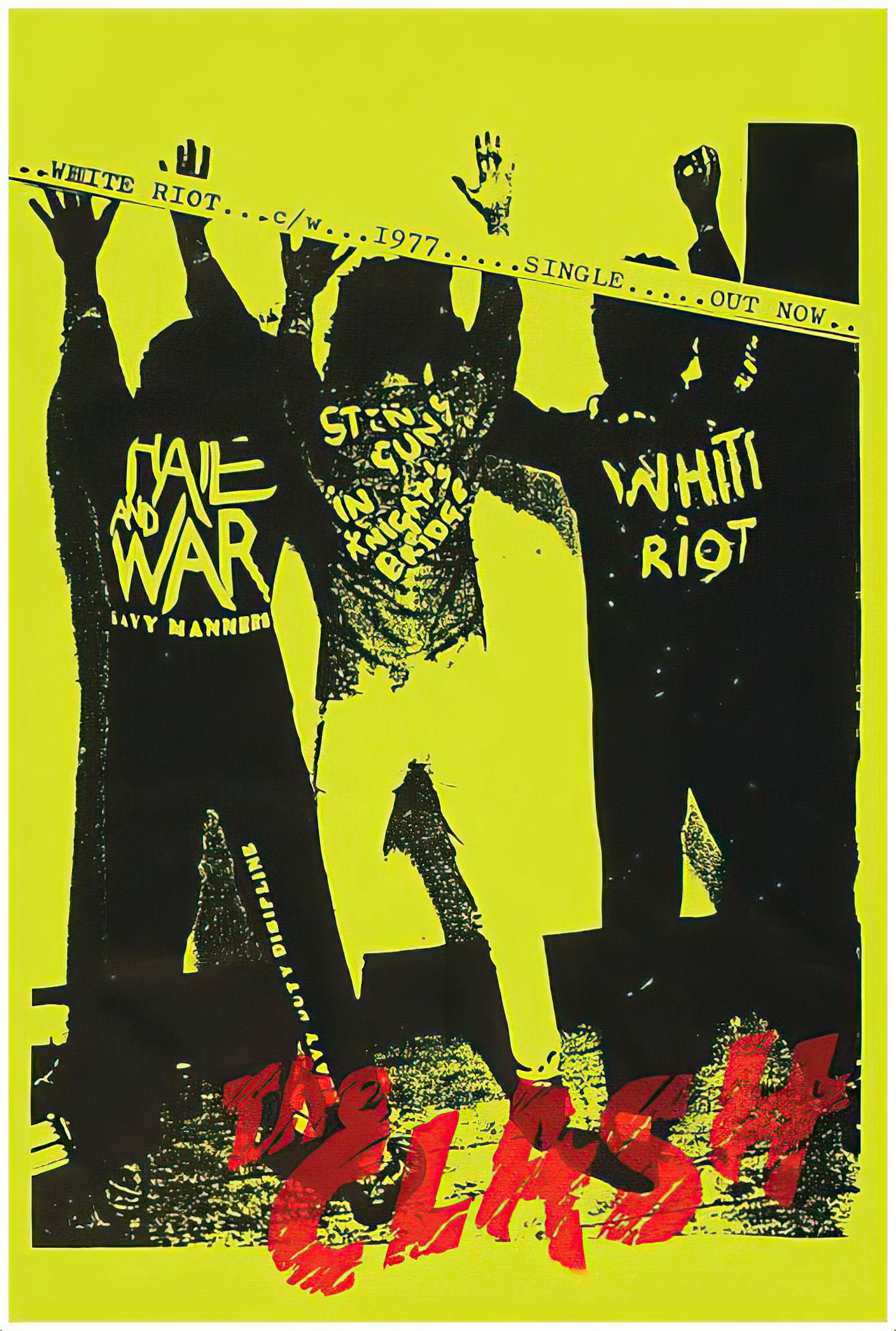
The single’s cover photograph, taken by Caroline Coon in November 1976 at a rehearsal studio in Camden Town, echoes the band’s anti-authoritarian stance. It originally showed “Hate and War” scrawled on the back of Joe’s boiler suit, but it was airbrushed and replaced with “1977” for the final release. Caroline’s shot was inspired by real events in which young people were routinely stopped and searched by police. The overriding sense was that ordinary people were under constant scrutiny, fanning the flames that had led to the carnage at Notting Hill Carnival. With that in mind, the confrontation in WHITE RIOT took on a certain urgency, its lyrics demanding action rather than passivity.

In March 1977, as WHITE RIOT landed in record shops, The Clash found themselves singled out by a music press eager to dissect every syllable. Melody Maker’s Caroline Coon praised it as “played with the force of an acetylene torch,” while the New Musical Express went so far as to call it “the first meaningful event all year” and declared that The Clash were “more than just a band” – a bold statement highlighting the charged atmosphere they fostered. There was little doubt that the track bore an unmistakable ferocity. But it also had its share of detractors, with radio stations refusing to air it. “The only person who played ‘White Riot’ on the radio was John Peel – and he’s gone on holiday,” Joe complained to Caroline. Radio support was scant, yet the group refused to dilute their principles simply to win airplay.

Prior to recording their debut album, The Clash first performed WHITE RIOT in public at the 100 Club Punk Festival on 20 September 1976. This was a hotbed of emerging punk acts, and The Clash slotted in perfectly, unveiling the track’s bristling intensity. The band’s line-up – Joe Strummer on rhythm guitar, Mick Jones on lead guitar, Paul Simonon on bass, and Terry Chimes on drums (soon replaced by Topper Headon) – operated as a close-knit unit. Their collaborative energy on stage marked them out even at this early juncture. Yet, as the band matured, there were moments when Mick found WHITE RIOT musically crude and wanted to drop it. Tensions could flare, with Joe adamant that the song’s purpose outweighed any doubts about its structure.

Meanwhile, the B-side to WHITE RIOT, titled 1977, was a brisk, no-nonsense piece co-written by Mick and Joe that declared, “No Elvis, Beatles or Rolling Stones.” Despite the sweeping line, the band never truly disowned its musical ancestry, demonstrated by how they often showcased influences like reggae with covers of songs such as Junior Murvin’s Police & Thieves. Still, 1977 acted as an energetic statement: the old guard was no longer relevant to the new generation’s experiences of strikes, austerity and bleak career prospects. It might have been tongue-in-cheek, but it was a jolt of punk’s characteristic irreverence, running for barely a minute and a half. Paul Weller later remarked on how effectively it captured a “don’t-give-a-damn attitude.”

Much of what fed into WHITE RIOT and 1977 reflected the era’s grim socio-economic conditions. Britain had struggled with rampant inflation and spiralling unemployment, and tensions between citizens and the police lurked around every corner. Joe, Paul and their manager Bernie Rhodes saw proof of that discontent at Notting Hill Carnival in August 1976. Paul Simonon was living nearby, witnessing first-hand how the largely Caribbean crowd was held in open contempt by police. Joe’s response was to ask why young white Britons were not equally up in arms over the structural inequalities they also faced. These energies – some drawn from the despair of neglected council estates, others from the cultural vibrancy the band discovered in their surroundings – pulsed through both sides of that first single.

As The Clash’s live shows gathered momentum, WHITE RIOT frequently closed their sets. At the Rock Against Racism Carnival in Victoria Park on 30 April 1978, they shared the stage with Jimmy Pursey of Sham 69 to deliver a rousing version of the track. The performance, captured on film in Rude Boy, exemplified how the group kept their initial manifesto alive. Even as their repertoire expanded into broader sonic territories, that early charge had an enduring place in their gigs.

The band’s ability to merge fervent left-wing politics with a sense of personal accountability made them unique among many of their peers. Billy Bragg’s summation that without The Clash, punk risked being little more than shallow aesthetics, underscores how crucial the group’s messages were. While others might have sported the right clothes and rebellious posturing, Joe’s lyrics carried pointed critiques of policing, socio-economic neglect and generational malaise. The group never abandoned those ideals. Decades later, Joe performed WHITE RIOT with the Mescaleros, further pushing its legacy into new contexts.


Cain, Barry. "A storm is coming: The Clash on punk's rise and political rebellion." Record Mirror, 9 April 1977, pp. 11

The Storm is Coming

The Clash's breakthrough moment as White Riot jumps 60 chart places and their debut album gains momentum, violent backlash against the band, including bricks thrown through windows by those who "can't identify with what we play", Strummer's manifesto declares war on media: "They want to stamp us out...we want to persecute them off the earth", 3-week album recording contrasted with with ELP's 2-year process, mocking progressive rock excess

Joe Strummer delivers apocalyptic visions of impending government control: "I see army conscription returning, identity cards, numbers", Mick Jones discusses the band's working-class roots and rejection of "love-song syndrome" rock, citing Phil Ochs as political inspiration

Read the Article

PDF1   |   PDF2    |   PDF3    |   PDF 4


Back to the top


Fanzines

GHAST UP, issue #1 - APRIL '77 20p, Written and made in Manchester

Ghast Up fanzine

REVIEWS & NEWS: CLASH-WHITE RIOT/1977

This is already being hailed as the most important event of the year. I hope that this is only the first of many, and we can expect more goodies like it. How-ever this is a great single, it over-spills with chaos. One snag though, the words are almost impossible to decifer. O.K. so maybe that was deliberate, but for us Clash fans outside London, who don't see them as often and don't know the words, your best bet is to get hold of "London!s Burning", Clash's own mag. and read along with it. The B side 1977 is just as good, in fact better. This has to sum it all up. Look, this record explains what is happening, much better than I can. Get it now, as it's not like-ly to be on their L.P., either "Riot" or "77". What Clash say is truth, they are totally dedicated. If you don't believe it then you should stick to one of the National pop papers, because we are not writing this review for you. CLASH reviewed by Mick.

Front and inside pages

 border=


The NEW WAVE magazine, issue #3

New Wave fanzine

SINGLES REVIEWS. CLASH: WHITE RIOT/1977

My Generation' was the record of 1965, 'Anarchy in the UK' the record of 1976, and this is the record of 1977. 'White Riot' is Joe Strummer's song about the society we live in. You all know how it sounds exciting guitar bursts, desperate vocals, and what's more it grows on you! Just as strong a song in every way 1977 is an old Kinks riff done the Clash way. Both sides amount to 32 minutes but there is enough power here to get most kids off their asses! If you get a pic-sleeve cover then you must be one of the chosen few...and when are we gonna get a chance to see 'em play a gig. Are they gonna be unseen heroes ?

Front and inside pages

 border=


Sniffin Glue fanzine, Issue No 8, page 14

THE CLASH 1977/WHITE RIOT (CBS)

"White Riot, I wanna riot! White Riot, a riot of me own!".

"White Riot, I wanna riot! White Riot, a riot of me own!".

Yeah, I've been waiting months for this band to release a record. I can't describe the feeling I get from listening to this single. It's so incredible that I hon-estly believe that it could change the dir-ection of rock music. This single brings rock back to where it should be. Back in the hands of the kids. Kids who have to live in the poxy council estates and grow up into a life of security-a steady job, family and car.

The country's so fucked up at the maent that there's no way out but to start all over again:

"In 1977, I hope I go to heaven, Been too long on the dole, Now I can't work at all, Danger stranger, You better paint your face, No Elvis, Beatles or the Rolling Stones,

In 1977, Knives in W.11, Ain't so lucky to be rich, Sten guns in Knightsbridge, Danger stranger, You better paint your face, No Elvis, Beatles or the Rolling Stones,

In 1977, You're on the never-never, You think it can't go on for ever, But the papers say it's better, I don't care, Cos I'm not all there, No Elvis, Beatles or the Rolling Stones, In 1977, in 1978, in 1979, in 1980, in 1981, in 1982, in 1983, in 1984!"

(1977'-Strummer/Jones).

MICK JONES + JOE STRUMMER

——

I hope that every kid who buys this single listens to it. Realise that we have got to act now. 1977 is the Queen's jubilee year, well let's make it our year as well. Let's get out and do something. Chuck away the fucking stupid safety-pins, think about people's ideas instead of their clothes. This"scene"is not just a thing to do in the evening. It's the only thing ar-ound that's honest and on our level!

SG have been having a go at the Clash recently. Well, I admit that they're the most important group in the world at the moment. I believe in them completely, all I said about them in the past is crap. With this single they've proved that they have been working. Nothing but hard work could produce a sound like they've got.

I can't wait to get the album. It's gonna have 14 tracks and that dosen't included 'White Riot'and 1977'. Just go out and create.

Mark P.
ALL CLASH PICS BY H.T. MURLOWSKI.

——

Get up go to work clock on clock off go home watch TV go to bed get up go to work clock on

Get up go to work clock on clock off go home watch TV go to bed get up go to work clock on clock off go home watch TV go to bed get up have your break fast go to work clock on clock off go home.

UNEMPLOYMENT, FOLLOW NO ONE LEAD YOURSELF!
Do not change your masters: become your owr master
Let the politicians do their own dirty work
from Sniffin' Glue fanzine, issue #8 (1977) - White Riot reviewed -

Page 1, Page 2

 align=


"THE CLASH." 48 THRILLS, no. 3, Mar. 1977, pp. 2 pages.

The Clash – White Riot / 1977

— Ecstatic review of The Clash's debut single on CBS, featuring White Riot and 1977, — Praises the drumming of Terry Chimes, analyzes the lyrics of White Riot

— Compares the B-side, 1977, to a Kinks riff and describes its middle section as sounding like "sten guns on black vinyl", 'the single worth the long wait' and builds anticipation for the forthcoming album

Read the fanzine ...

PDF


Sandy Robertson', Issue #2 (1977)

White Stuff fanzine,

Auction: Patti Smith White Stuff no.2
stillunusual Flickr
stillunusual flickr.com
stillunusual tumblr.com/

White Stuff no.2 Fanzine (auction)

This is the second issue from 1977. Description below from the excellent stillunusual blog.

Sandy Robertson's White Stuff was based around his fandom for Patti Smith (the name of the zine comes from a line in Smith's song "Ain't It Strange"). Robertson had moved to London from Renfrew in Scotland with a burning ambition to become a music journalist, and after churning out several issues of White Stuff he got a job with rock weekly Sounds…. 1977. Stapled sheets. Still in nice condition. 21 x 29.5cm. 10 pages.

CLASH! THE CLASH-White Riot/1977(CBS)

First single from Patti's dancing partners, this is the best thing(along with 'Anarchy..') te come out of the U.K. vanguard and ente vinyl. I keep telling everyone that the A side is like the Glitter Band, and the B side is the Kinks remodelled. Not many have agreed with me yet, but we concur en one thing-it's a great record. Clash are my fave of the new British groups that I've seen perform, and this should be a hit. I think it's get a pic sleeve, by the way, but my copy(thanks CBS for remembering me) ain't get one. Whatever, buy it now.

PDF

# Page 1, Page 2, Page 3
# Page 3

Back to the top


Books

by Nick Assirati (Author)

The Clash: every album, every song


by Marti Popper (Author)

The Clash: All the Albums All the Songs


Back to the top


Social Media

White Riot (1977) - search results | Facebook
Search for White Riot on Facebook


The Clash head into Studio Three, Whitfield Street to record ‘White Riot' and ‘1977' for their debut single

The Clash | Facebook - https://www.facebook.com/

“All the power's in the hands of people rich enough to buy it / While we walk the street too chicken to even try it” White Riot by The Clash.

The Clash - Jan '77: The Clash head into Studio Three, Whitfield Street to record ‘White Riot’ and ‘1977’ for their debut single.

The Clash FB


All the power's in the hands Of people rich enough to buy it

The Clash FB


VIDEO: White Riot, 1977

The Clash FB


The Clash "White Riot" the first single released on 18 March 1977

Link or a similar Link


VIDEO: The Clash believed their music should keep people in touch with life's iniquities

Link


The Clash release their debut single ‘White Riot'

18th March 1977, The Clash | Facebook

Back to the top


Sundry

Young, Simon. “White Riot: The Clash.” Total Guitar (Italian), no. 2, Feb. 2003, pp. 32–35. 4 pages.

The Clash: WHITE RIOT

— Technical breakdown of The Clash's White Riot, analyzing guitars (Les Paul/Telecaster) and amp settings.

— References 1976 Anarchy Tour with Sex Pistols and 1977 recording sessions.

Read the article

PDF


Photos

PETER COOK - SIGNED LIMITED EDITION PHOTOGRAPH - THE CLASH

Omega Auctions: A limited edition photograph by Peter Cook, signed by the photographer and numbered 1/30. To measure 29.5 x 42.5cm. Image depicts The Clash.

Rare images of The Clash (11 January 1977) taken during the recording of the LP version of White Riot for renowned music documentary director Julien Temple.

The recording predates the signing of their record contract with CBS on 25 January.


Back to the top


Extensive archive of articles, magazines and other from the Roxy gig and the pre-White Riot period

Archive - Topper joins - Snippets - UK articles / magazines - Fanzines - Audio / Video - 1977 General


www.blackmarketclash.co.uk

email blackmarketclash.co.uk@gmail.com

THE CLASH
1976  1977  1978  1979  1980  1981  1982  1983  1984  1985  THE CLASH: ALBUM BY ALBUM, TRACK BY TRACK 

STRUMMER, BAD, Pogues, films + : THE SOLO YEARS
THE 101ers: 1974-1976   SOLO YEARS: 1986-2025

STRUMMER & THE LATINO ROCKABILLY WAR
ROCK THE RICH 88-89   ROCK THE RICH 99-00  

STRUMMER & THE MESCALEROS
ROCK ART TOURS 1999   ROCK ART TOURS 2000   GLOBAL A GO GO TOURS 2001   GLOBAL A GO GO TOURS 2002   STRUMMER DEMOS OUTAKES

BOOKS, NEWSPAPERS & FEATURE MAGAZINES
THE CLASH YEARS –– 1975-1986 
THE SOLO YEARS –– 1987-2002 
RETROSPECTIVE FEATURE MAGAZINES –– 2002-2025  
BOOKS  OTHER LINKS  

THE CLASH AUDIO & VIDEO
THE CLASH INTERVIEWED – INTERVIEWED / DOCS

Sex Pistols / The Jam / The Libertines / Others
The Sex Pistols  The Jam  The Libertines  other recordings-some master

Discography

Wikipedia
A fantastic concise listing
Compilations
Black Market Clash
The Story of the Clash, Volume 1
1977 Revisited
The Singles (1991)(2007)
Super Black Market Clash
The Essential Clash
The Clash Hits Back
Joe Strummer 001
Joe Strummer 002
Box sets
Clash on Broadway
Singles Box
Sound System
5 Album Studio Set
Albums
The Clash
Give 'em Enought Rope
London Calling
Sandinista
Combat Rock
Cut the Crap
* Spirit of St Louis
Live albums
Live at Shea Stadium
From Here to Eternity
Singles
Capital Radio
White Riot
Remote Control
Complete Control
Clash City Rockers
(White Man) In Hammersmith Palais
Tommy Gun
English Civil War
The Cost of Living
London Calling
Bankrobber
The Call Up
Hitsville U.K.
The Magnificent Seven
This Is Radio Clash
Know Your Rights
Rock the Casbah
SISOSIG / Straight to Hell
This Is England
Fingerpoppin
* Shouting Street
* Love Kills
* Are You Ready for War
* Shouting Street
* Janie Jones & The Lash
London Calling 1988
I Fought the Law 1988
SISOSIG 1991
Rock the Casbah 1991
Train in Vain 1991
Return to Brixton
Video albums
1982 The Clash: Live in Tokyo
1985 This Is Video Clash
2003 The Essential Clash (DVD)
2008 The Clash Live: Revolution Rock
The Clash - London Calling DVD

Film/documentaries
1980 Rude Boy
2000 Westway to the World
2006 The Clash: Up Close and Personal
2007 Joe Strummer: The Future Is Unwritten
2012 The Rise and Fall of The Clash
2013 Audio Ammunition
Music videos
White Riot
Complete Control
Tommy Gun
London Calling
Clampdown
Train in Vain
Bankrobber
The Call Up
This Is Radio Clash
Rock the Casbah
Should I Stay or Should I Go (live at Shea Stadium)
Career Opportunities (live at Shea Stadium)
I Fought the Law
Should I Stay or Should I Go
The Magnificent Seven
Documentary videos
JOE STRUMMER - A Tribute - Roots Rock Rebel DVD
Lets Rock Again DVD
London Calling & Other Clash DVD
Punk Generation DVD
Punk in England DVD
Punk In London Orig DVD
Straight to Hell DVD
Live/ Revolution Rock DVD
London Calling DVD Unofficial Documentary
Music In Review DVD 01 DVD
Music In Review DVD 02 DVD
Music Master Collection Box Set 3xDVD & Blu-ray
Ultimate Review - Punk Icons DVD
Up Close and Personal Ray Lowry DVD
The Greatest Punk Hits DVD
The Punk Rock Movie DVD
Tory Crimes & Other Tales; Bored with the USA DVD
Tory Crimes & Other Tales; The Punk Era DVD
Viva Joe Strummer DVD